

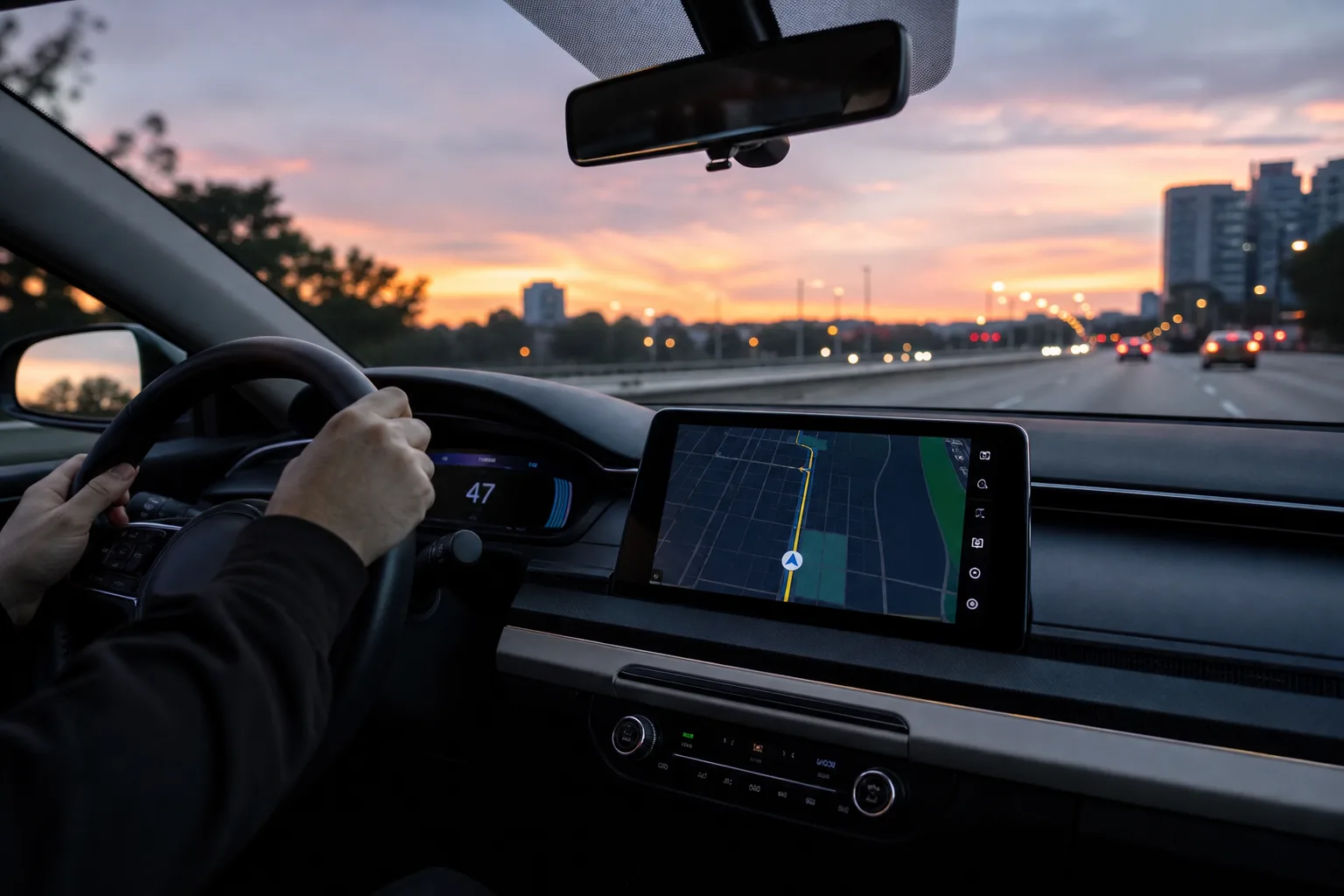
- The Android Auto speedometer has appeared for a small number of Google Maps beta users, suggesting Google has begun testing a broader release.
- Android Auto speedometer support arrives unusually late, given that Google Maps has shown live speed data on phones and Apple CarPlay for years.
- The early sighting came from a Canadian user running Google Maps version 26.29.02.946673643 through the beta channel.
- Waze has offered an in-car speed readout for years, making Google Maps’ slow progress particularly difficult to explain.
Table of Contents
The Android Auto speedometer is finally showing signs of life
Google Maps is beginning to show an Android Auto speedometer for at least a handful of drivers, ending one of the stranger omissions in Google’s in-car software. This is not a broad launch yet. It looks more like a cautious server-side test, the sort of staggered Google rollout that can leave two people with the same phone, car and app version seeing completely different interfaces.
Reports from Android Auto users point to a live speed readout appearing in the Google Maps navigation screen. One early report came from Canada, with the driver using Google Maps beta version 26.29.02.946673643. That is thin evidence, admittedly, but it is evidence. Until recently, the feature was conspicuously absent altogether.
And frankly, it took long enough. Google Maps has displayed a speedometer on Android phones for years. It added the equivalent capability to Apple CarPlay in 2024. Yet the company’s own Android-based dashboard experience — the one most likely to be used on a large, glanceable screen — was left waiting at the curb.
Why this small Google Maps feature matters
A live speed readout sounds trivial until you actually use Android Auto every day. Plenty of cars have clear digital instrument clusters, of course, but others bury speed in a smaller display, place it awkwardly behind the steering wheel, or simply have gauges that are harder to scan than a number sitting beside the route you are already following. Rental cars are an especially good example: every unfamiliar dashboard turns basic information into a brief scavenger hunt.
The Android Auto speedometer should also make Maps more consistent across the devices where people use it. You can glance at a phone mount and see your pace. You can do it in CarPlay. The absence in Android Auto has made the product feel oddly unfinished, despite Android Auto itself being a mature platform.
Maps’ speed information should not be treated as an authority over the car’s instruments. See the official Maps help documentation for more information. That caveat matters. GPS position is sampled and calculated, while a vehicle’s speed signal comes from the machine doing the moving. Drivers should obey posted limits and use the car’s own instruments when there is a discrepancy.
Still, the practical benefit is real. When an Android Auto speedometer sits close to Maps’ speed-limit indicator, it reduces the number of places a driver has to look. Less eye travel is generally better in a car. This is basic interface design, not moonshot technology.
Google is playing catch-up with Waze and CarPlay
The awkward part is that Google already owns the obvious comparison point. Waze, which is part of Google, has supported an on-screen speedometer in Android Auto for years. Waze has always leaned harder into the active-driving experience: police reports, road hazards, community alerts and a visual sense of what is happening around the route. Its speed display fits that personality.
Google Maps, meanwhile, has been trying to serve everybody at once. It is a walking app, a transit planner, a local-search tool, an EV trip assistant and a navigation system. That breadth is valuable, but it can also produce a maddeningly slow pace on obvious driving features. The missing Android Auto speedometer is a neat little case study in that problem.
Apple CarPlay makes the delay harder to shrug off. Google introduced a Google Maps speedometer there in July 2024, meaning Android Auto users have waited years for a feature delivered by Google. We do not know why. It may be a safety review, a technical wrinkle around the wide range of Android Auto display sizes, or simply an unglamorous prioritization decision. Google has not publicly explained the gap.
My read is less charitable: Google’s car software teams have been spending their attention on bigger-looking projects, including new media controls, motorcycle-friendly navigation and Gemini integration. Those are useful additions, but a map app should nail the bread-and-butter driving screen before it asks users to chat with an AI while merging onto a highway.
Do not expect every dashboard to change overnight
Anyone hoping to see the Android Auto speedometer during tomorrow morning’s commute should temper expectations. The current sightings are tied to the Maps beta, and even beta software does not guarantee access when a feature is controlled from Google’s servers. There are not enough independent reports to call this a public rollout.
That familiar uncertainty is part of Android Auto’s appeal and its headache. Google can improve a system without requiring a new car or a dealer visit, which is great. But it also means feature availability is often opaque. An update lands, nothing appears, Reddit detectives compare version numbers, and eventually the feature quietly materializes. Remember the endless waiting for Coolwalk’s redesigned interface? This has that same energy.
Drivers who want to check whether the Android Auto speedometer is available can join the Google Maps beta program if places are available, update Maps and reconnect Android Auto. But I would not install beta navigation software solely for a speed number. The sensible move is to wait for stable availability, particularly if your phone is the thing guiding you through unfamiliar roads.
A modest feature, but an important signal
If the test expands, the Android Auto speedometer will not transform anyone’s commute. It will simply make Google Maps feel less behind the competition. Sometimes that is enough. Software quality is often determined by the small missing conveniences that users notice every single day, not the splashiest feature on a launch slide.
Google now needs to turn these isolated sightings into a reliable release and say where it is available. The real question is not whether Maps can display a number — Waze, phones and CarPlay already settled that — but why Android Auto users had to wait this long for Google to do the obvious.

