

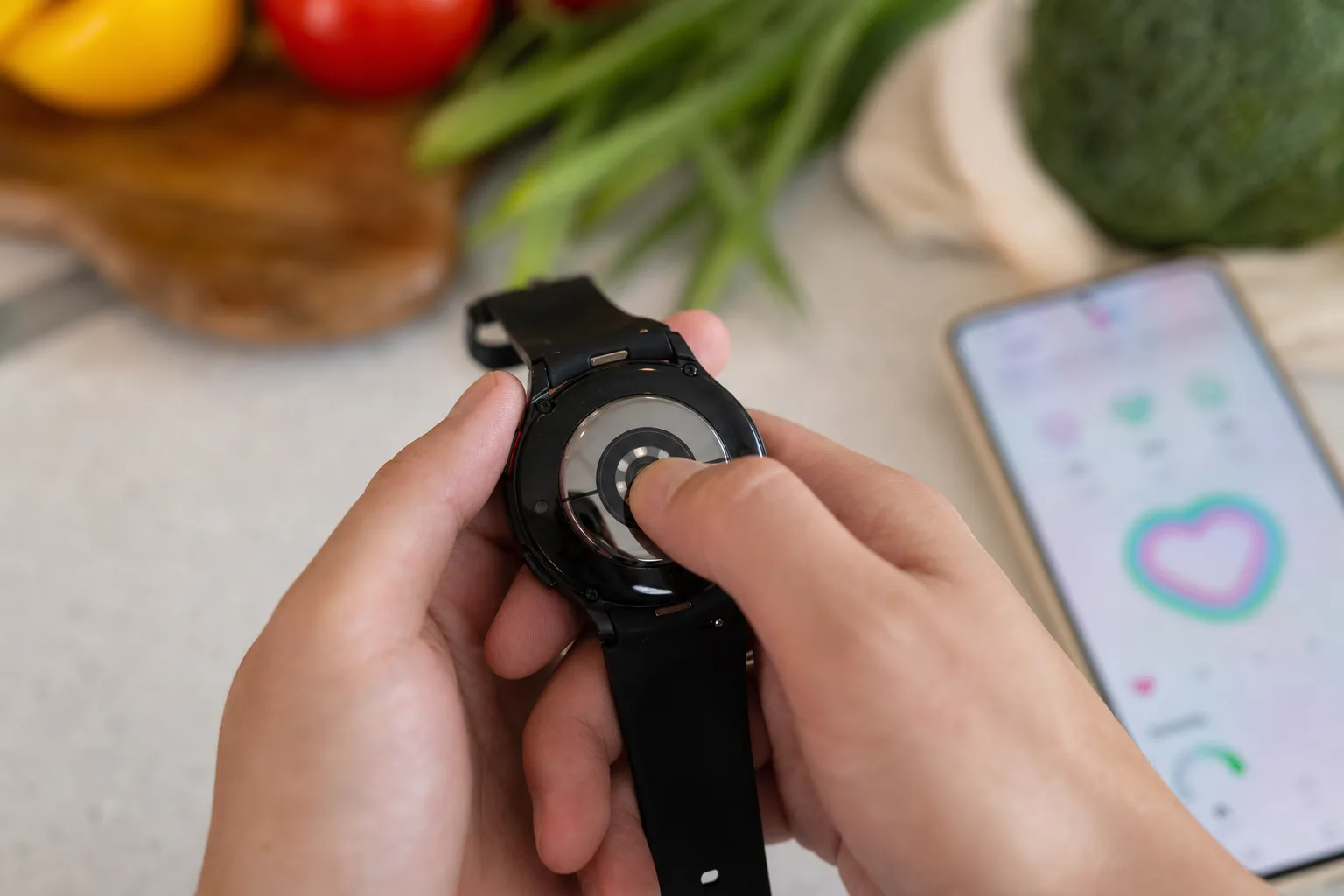
- Galaxy Watch 8 estimates skin carotenoids with colored LEDs and a five-second thumb scan rather than measuring every antioxidant in the body.
- The Galaxy Watch 8 score is best treated as a long-term dietary trend, not a medical reading or a verdict on yesterday’s lunch.
- Samsung says thumb pressure and finger skin reduce optical interference from blood and melanin during the sensor measurement.
- Carotenoids can take two to three weeks to accumulate in skin, so meaningful score changes should be gradual.
Table of Contents
A health score that needs a little skepticism
The Galaxy Watch 8 wants to know something that no smartwatch has any business pretending to know perfectly: whether you have been eating enough fruit and vegetables. Its new Antioxidant Index turns a five-second thumb scan into a number from 0 to 100. That sounds like a tiny wellness miracle. My read is less dramatic but still positive: it is a clever proxy, provided owners understand what it is actually measuring.
Samsung is not somehow reading every antioxidant circulating through your body. The Galaxy Watch 8 is looking for carotenoids in your skin. These are naturally occurring pigments found in foods such as carrots, leafy greens, sweet potatoes and peppers. They have antioxidant properties, and higher skin carotenoid levels have been used in research as a rough signal of fruit and vegetable consumption.
That distinction matters. A watch score cannot tell you whether your nutrition is broadly sound, whether you need a supplement, or whether a health problem is brewing. It can tell a narrower story: over time, are skin levels of these particular plant-derived pigments trending upward, downward or flat?
How the Galaxy Watch 8 reads your thumb
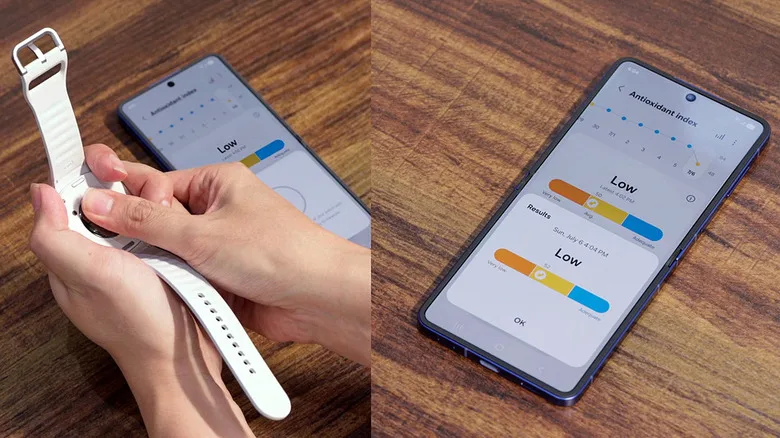
Using the feature requires taking the watch off. In Samsung Health, select Antioxidant Index, tap Measure, then press a thumb against the BioActive Sensor on the back. It is not the glamorous, hands-free future smartwatch marketing often promises, but there is a sensible technical reason for the ritual.
The sensor relies on multi-wavelength absorption spectroscopy. Put plainly, the Galaxy Watch 8 shines several colors of LED light into the skin — Samsung identifies yellow, blue, purple and green light — then measures what returns to the photodiodes. Carotenoids absorb certain wavelengths, particularly blue light, more strongly. The pattern of absorbed and reflected light gives Samsung an estimate of carotenoid concentration, which it converts into the consumer-friendly score.
Optical sensing is famously finicky. Anyone who has seen a wrist heart-rate reading go strange during a hard run has met the problem first-hand. Melanin and hemoglobin can both complicate this kind of measurement. Samsung says the finger is useful because it helps limit melanin interference, while firm thumb pressure temporarily restricts local blood flow and reduces the hemoglobin signal. It is a surprisingly practical solution: the sensor is essentially trying to get a clean look at pigment in skin without blood getting in the way.
The underlying science is not invented out of whole cloth for a smartwatch. Raman spectroscopy is a laboratory method used to assess skin carotenoids, and reflection-based spectroscopy has been studied as a less cumbersome alternative. A 2023 randomized controlled study indexed by PubMed, involving Samsung researchers, reported a strong correlation between reflection spectroscopy and Raman spectroscopy for skin carotenoid measurement. That is encouraging, though correlation is not the same thing as a clinical diagnostic claim.
What the score can and cannot tell you
Samsung says it validated the Galaxy Watch 8 sensor against Raman spectroscopy and compared results with blood tests, dietary logs and clinical information from several hundred participants. But the company has not given consumers the number they would most want: a plain accuracy rate or margin of error for an individual reading.
Frankly, that absence should shape how anyone uses the feature. A score of 62 is not a nutrition report card, and it certainly is not a blood test squeezed into a round computer. Samsung explicitly says the Antioxidant Index is not intended to diagnose or treat conditions. UV exposure, alcohol use and stress can affect the reading as well, so diet is not the only thing moving the needle.
There is also the inconvenient issue of timing. Carotenoids do not appear in the skin right after a virtuous salad. Samsung says it usually takes two to three weeks for dietary carotenoids to build to detectable levels. That makes the Galaxy Watch 8 feature ill-suited to the usual gadget impulse: check a metric, change one thing for a day, check again, declare victory. In Engadget’s testing, deliberate dietary changes produced only a two-point drop, while later readings landed between 56 and 60. That is exactly what a slow-moving biological trend should look like.
For people who enjoy data, the better approach is boring but useful. Take readings under similar conditions, perhaps weekly; watch the direction over a month; and connect it to patterns you already know about your meals. If you are trying to eat more vegetables, a slowly rising figure might offer a small bit of reinforcement. If it does not rise, that does not prove you have failed. It may simply reflect normal measurement variation or one of those outside factors Samsung flags.
Why this feature earns a closer look
Wearables have spent years making health feel like a dashboard: steps, resting heart rate, sleep stages, training load, blood oxygen. Some of those figures are genuinely useful. Others become a kind of anxious digital horoscope. The Galaxy Watch 8 Antioxidant Index sits in an unusual middle ground. It is not a direct medical measurement, but it is also tied to a tangible behavior most people can act on without buying another subscription or treating lunch like an optimization project.
Samsung’s current US comparison material lists the feature on the Watch 8, Watch 8 Classic and Galaxy Watch Ultra, and also on newer Watch 9 and Ultra2 models. The Galaxy Watch 7 is absent, and the company has not offered a detailed public explanation. That may point to a hardware requirement in the newer sensor stack, or it may simply be a product segmentation decision. Either way, it is a reminder that software-defined health features often have a sales strategy tucked behind the science.
I would not buy the Galaxy Watch 8 for this metric alone. But as a low-stakes, long-view prompt to eat the vegetables you were already supposed to eat, it has more credibility than most wellness gimmicks. The real test is whether Samsung keeps explaining its limits as loudly as it advertises the score. A number on your wrist is easy to sell; teaching people not to overinterpret it is the harder job.
Frequently Asked Questions
Does the Galaxy Watch 8 measure all antioxidants?
No. The watch estimates carotenoids in the skin, which are pigments associated with many yellow, orange and green fruits and vegetables. Samsung uses that estimate as a dietary indicator, not as a complete measure of antioxidant status throughout the body.
Why does the Galaxy Watch 8 require a thumb scan?
Samsung says the thumb helps control two major sources of interference in optical readings: melanin and hemoglobin. Skin on the finger has less melanin variation, while pressing the thumb against the sensor temporarily reduces blood flow and hemoglobin’s effect.
How long does it take for an Antioxidant Index score to change?
Samsung says carotenoids from food generally need two to three weeks to build up in skin at levels the sensor can detect. A score is therefore more useful for tracking sustained eating habits than checking the impact of one meal.
Is Samsung’s Antioxidant Index a medical test?
No. Samsung says the feature is not meant to diagnose, treat or manage a medical condition. It has compared the method with laboratory techniques and related clinical data, but it does not publish a simple consumer accuracy percentage or margin of error.

