

- Pixel Extreme Charging reaches 75% in 28 minutes, seven minutes ahead of Google’s ordinary charging profile in testing.
- Pixel Extreme Charging holds higher power longer, pushing the Pixel 11 Pro XL battery to nearly 43°C for roughly 20 minutes.
- Samsung and OnePlus refill faster while maintaining lower charging temperatures, exposing a cooling and battery-design gap at Google.
- The feature requires a compatible 45W USB PD PPS adapter with 21V support, not merely any recent fast charger.
Table of Contents
Pixel Extreme Charging fixes a small problem by making the phone hotter
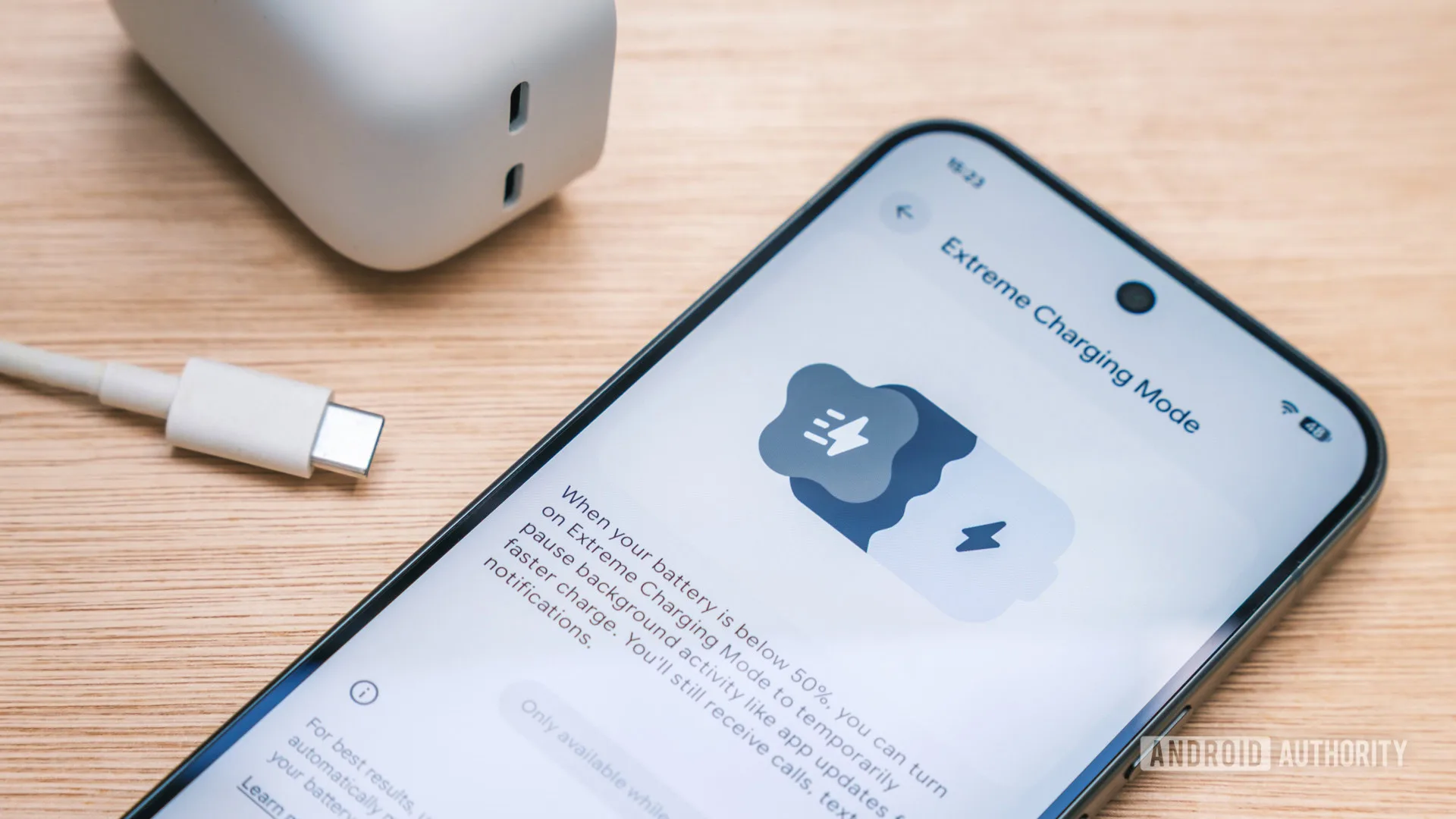
There’s a familiar kind of frustration behind Pixel Extreme Charging: you’re late, your phone is at 12%, and the cable on your kitchen counter suddenly feels like a very slow IV drip. Google’s new Pixel 11 Pro XL mode improves that moment. It can get the phone to 75% in 28 minutes, according to testing, rather than 35 minutes with the regular profile.
That’s a real improvement, not marketing fog. But it comes with an asterisk that should be printed in large type: the Pixel gets meaningfully hotter to shave off those minutes. The new setting reportedly drove the battery to 42.9°C, above the roughly 40°C mark generally associated with added lithium-ion battery stress, and kept it there for around 20 minutes.
My read is that Google has built a useful emergency button, then wisely declined to make it the default. The trouble is that its name also spotlights how far Pixel charging still trails the best Android competition.
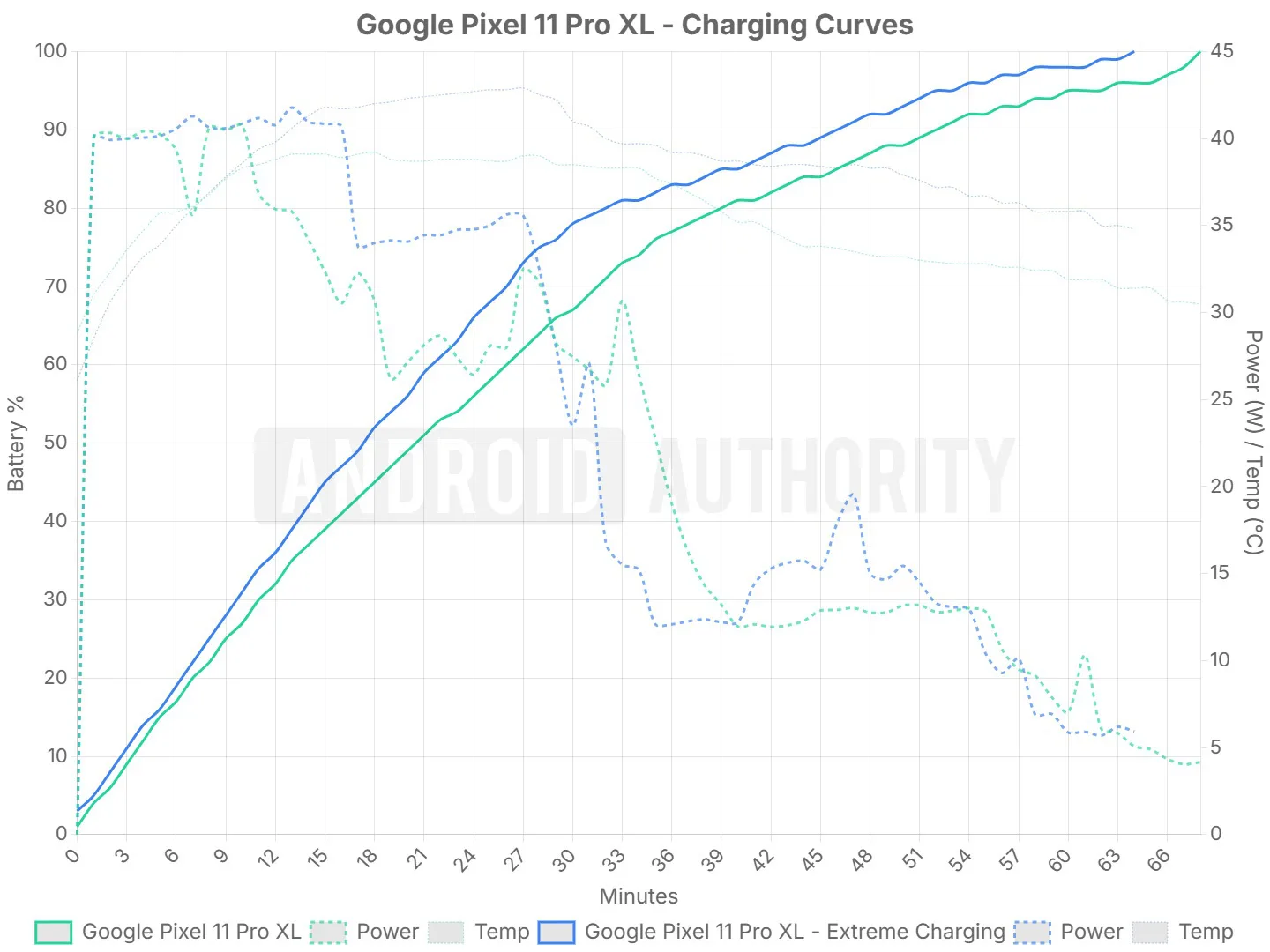
Google says the Pixel 11 Pro XL can charge from empty to 75% in about 30 minutes under the right conditions. The testing broadly backs that claim, with Pixel Extreme Charging reaching 50% in 18 minutes and a full battery in 64. Regular charging took 21 minutes to reach 50%, 35 minutes for 75%, and 69 minutes to finish.
Five minutes at the end of a full refill is not a life-altering difference. Seven minutes at 75% can be. If you’re throwing on shoes while your rideshare waits outside, an extra sliver of battery is more useful than an abstract argument about charging curves.
A compatible charger is part of the catch
Before anyone sees those numbers, there is some gear trivia to get through. Pixel Extreme Charging requires a 45W USB Power Delivery Programmable Power Supply charger that can deliver 21V. That detail matters because many PPS bricks, including ones consumers bought relatively recently, support lower voltage ranges such as 11V.
In plain English: a USB-C charger that fast-charges another phone may not unlock the Pixel’s fastest mode. Google has long published charger guidance through its official Pixel support pages, but this is still the sort of compatibility footnote that turns a seemingly simple feature into a scavenger hunt.
Then there’s the slightly odd software behavior. The Extreme Charging toggle apparently may not be visible immediately after setup. It surfaced in testing only after multiple empty-to-full cycles and some waiting. That feels very Google: clever hardware, decent idea, and a setup path with the occult logic of an old Chromecast troubleshooting thread.
The thermal numbers are the real story
Google does not appear to raise the Pixel 11 Pro XL’s peak draw much with this mode. The handset reaches about 41W either way. Instead, Pixel Extreme Charging keeps the phone near that peak for longer: roughly 16 minutes, compared with about 10 minutes on the standard setting. It also spends more time around 35W before tapering once the battery passes 70%.
That is a straightforward strategy. Keep the accelerator down longer, arrive sooner. But batteries aren’t like a sink filling with water; heat, voltage, cell chemistry, and charging control all matter, especially near the upper end of the battery gauge.
Standard mode reportedly capped temperature at about 39°C, with a 35.4°C average across a full cycle. Extreme mode increased that average to 38.3°C. No, 42.9°C is not an immediate catastrophe, and it does not mean the phone is about to melt in your hand. The concern is repetition. Heat is one of the basic enemies of long-term battery capacity, alongside time and charge cycling. Use this mode occasionally and the trade-off seems reasonable. Use it twice daily for three years, and I’d expect the battery health math to look less friendly.
That’s also why the feature should not be confused with a general battery-health recommendation. It is a convenience mode. Treat it like taking a taxi because you overslept, not your permanent commuting plan.
Pixel Extreme Charging still isn’t competitive at the top end
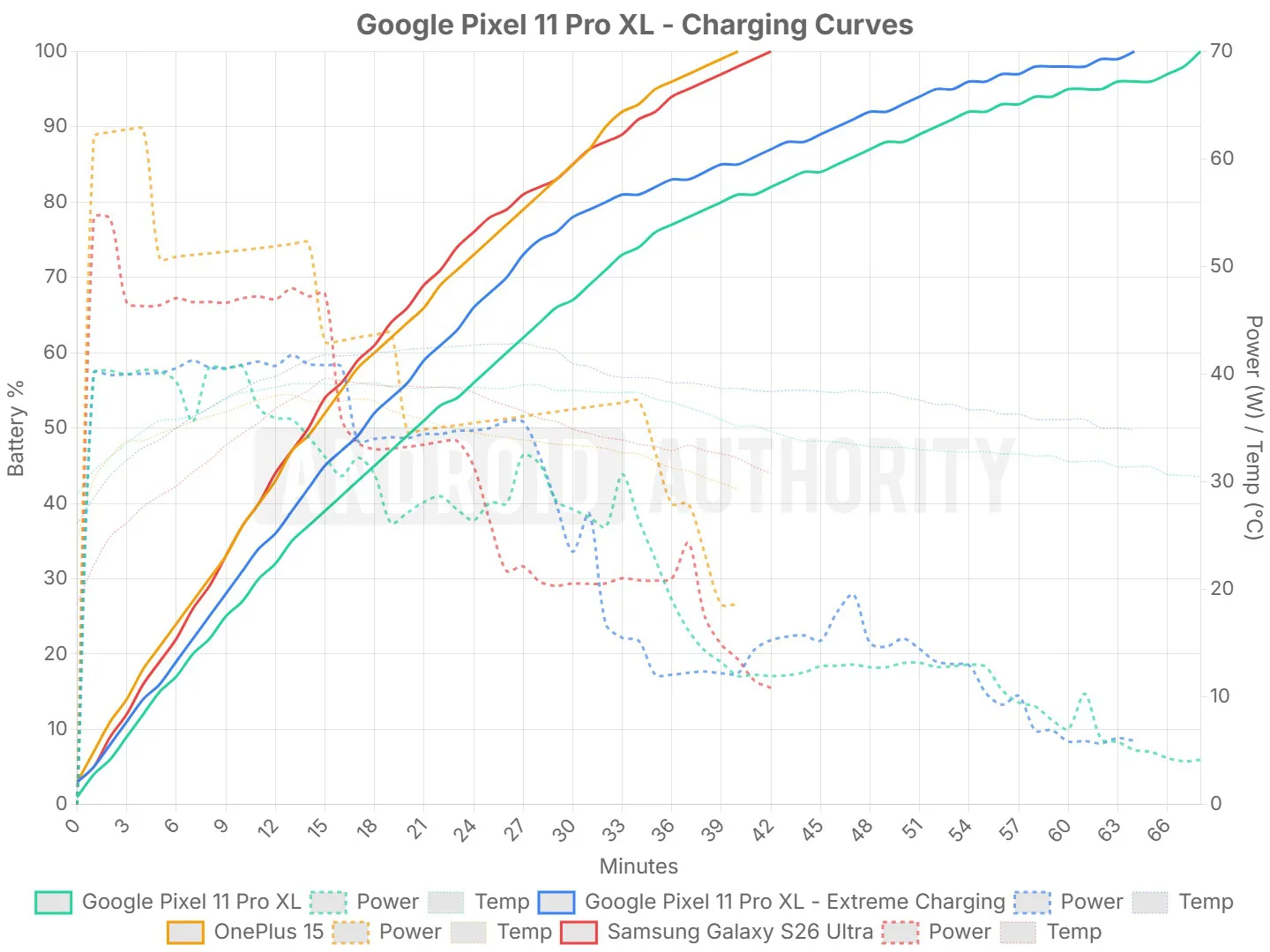
The numbers look worse beside the Samsung Galaxy S26 Ultra and OnePlus 15. Both can reportedly complete a full charge in about 42 minutes, versus 64 minutes for the Pixel with its most aggressive setting enabled. After 10 minutes on a charger, the OnePlus and Samsung sit around 37%, while the Pixel reaches roughly 31% with Pixel Extreme Charging and about 27% without it.
Those are not tiny gaps. They change how people use a phone. With a fast OnePlus or Samsung refill, you can plausibly stop thinking about overnight charging and recover from a near-empty battery while making coffee. With the Pixel, Google has narrowed the gap a little, but you still need to plan around it.
The OnePlus comparison is particularly awkward because the OnePlus 15 carries a reported 7,150mAh silicon-carbon battery, dramatically larger than the Pixel 11 Pro XL’s 5,115mAh cell. Yet it gets filled faster. Hardware makers have increasingly turned to split-cell battery arrangements, more capable charge pumps, and better internal thermal pathways rather than simply throwing higher wattage at a single cell. OnePlus has invested heavily in that formula, and Samsung has steadily improved its own charging controls.
Temperature makes the comparison especially awkward. The Galaxy and OnePlus reportedly stay below 40°C and average closer to 34°C during charging, despite delivering more power and completing the job much sooner. If these figures hold across more testing, Google’s limitation is not merely a conservative software switch. It looks like a battery and cooling architecture issue.
Google needs to fix the hardware, not rename the compromise
I’m glad Pixel Extreme Charging exists. Users deserve the option to prioritize speed on a chaotic morning, and Google deserves credit for exposing a choice rather than pretending every charge cycle has identical consequences. Frankly, Apple could stand to offer this kind of direct control too.
But calling a 64-minute full charge ‘Extreme’ when rivals do the work in roughly 42 minutes is hard to take seriously. The Pixel 11 Pro XL does not need a more dramatic toggle. It needs the thermal engineering, battery layout, and charging system that let competitors sustain higher power without cooking the cell.
For now, Pixel owners should use the setting when the clock genuinely matters, pair the phone with the right 21V PPS charger, and leave it off the rest of the time. The bigger question for Google’s next hardware cycle is simpler: can it make fast charging ordinary rather than an occasional heat-soaked exception?
Frequently Asked Questions
What charger is needed for Pixel Extreme Charging?
The Pixel 11 Pro XL needs a 45W USB Power Delivery PPS charger that supports 21V output to access Google’s highest charging behavior. Some newer PPS adapters top out at 11V, so owning a modern charger alone does not guarantee compatibility.
Is Pixel Extreme Charging safe to use every day?
Google makes the setting optional, and that is sensible. Testing found battery temperature reached 42.9°C and stayed above 40°C for about 20 minutes, conditions that can add battery stress when repeated frequently over a phone’s lifespan.
How much faster does the Pixel 11 Pro XL charge in extreme mode?
In the reported test, the Pixel 11 Pro XL reached 50% in 18 minutes rather than 21, hit 75% in 28 minutes rather than 35, and completed a full charge in 64 minutes rather than 69.

