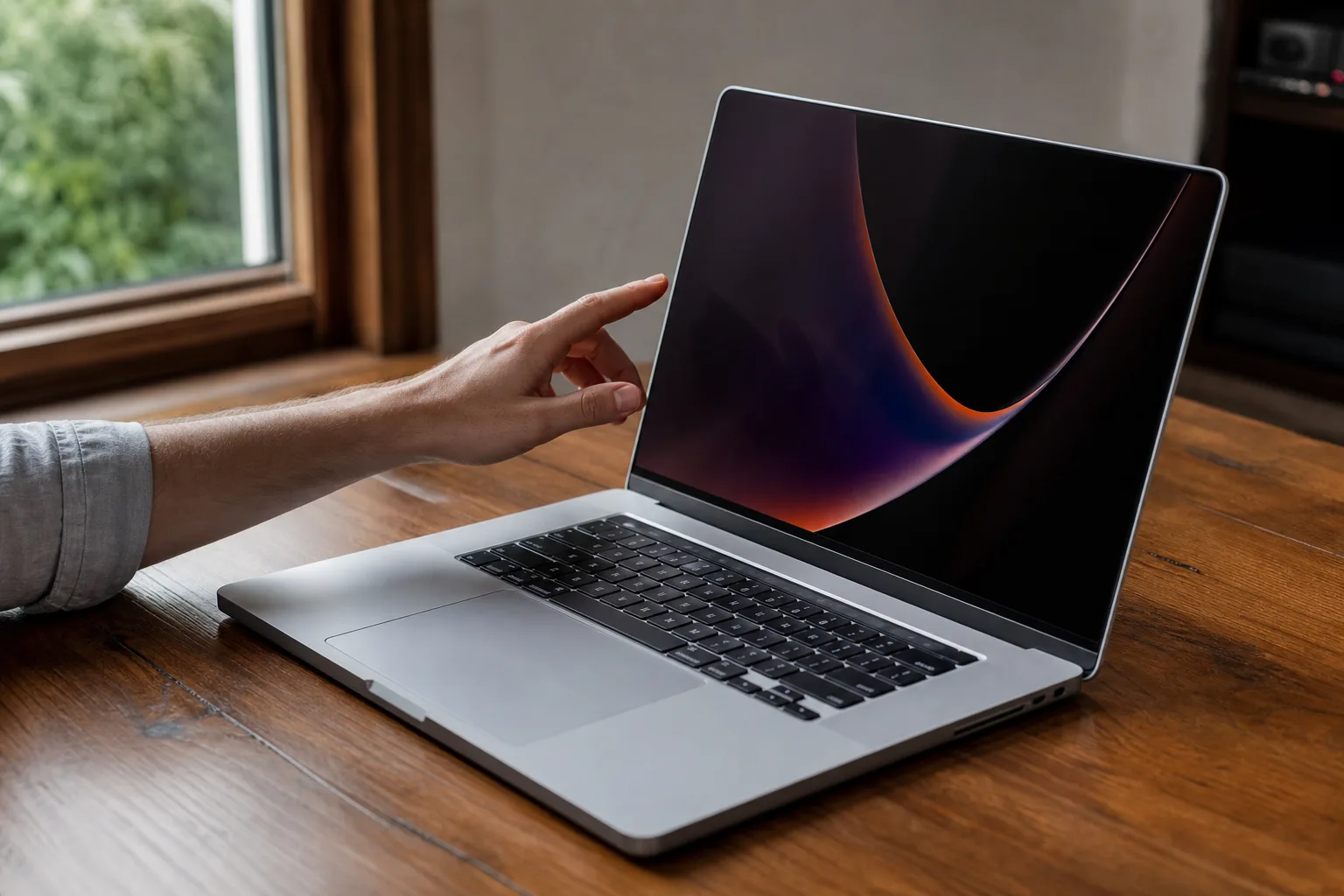
- The touchscreen OLED MacBook Pro is reportedly headed for a near-term launch with a substantially lighter redesigned chassis.
- Apple’s touchscreen OLED MacBook Pro could pair its new panel with existing high-end M5 processors rather than future M7 silicon.
- A lighter design would address one of the persistent compromises of Apple’s powerful professional laptops, particularly the 16-inch model.
- The reported release may offer an early indication of how Apple CEO John Ternus intends to prioritize industrial design.
Table of Contents
The touchscreen OLED MacBook Pro could finally shed some baggage
Apple’s MacBook Pro has spent years getting better at almost everything except disappearing into a backpack. That may finally change. Bloomberg’s Mark Gurman reports that the forthcoming touchscreen OLED MacBook Pro could be “significantly lighter” than today’s machines, thanks to an internal redesign that reduces and rearranges components.
If that report holds, the weight reduction may matter more than the touchscreen itself. Apple has historically treated touch input on Macs as something for iPads, while the MacBook Pro became a place for uncompromising performance, ports and thermal headroom. The result is a capable laptop, but not always a graceful one. The current 14-inch MacBook Pro starts at 3.4 pounds, while the 16-inch version can reach 4.7 pounds depending on configuration. That is perfectly manageable on a desk. On an airport day, it is another story.
Gurman says Apple achieved the expected reduction by miniaturizing parts and changing how the internals are laid out. Apple hasn’t confirmed the product, its specifications or its launch date, so readers should treat every detail as reported rather than official. Still, this is a familiar Apple playbook: redesign the hidden architecture first, then use the reclaimed space for a slimmer enclosure, better battery capacity, new display hardware or some combination of all three.
OLED is a particularly consequential addition. Apple has already brought the display technology to the iPhone, Apple Watch and high-end iPad Pro, where the advantages are obvious: true blacks, punchier contrast and granular control over power use on darker content. A touchscreen OLED MacBook Pro display, however, introduces different demands. Creative professionals stare at these panels for eight or 10 hours at a time, often editing static interfaces with timelines, toolbars and menu bars parked in the same spots. Color consistency, brightness management and long-term panel durability will matter far more than the showroom pop of an OLED demo.
Why the touchscreen OLED MacBook Pro is a bigger break than it sounds
Touch-enabled laptops can be ergonomically awkward, and Apple executives have repeatedly positioned macOS as a pointer-and-keyboard operating system. They were not entirely wrong. Holding an arm up to tap a vertical screen gets tiring fast. Anyone who has used a touchscreen Windows laptop for a week knows the pattern: you use touch occasionally, then retreat to the trackpad.
But that argument has weakened as Apple’s own software platforms have converged. macOS now shares more design language with iPadOS than it once did, and Apple Silicon has blurred the technical boundary between the two product families. A touchscreen OLED MacBook Pro would not turn macOS into iPadOS, nor should it. The sensible version of this product would treat touch as an additional input option for scrolling, marking up an image, moving objects in a presentation or scrubbing through media—not a demand that users abandon a keyboard and trackpad that are already excellent.
Apple also faces a competitive reality it can no longer dismiss quite so easily. Microsoft’s Surface Laptop line, Dell’s XPS models and Lenovo’s Yoga range have made touch a standard premium-laptop expectation, even if not every buyer uses it daily. Apple has been able to hold out because its trackpads are industry-leading and its MacBook Pro screens are already very good. OLED removes one reason to wait, while touch removes one of the last obvious feature gaps on a spec sheet.
Frankly, the real question is whether Apple can introduce touch without compromising the MacBook’s famously rigid lid, battery life or repairability. OLED panels and touch digitizers add complexity. If Apple’s claimed weight savings merely cancel out that extra hardware, the company will still have done useful engineering. If it can make the laptop meaningfully lighter anyway, that is the more impressive trick.
Don’t expect M7 chips in the first touchscreen OLED MacBook Pro
Gurman’s reporting indicates the new machine will use higher-end variants of Apple’s existing M5 generation rather than the M7 chips expected in early 2027. That detail is easy to misread as a disappointment. It should not be. Apple’s launch cadence has increasingly separated silicon updates from major chassis redesigns, and the company has little incentive to hold a new display and industrial-design platform for a processor that is still well down the road.
For working users, a touchscreen OLED MacBook Pro built around an M5 Pro or M5 Max-class chip could be the more practical upgrade anyway. Processor gains are often most visible in specific workloads—3D rendering, video exports, local AI tasks and massive code builds—while a lower carry weight and better display affect every minute spent with the device. The best laptop upgrades are frequently the boring-sounding ones you notice every day.
Apple will need to make a clear case for the price. OLED remains expensive at laptop sizes, and MacBook Pro pricing is already not for the faint of heart. The company’s current MacBook Pro lineup starts well above mainstream notebook territory before buyers add memory, storage or a higher-tier chip. A touchscreen OLED MacBook Pro with a display redesign and touch hardware could push the ceiling still higher. That is acceptable for editors, developers and designers who can justify the tool; it is less appealing if Apple tries to frame the model as a universal upgrade.
John Ternus’s first design-era signal?
The rumor matters for another reason: its timing. Gurman has described the product as an early hardware milestone under Apple CEO John Ternus, who previously worked as a hardware engineer. According to the report, Ternus has moved to rebuild Apple’s design teams and have them report directly to him.
That does not mean Apple is suddenly returning to some misty-eyed Ive era. The company is too large, too operationally disciplined and too reliant on supply-chain scale for that caricature to make sense. But it may indicate a renewed willingness to take physical-product risks after several conservative MacBook Pro cycles. Remember the 2016 butterfly-keyboard era? Apple learned, painfully, that radical thinness without enough engineering margin is not design leadership. A lighter touchscreen OLED MacBook Pro needs to feel like the lesson absorbed: less bulk, yes, but no new collection of avoidable compromises.
Reports point to a launch as soon as next month, alongside an OLED-equipped iPad mini. If Apple delivers, the laptop will be judged less on whether it can accept a finger tap and more on whether it feels meaningfully different in the hand. For a product family that has become heavier-duty with each generation, making power portable again would be the statement that counts.