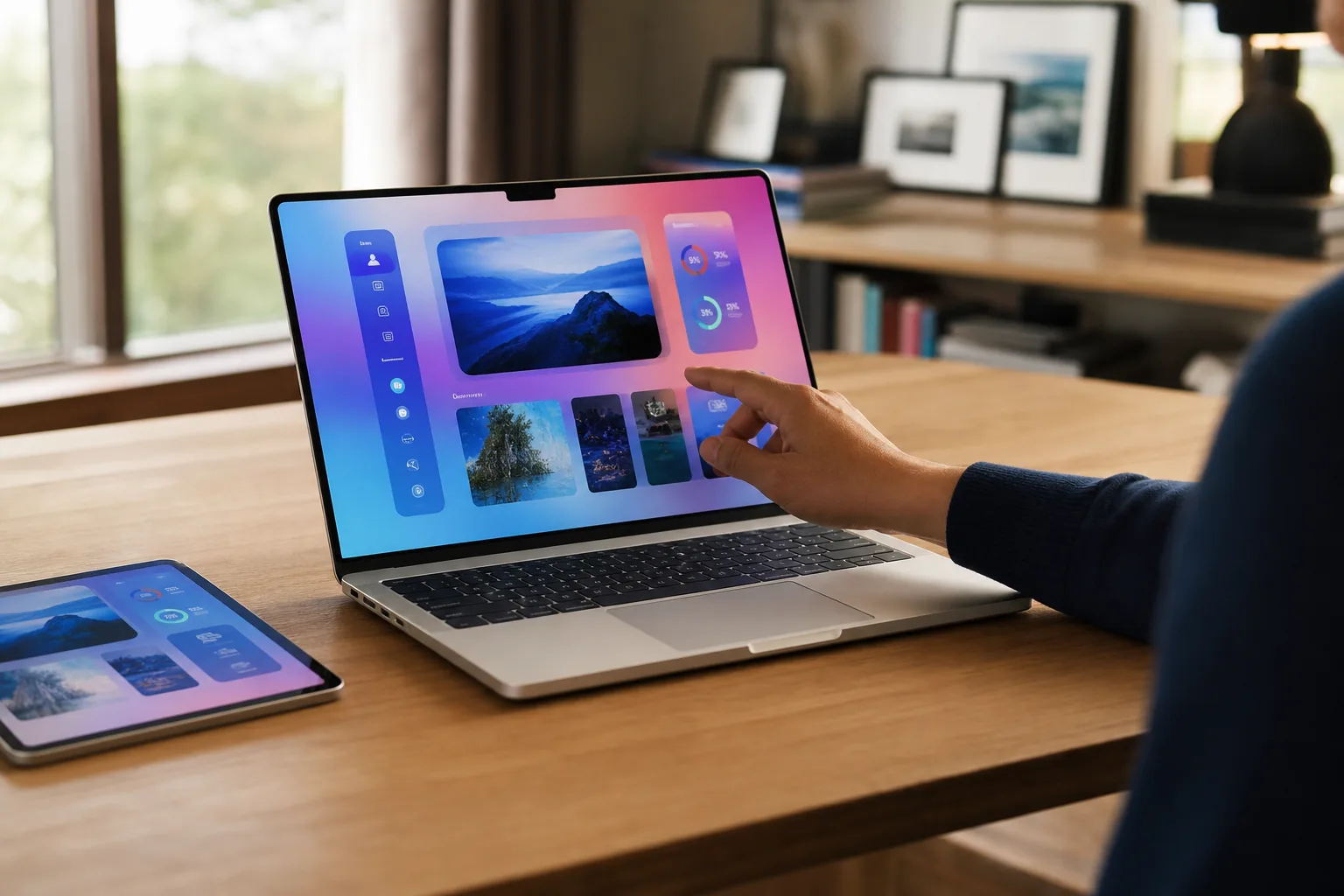
- Apple’s reported touchscreen MacBook could arrive around October 27, ending years of resistance to touch input on Macs.
- The touchscreen MacBook may use M5 Pro and M5 Max chips rather than Apple’s newly introduced M6 silicon.
- An OLED iPad mini and refreshed entry-level Macs are also reportedly part of Apple’s unusually crowded October hardware calendar.
- Apple must make touch feel native to macOS, or the new laptop risks becoming an expensive answer to a question few users asked.
Table of Contents
Apple’s touchscreen MacBook moment may finally be here
Apple has long insisted that a Mac with a touch display would be a bad idea. Now, if Bloomberg’s Mark Gurman is right, the company could be ready to reverse course. A touchscreen MacBook is reportedly set to appear on or around October 27, potentially alongside an OLED-equipped iPad mini and modest refreshes to the iMac and 14-inch MacBook Pro.
That date is still a reported possibility, not an Apple invitation or a confirmation from Cupertino. Even so, the specificity is notable. Apple has been linked to a touch-capable laptop since at least 2023, but the rumors have mostly felt like a distant product-roadmap item. This feels more concrete: a claimed launch window, a likely chip family, and a broader event lineup that makes commercial sense.
The company’s resistance has always been unusually firm. Critics have argued that vertical touch surfaces become ergonomically tiring — the famous “gorilla arm” problem — while Apple executives have long positioned the iPad as the place for direct manipulation and the Mac as the place for keyboard, trackpad, and mouse work. Anyone who has used a Windows 2-in-1 knows there’s some truth in that. You don’t want to hold your arm up all afternoon to edit a spreadsheet.
But the old argument has aged. Modern laptop touch screens are not meant to replace trackpads; they complement them. Pinching a map, tapping a playback control, signing a document, or quickly moving through a visual app can be more natural with a finger. Microsoft, HP, Dell, Lenovo, and others have been shipping touch laptops for years. Apple’s absence has become less like disciplined product strategy and more like a conspicuous hole in the lineup.
What the touchscreen MacBook may actually be
Gurman’s reporting points to a high-end model that could carry the MacBook Ultra name, though that branding is far from settled. The rumored touchscreen MacBook would reportedly use M5 Pro and M5 Max processors — the same family expected in current professional MacBook Pro models — rather than a Pro-tier M6 chip.
That distinction is easy to overlook, but it says plenty about Apple’s priorities. If the report is accurate, this won’t be a cheap experiment aimed at students or casual buyers. Apple appears to be treating touch as a premium Mac feature first, much as it introduced mini-LED displays and high-end port selections before bringing pieces of that technology farther down-market.
The software question is harder: can macOS meet the hardware halfway? Gurman has described an interface that changes based on the method of input. That could mean larger controls when fingers approach the screen, touch-friendly layouts in selected apps, or adaptive behavior similar to what Apple already does across iPadOS and macOS. A touchscreen MacBook running untouched desktop macOS would feel unfinished; tiny menu targets and dense toolbars are built for a precise pointer, not a thumb.
Apple has the ingredients to make this less awkward than Windows’ long and occasionally messy touch-laptop history. Its hardware and software teams are unusually integrated, and the company has years of iPad interface research to draw on. But that same history creates a complication: Apple can’t turn the Mac into a bigger iPad without muddying the reason both products exist.
The iPad mini may get the display it deserves
The other reported headliner is a redesigned iPad mini with an OLED display. Frankly, that upgrade has been overdue. The iPad mini remains one of Apple’s most appealing oddball devices: small enough to carry almost anywhere, large enough for reading, notes, gaming, cockpit-style controls, and media. Yet it has often received display technology later than Apple’s more expensive tablets.
OLED would bring deeper blacks, improved contrast, and more precise pixel-level lighting than the LCD panel used in the current iPad mini. For late-night reading and video, the difference can be immediately visible. It would also help Apple defend the mini against increasingly capable small Android tablets, although price will matter a lot. A premium OLED panel could push a device many buyers already view as a luxury second screen into uncomfortable territory.
There is a strategic wrinkle here. A better iPad mini arriving beside a touchscreen MacBook could make Apple’s product boundaries look blurrier than ever. The mini is already the company’s most portable touch computer. If Apple gives the Mac direct touch interaction too, it needs a sharper answer to the question buyers will ask at checkout: why buy one rather than the other?
Smaller Mac updates could tell the bigger chip story
Bloomberg also expects Apple to update the entry-level 14-inch MacBook Pro and the iMac with M6 chips. The basic MacBook Pro currently uses M5 silicon, while the iMac is reportedly still on M4. These sound like routine spec bumps, and perhaps they are. Yet Apple’s chip cadence has become a product story in its own right, especially as the company draws more attention to on-device AI tasks and energy efficiency.
A lower-end M6 MacBook Pro could give Apple a clean tiering system: new mainstream silicon for broadly available machines, and M5 Pro or M5 Max for the rumored touchscreen MacBook aimed at demanding users. It’s a little counterintuitive on paper, but Apple has never been shy about mixing generations when it wants to segment performance and margins.
Readers should keep expectations calibrated until Apple speaks. Product names, prices, display sizes, and exact input behavior are all unsettled. For baseline context, Apple’s current MacBook Pro lineup still presents the notebook as a traditional keyboard-and-trackpad machine, which makes any touch-focused announcement a meaningful departure rather than a minor feature update.
Apple’s real challenge is making touch feel intentional
The value of a touchscreen MacBook won’t be measured by whether it can scroll Safari with a finger. Nearly every competitor cleared that bar years ago. The test is whether Apple can make touch useful without asking people to relearn the Mac or accidentally turning the display into a smear magnet they ignore after a week.
My read is that Apple has waited so long because it knows a touch panel alone isn’t persuasive. But the delay also gives it an opening. If adaptive macOS controls, pen support, strong battery life, and a genuinely thoughtful hinge come together, the touchscreen MacBook could reset expectations for premium laptops. If it lands as a conventional MacBook Pro with a feature Apple once mocked, the company will have handed Windows makers a very easy talking point.
October could settle a question Apple has managed to avoid for years: was the Mac never meant for touch, or was Apple simply waiting until it could charge premium money for doing it its own way?