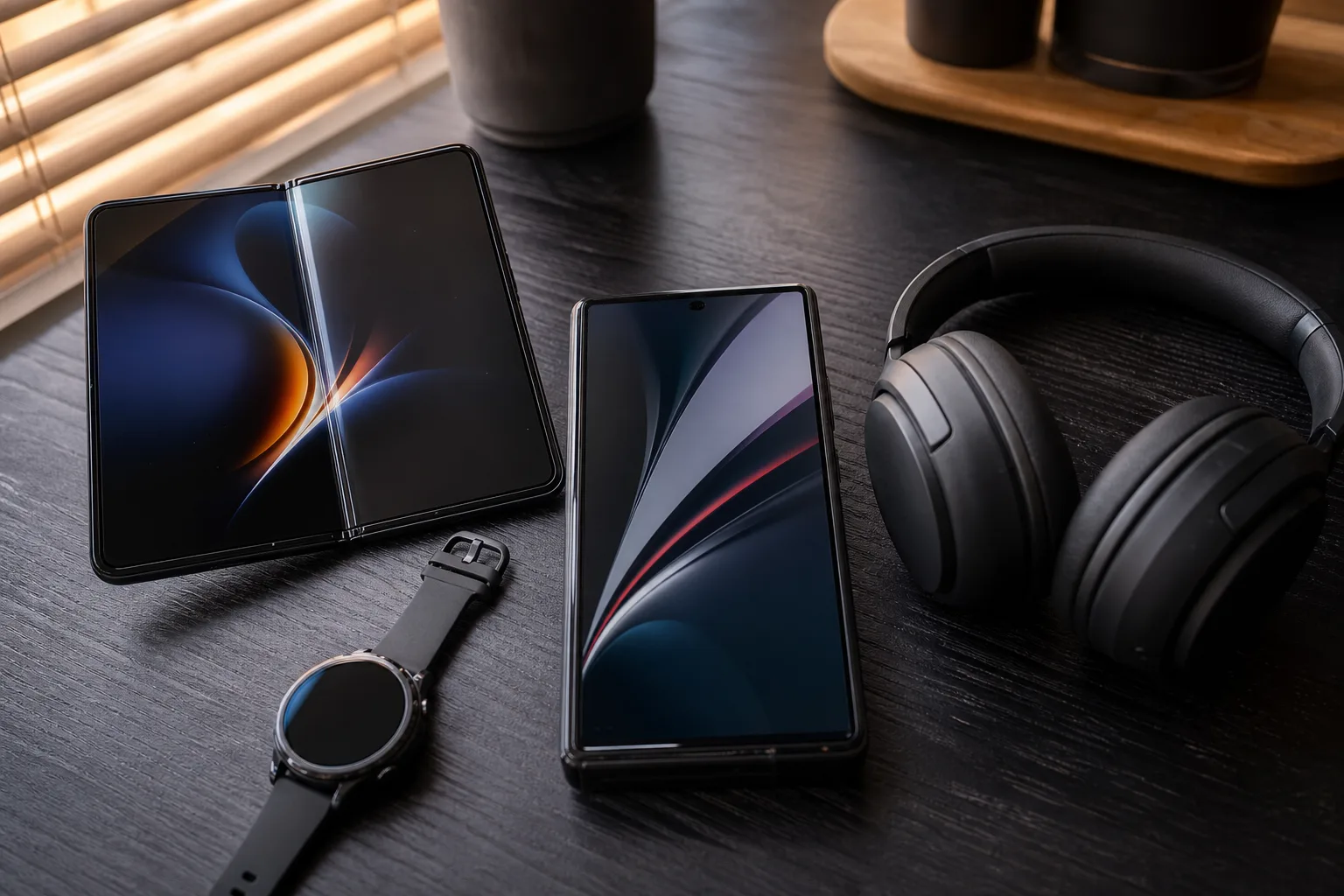
- Prime Day tech deals cut up to $420 from Samsung flagships, though even sale prices keep premium phones firmly expensive.
- The strongest Prime Day tech deals include $300 off Pixel 11 models and record cash discounts on the Pixel Watch 5.
- Samsung’s Galaxy Z Fold 8 Ultra falls $400, a meaningful reduction that still leaves foldables priced beyond conventional flagships.
- Surface Copilot+ PCs, Bose headphones and Sony audio gear round out a sale built around unusually broad hardware discounts.
Table of Contents
Prime Day tech deals put real pressure on premium prices
The most interesting thing about this round of Prime Day tech deals isn’t that Amazon has discounted expensive gadgets. Amazon always discounts expensive gadgets. It’s the size of the cuts on products that were released only months ago, especially Google’s Pixel 11 family and Samsung’s foldables. A $300 phone discount or $400 foldable discount changes the purchase math in a way a free case never will.
Amazon’s fall event has pushed the base Pixel 11 down to $749 from $899, while the Pixel 11 Pro starts at $849, or $250 below its $1,099 list price. The Pixel 11 Pro XL starts at $999, down from $1,299. Several higher-capacity configurations are also reduced, including the 512GB Pixel 11 Pro at $969 and the 512GB Pro XL at $1,119.
Those are the kind of straightforward cash reductions shoppers should prefer. Carrier promotions can appear larger, but they often require a trade-in, a high-tier data plan, or a commitment that follows you around for three years like an unwanted gym membership. These Prime Day tech deals are simpler: pay less upfront, with no arithmetic homework required.

The timing also says something about the Android market. Google and Samsung can’t rely on launch-week excitement alone when Apple, carrier subsidies and last year’s phones remain credible alternatives. Pixel phones have built a loyal following around camera processing and clean Android software, but a flagship still needs a price argument. At $749, the standard Pixel 11 has one.
Anyone shopping should still compare storage tiers carefully. The cheapest advertised price is often attached to the lowest-capacity model, and modern phones can fill up quickly if you shoot lots of video or keep offline media. The 512GB Pixel 11 Pro discount is particularly compelling because the upgrade itself generally carries a painful premium at checkout.
Samsung’s foldable discounts are the biggest Prime Day tech deals
Samsung has the most dramatic discounts of the sale. The 256GB Galaxy Z Fold 8 is listed at $1,550, down $350 from $1,900, while its 512GB sibling is $1,750. The Galaxy Z Fold 8 Ultra drops even further: $1,700 for 256GB and $1,900 for 512GB, each reflecting a $400 reduction.
Let’s be blunt: $1,700 is not cheap. It is, however, a more defensible number for somebody who genuinely uses a phone as a pocketable work screen, reads on the move, or wants one device that can replace a small tablet. Foldables have spent years living in the awkward space between brilliant idea and luxury indulgence. These prices don’t make them mainstream, but they trim some of the early-adopter tax.
The more conventional Galaxy S26 Ultra gets an even larger nominal cut, with Amazon listing the 256GB version from $980 versus $1,400 and the 512GB model at $1,180 versus $1,600. That is $420 off either configuration. Frankly, this may be the sensible Samsung buy for most people. It retains the large-screen flagship experience without asking buyers to accept the durability questions and unusual proportions that still come with a folding display.
Samsung’s official product pages remain the right place to check supported bands, software commitments and exact regional specifications before buying. The company’s smartphone catalog is more useful for that than a sale listing, which can be maddeningly light on the details that matter after checkout.
Pixel Watch 5 pricing is quietly one of the sale’s best moves
The Pixel Watch 5 deals deserve more attention than they’ll probably get. The 41mm model is down to $335 from $449, while the 45mm version costs $365 against a $430 list price. LTE variants land at $415 for 41mm and $445 for 45mm. Even the 45mm Stephen Curry Special Edition has fallen to $495, down from $580.
Wearables are where retail pricing has become especially detached from reality. Watch makers announce a premium figure, reviewers assess the product at that figure, then six months later the street price tells the more honest story. For prospective Pixel owners, these Prime Day tech deals make Google’s watch ecosystem far easier to justify, particularly if you value Fitbit integration and Google’s software design over the broader iPhone-only Apple Watch ecosystem.
The caveat is familiar: do not buy the special edition merely because it is discounted. Buy it if you prefer the specific design treatment. A branded edition that sits unused in a drawer is still an expensive accessory, no matter how good the percentage off looks on the product page.
Laptops and audio gear fill out a crowded sale
Amazon’s promotion also extends to Microsoft’s current Surface Laptop and Surface Pro Copilot+ PCs, along with Bose and Sony headphones. The source pricing includes Bose QuietComfort Ultra Headphones, second generation, at $369 instead of $449 across several finishes, an $80 cut. The standard second-generation QuietComfort headphones are $319.
These aren’t flashy Prime Day tech deals, but they may be the most practical. A good noise-canceling headset lasts longer than the average smartphone upgrade cycle, and Bose remains a credible choice for frequent travelers who prioritize comfort. Sony’s 1000X line is the obvious rival, so buyers should compare fit and features rather than treating either brand as automatically superior. Headphones are intensely personal; the best spec sheet cannot tell you whether a headband gives you a headache on a five-hour flight.
Microsoft’s Surface discounts are equally worth a second look for people who need a Windows machine rather than another phone. Copilot+ branding has been everywhere, perhaps too everywhere, but the more tangible story is that these are modern, efficient Windows laptops and tablets receiving meaningful retail cuts while the category is under pressure from Apple silicon and increasingly capable ARM hardware.
My read is that buyers should treat this sale as a chance to purchase hardware they already had on a shortlist, not an invitation to collect deals for their own sake. The Pixel and Galaxy price cuts are genuine. The foldable reductions are notable. But a $400 discount on a $2,100 phone still means spending $1,700. The real test for these Prime Day tech deals will be whether competitors are forced to make their regular prices look this reasonable after the sale banners come down.