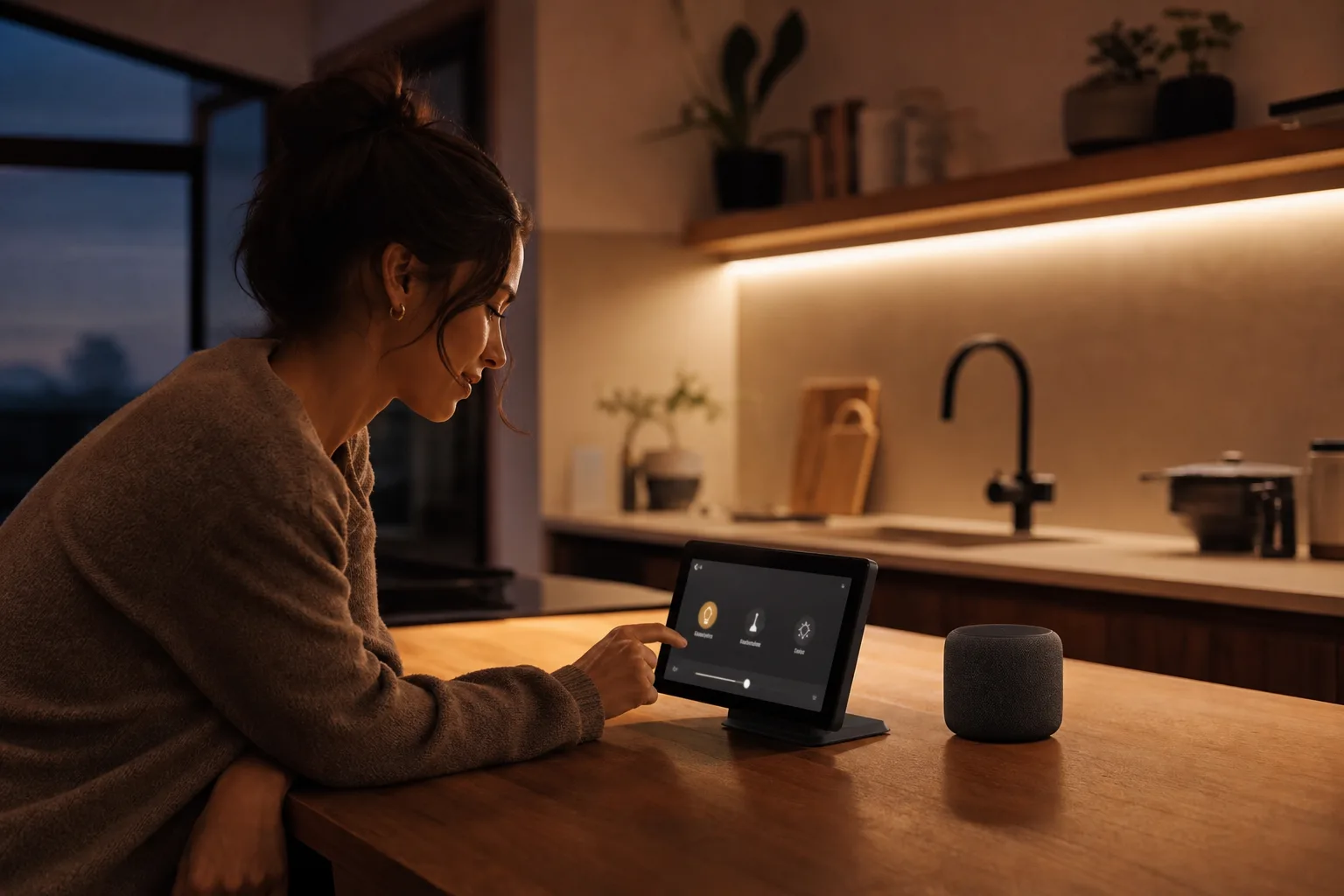
- The Apple Welcome home event on October 13 signals a renewed push into smart-home hardware and services.
- Reports tied to the Apple Welcome home event suggest Apple may be planning more ambitious Home products than another round of minor upgrades.
- A separate report puts a touchscreen MacBook Pro launch later in October, giving Apple an unusually packed month.
- Talk of softer iPhone 18 Pro demand raises the stakes for Apple’s next product announcements.
Table of Contents
Apple Welcome home event puts the house back on Apple’s agenda
Apple has scheduled its Apple Welcome home event for October 13, using an invitation line that is about as subtle as a neon sign: “Welcome home.” That wording makes one thing fairly clear. Cupertino wants us looking beyond the iPhone and toward the part of its product portfolio that has long felt promising but frustratingly underdeveloped: the smart home.
The company hasn’t laid out a product list, so the details remain uncertain. Still, recent reporting around the Apple Welcome home event points toward a broader set of Apple Home accessories, while separate rumors have put a major MacBook Pro refresh later in the month. If that schedule holds, Apple could be setting up a two-step October: home first, professional computing second.
That would be a notable change of posture. For years, Apple’s home strategy has largely meant the HomePod, Apple TV, Home app, and HomeKit support from third-party brands. Good pieces, mostly. But they’ve never added up to the kind of coherent household presence Amazon built with Echo or Google built with Nest.
The Apple Welcome home event matters less because an invitation promised a familiar marketing theme and more because Apple needs to show it has an actual plan. A smart home isn’t a phone launch where buyers upgrade, unbox, and move on. It’s plumbing. People have to trust it with locks, cameras, lights, routines, family access, and the occasional 2 a.m. alert that makes no sense.
Apple Home needs more than another speaker
Leaks suggest Apple’s “second-party” Home accessories could be more substantial than the usual collection of cases, cables, and branded add-ons. The term points to an unusual middle ground. Apple has historically kept a fairly rigid line between its own devices and partner hardware, even as it asks accessory makers to participate in its certification systems.
What might that look like? Apple hasn’t confirmed anything, and the reports do not provide a definitive product list. But the missing pieces are hard to ignore: displays, cameras, sensors, and controls that feel designed as one system rather than a pile of apps sharing a Wi-Fi password. A dedicated home display has been rumored for years, and frankly it’s the clearest missing piece. Amazon’s Echo Show and Google’s Nest Hub proved there’s a place for a screen in the kitchen or hallway, even if neither company has made the category feel indispensable.
Apple has an advantage here that competitors would love to have: an installed base of iPhones, iPads, Apple Watches, Macs, Apple TVs, and HomePods already inside many homes. Matter, the industry interoperability standard supported by Apple, Google, Amazon, Samsung, and others, should theoretically make that advantage more useful. Apple’s Home platform already supports a growing set of Matter-compatible products.
The problem is that theory and Tuesday night are different things. Ask anyone whose “smart” lights have become unreachable after a router update. Apple’s opportunity is not to add more tiles to the Home app. It is to make the whole experience boringly dependable. That’s the highest compliment home technology can earn.
What the Apple Welcome home event could say about Apple’s priorities
The timing of the Apple Welcome home event is interesting because it lands amid signs that Apple may be looking for its next dependable source of hardware growth. One report says the company has reduced iPhone 18 Pro production plans due to soft demand. Production chatter should never be treated as a retail-sales verdict — supply-chain adjustments happen for plenty of reasons, including component availability and revised forecasts — but the report is still a useful reminder that even Apple cannot assume every premium-phone cycle will run on autopilot.
The iPhone doesn’t need to be in trouble for Apple to broaden its bets. The company has every incentive to turn adjacent categories into meaningful businesses. Home hardware can sell devices, yes, but its larger value is stickiness. A household that relies on Apple for media, security, automation and family communications is much less likely to casually wander off to another ecosystem.
There’s also a privacy angle Apple will almost certainly emphasize at the Apple Welcome home event. Amazon and Google have spent years trying to convince customers that microphones and cameras in their living spaces are worth the trade-off. Apple’s privacy-first positioning gives it a credible opening, especially if more processing happens locally and users receive clear controls over recordings, access, and data retention. But a slogan won’t be enough. The company will need to explain the practical protections, not merely place “privacy” in an ad beside a sunlit living room.
My read is that Apple’s home ambitions will succeed or fail on setup and support, not industrial design. The hardware will probably look lovely. It always does. The real test is whether a non-technical family member can add a sensor, share access, recover from an outage, and understand why an automation did or did not run without calling the one relative who knows the router password.
A separate MacBook Pro report raises the stakes
While the October 13 invitation directs attention to the home, reporting has also pointed to an October 27 launch window for a touchscreen MacBook Pro and other products. If accurate, that would be a bigger deal than it initially sounds. Apple has spent years defending the idea that touch belongs on the iPad while the Mac remains a pointer-and-keyboard machine. A touchscreen MacBook Pro would be an explicit reversal, or at least an admission that the categories have been converging for a while.
It would also make October unusually crowded. The Apple Welcome home event could establish the company’s consumer-home narrative, then a later Mac announcement could target creators and professionals heading into the holiday buying season. Apple has used staggered launches before, but this arrangement would suggest a company carefully segmenting its messages rather than trying to cram every product into one overstuffed presentation.
There is a risk, though. Smart-home buyers have heard “the future of the connected home” pitches for more than a decade. They have drawers full of obsolete hubs to prove it. The Apple Welcome home event needs to present products with a lifespan longer than a marketing cycle, clear compatibility rules, and enough value that people will use them when the novelty evaporates.
October 13 is Apple’s chance to answer a basic question it has sidestepped for too long: does it want to be the company that makes individual devices people love, or the company that makes an entire home work better? Those are very different jobs. The second one is harder. It may also be where Apple’s next durable advantage lives.