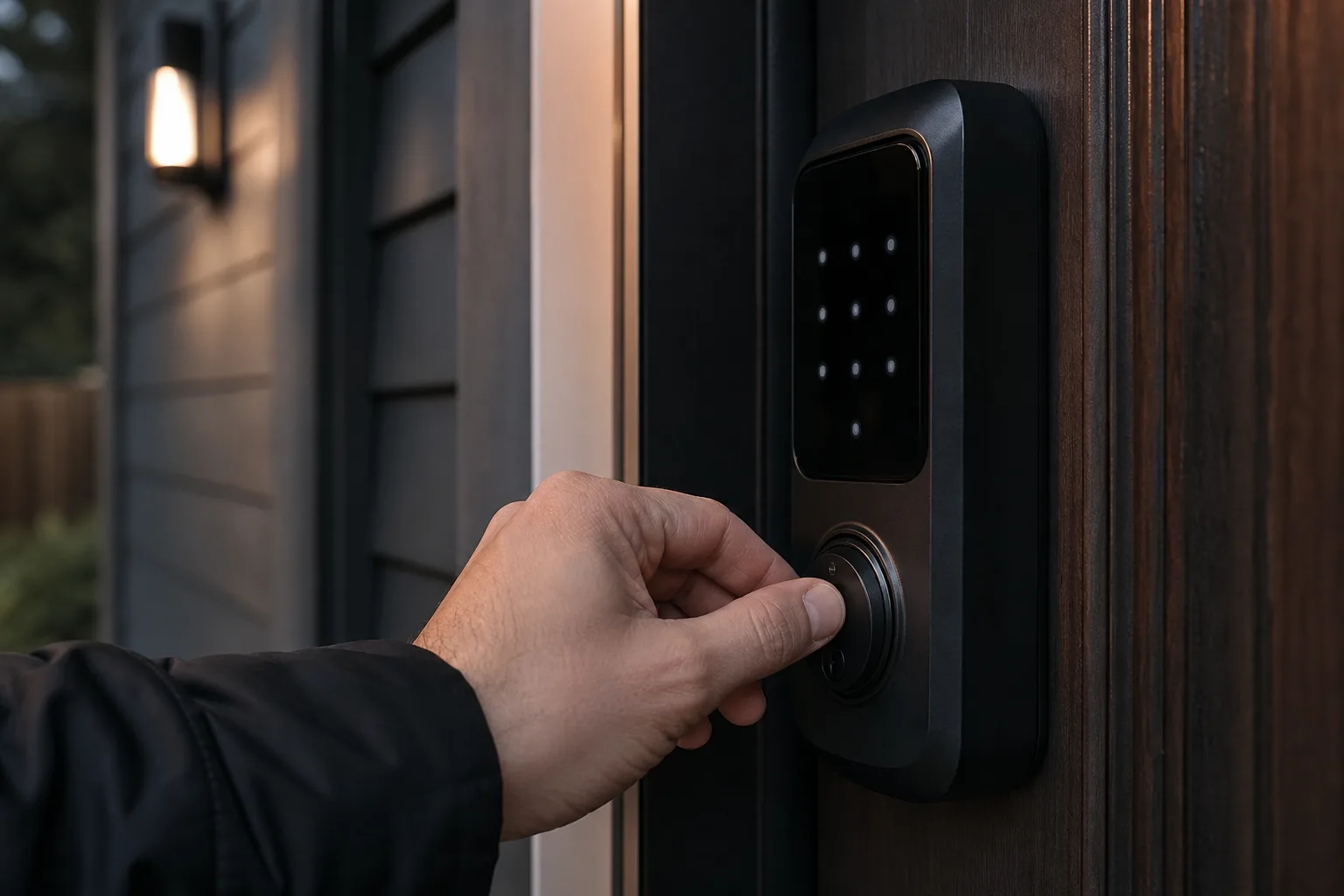
- The Ring Smart Lock uses a hand-powered dial to generate enough electricity for emergency entry after its battery runs flat.
- Ring Smart Lock buyers will get fingerprint, PIN, app, and Alexa access methods, with temporary codes available for guests.
- Amazon has set a $250 price and early 2027 launch window, while key details on battery life and Matter remain unknown.
- The manual power idea is clever, but its real value depends on whether stressed users can operate it quickly in bad weather.
Table of Contents
Ring Smart Lock takes aim at the category’s most annoying failure
A dead smart lock is one of those tiny modern disasters that feels absurdly large when you’re standing outside your own front door. Ring thinks it has a better answer with its upcoming Ring Smart Lock: a manual energy dial that lets users generate enough power to wake the lock up and get inside.
That’s a genuinely clever idea. Smart locks have spent years adding Wi-Fi, apps, guest codes, geofencing, fingerprint readers, and voice controls, yet many still fall back on the same old problem when their batteries die: find the physical key, borrow a 9-volt battery, or hope you remembered a USB-C power bank. None of those options feels especially smart when you’re returning from a trip at 11 p.m. with luggage in one hand and a grumpy child in the other.
Amazon says its first Ring Smart Lock will arrive in early 2027 for $250, in black, silver, and brass finishes. The company hasn’t pinned down a specific release date, and there are still important gaps in what it has shared. But the emergency-power mechanism is the headline feature because it addresses the one smart-lock anxiety that never really went away.
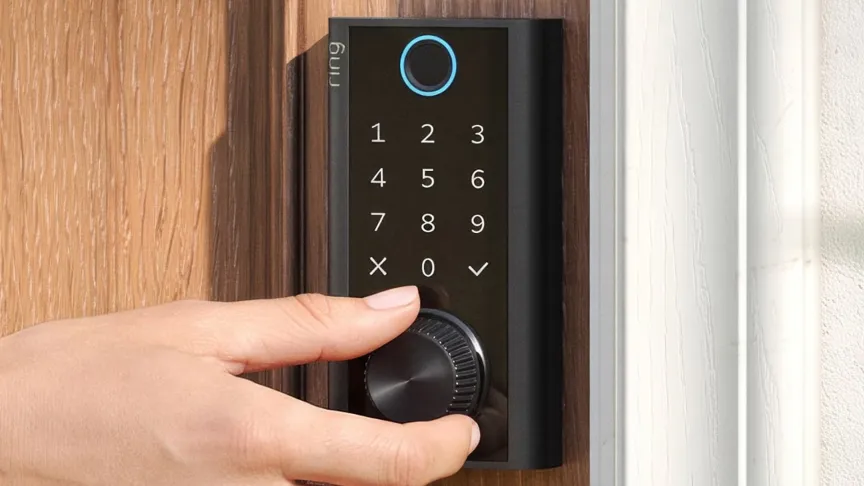
How the Ring Smart Lock emergency dial works
The outer portion of the Ring Smart Lock includes what Ring calls a manual power dial. If the removable Quick Release Ultra battery pack is empty, a user turns that dial to create enough electricity for the exterior controls to come back to life. Once the keypad lights up, they can enter a PIN or use the fingerprint reader to unlock the door.
It’s effectively a tiny hand generator built into a lock. Think of the old wind-up flashlight in the kitchen drawer, except this one is there to rescue your front-door access rather than illuminate a blackout.
Ring says users will have four ordinary ways to unlock: fingerprint recognition, a PIN code, the Ring app, or Alexa. Temporary PINs will also be supported, which matters more than the marketing copy might suggest. A dog walker, cleaner, visiting relative, or teenager coming home from school doesn’t need your account password or a house key tucked under a suspiciously decorative rock.
The company also says the battery can be removed and recharged indoors. That may sound routine, but it is a meaningful departure from locks that rely on disposable cells. If the pack is easy to remove and recharge, Ring could make regular maintenance less wasteful and less fiddly.
This fallback is the feature that gives the product a reason to stand out in a crowded smart-lock aisle. Yale, Schlage, Aqara, Level, and others have all tried to make door access feel less like key management. Most have not solved the dead-battery moment quite this directly.
A better fallback than a key? Maybe.
I’d argue Ring is right to treat backup access as a product feature instead of an embarrassing footnote. Plenty of smart locks offer emergency terminals for a 9-volt battery. Others put a USB-C port on the outside, allowing temporary power from a battery pack. Both solutions work in theory. In practice, who carries a 9-volt battery around? And how often is your power bank charged, available, and carrying the right cable?
A physical key remains the boringly dependable option. It has no firmware, no battery gauge, and no cloud service status page. But keys are also easy to lose, awkward to share, and surprisingly hard to use as a family system once several people need access at different times. The Ring Smart Lock is betting that a dial on the door is a more realistic emergency plan than asking every household member to carry a metal backup.
That bet needs testing. Ring hasn’t said how long users must turn the dial, how much force it requires, or whether the mechanism remains easy to operate after years of rain, dust, freezing temperatures, and general front-door abuse. A backup system that takes 30 seconds of vigorous cranking might be acceptable. One that needs several minutes while you’re soaked in a storm? Less so.
There’s also a basic accessibility question. A physical key has obvious limitations for some users, but so does a manually operated generator. Ring needs to show that this mechanism works for people with limited hand strength, not merely for a product demo with a fully charged camera crew nearby.
The missing details matter as much as the dial
The Ring Smart Lock arrives with a familiar Ring advantage: it slots into an ecosystem of Ring doorbells, cameras, and Amazon Alexa devices. If you’re already deep in that world, door control through the Ring app and Alexa will feel like the obvious next step. Amazon’s Ring product ecosystem has steadily expanded from video doorbells into alarms, cameras, and subscription-backed monitoring; a lock is an overdue missing piece.
But the company needs to answer several questions before anyone should commit $250. Battery-life estimates are absent. So is a clear statement on Matter, the smart-home standard designed to reduce the irritating platform silos that have plagued connected homes for years. Matter support could determine whether the lock plays nicely with Apple Home, Google Home, Samsung SmartThings, and other setups beyond Amazon’s orbit.
Third-party integrations are another open issue. For some buyers, the ideal lock talks to their alarm system, lights, thermostat, and automation routines. For others, frankly, fewer integrations may be preferable. A front-door lock should be reliable before it is clever.
Security and privacy will need close scrutiny, too. Fingerprints are convenient, but Ring will need to explain where biometric templates are stored, how authentication behaves during connectivity outages, and what happens if someone repeatedly tries to use the exterior controls. Those aren’t edge cases. They are the job.
Ring’s real challenge is making the clever part invisible
There’s a version of the Ring Smart Lock that becomes the rare smart-home gadget people recommend without caveats: charge it occasionally, unlock it however you like, and forget that the emergency dial exists until the one day it saves you. That’s the dream.
There’s also a version where the dial becomes a novelty feature, Matter support never materializes, and users still stash a key somewhere because they don’t trust a $250 internet-connected lock to be the final authority on getting home. Remember when the industry promised every connected device would simplify life? The devices that endure tend to be the ones that respect the old-fashioned failure modes.
My read is that Ring has identified the right problem. Now it has nearly a year to prove that turning a dial is truly less stressful than carrying a key.