

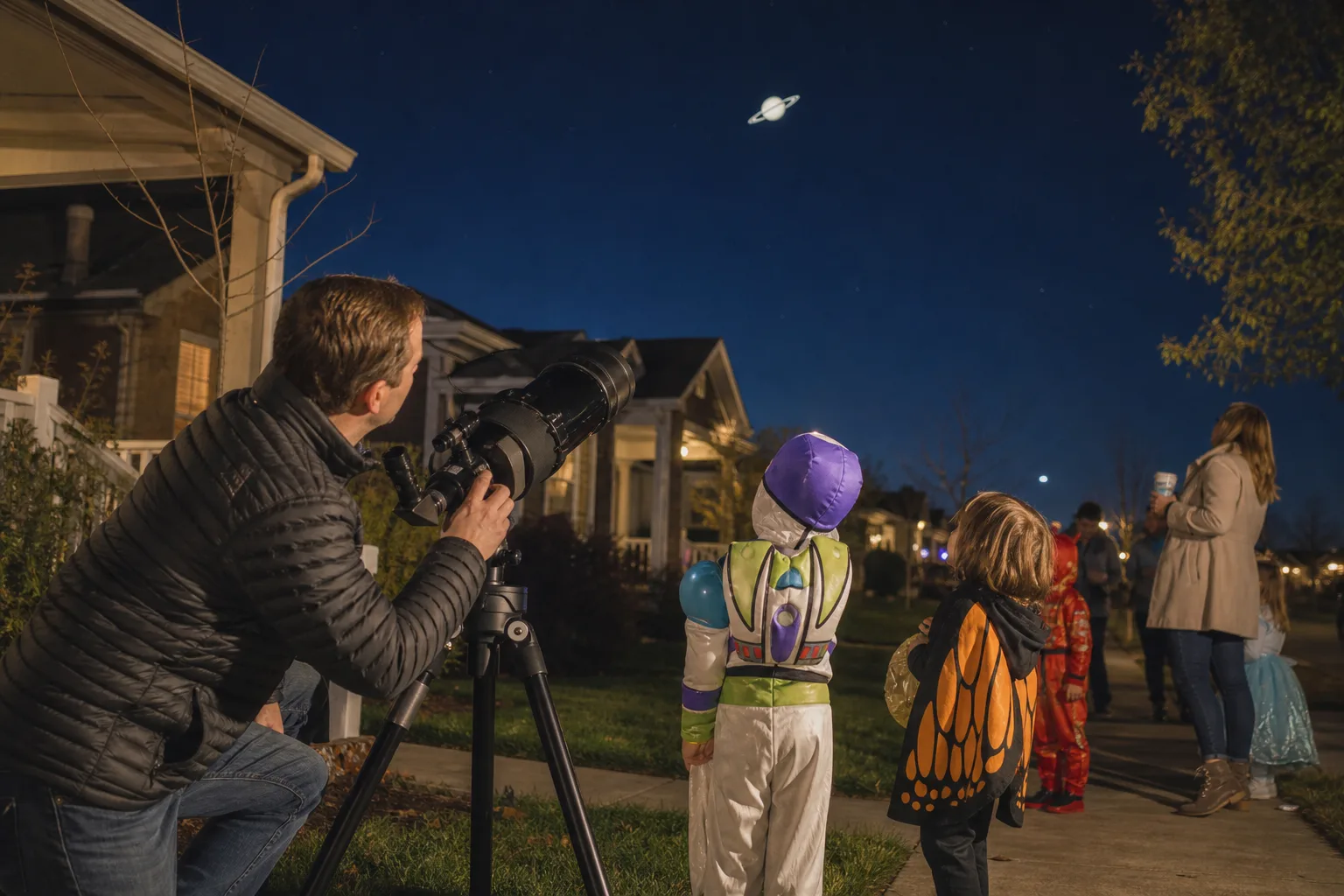
- The Halloween night sky could offer Saturn, early Taurid meteors and clear viewing across several US regions on Oct. 31.
- For Northeast observers, the Halloween night sky may also include a bright Tiangong space station flyover shortly after 7 p.m. EDT.
- Saturn’s rings will appear narrow, but even a modest telescope can reveal their distinctive shape.
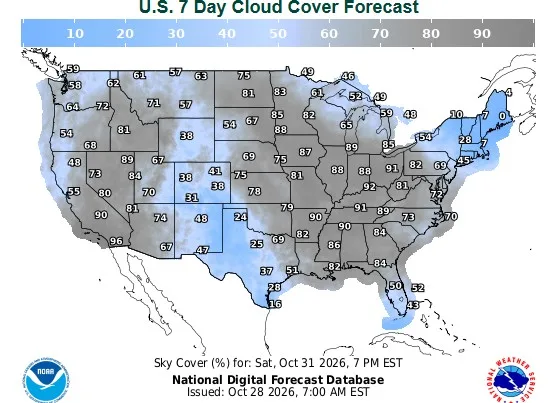
- Cloud cover, not astronomical timing, will likely decide whether trick-or-treaters get a view of the evening’s celestial lineup.
Table of Contents
Halloween night sky has a better treat than another candy bar
The Halloween night sky on Saturday, Oct. 31 has the makings of a genuinely good sidewalk astronomy night: Saturn in the early evening, the chance of a bright Taurid meteor, and a particularly useful Tiangong space station pass for parts of the Northeast. You don’t need an observatory, a tracking mount, or a degree in orbital mechanics. A clear patch of sky and five minutes away from the porch lights will do a surprising amount of work.
The dark-sky escape matters. Forecast guidance cited for the evening points to clearer conditions across much of New York, New England, northeast Pennsylvania and northern New Jersey, plus sections of the Great Plains, central Rockies, Pacific Northwest and Florida. A storm system across the middle of the country could leave Iowa, Nebraska and areas south toward the Gulf Coast under rain or heavy cloud. Treat any forecast this far out as provisional; autumn weather has a habit of changing its mind at the exact moment the candy bowl comes out.
Even with that uncertainty, the Halloween night sky is unusually well suited to casual viewing. It gets dark early, families are already outdoors, and Saturn is prominent enough that you can turn a walk around the block into a tiny science demo without making anyone download an app.
Saturn is the main event, even with its rings nearly edge-on
At roughly 7 p.m. local time, look toward the east-southeast and climb about two clenched fists held at arm’s length above the horizon. The bright, faintly yellow-white object in that area should be Saturn. To the unaided eye, it will look like a steady star. Aim even a small telescope at it, though, and the disguise falls apart.
The rings remain visible, but their geometry is not doing Saturn any favors. They are tilted only around 6.5 degrees relative to our line of sight, meaning they appear slim rather than widely spread. For experienced observers, that’s a less dramatic presentation. For a child who has never seen Saturn through an eyepiece, frankly, it hardly matters. The moment a bright dot resolves into a planet with rings is still one of astronomy’s best tricks.
A telescope around 30x magnification should be enough to separate the ring structure from Saturn’s globe in decent conditions. Don’t chase huge magnification unless the air is unusually steady. A sharp, modestly enlarged image beats a blurry one every time, much like watching a 4K stream over a stable connection instead of trying to force 8K through hotel Wi-Fi.
The Halloween night sky also offers a useful reminder that a telescope is not automatically a better experience. If you’re hosting neighborhood viewers, Saturn is a fine telescope target, but give people time with their naked eyes too. Identifying the planet first makes the eyepiece reveal feel less like a magic trick and more like discovery.
Watch for Taurid fireballs, but keep expectations in check
The Taurid meteor shower is active around Halloween and gets called the “Halloween Fireballs” for a reason. Its debris particles tend to be larger than the grains responsible for many meteor displays, so a Taurid can produce a slow, bright streak or, on lucky nights, a fireball that looks almost theatrical. Think Roman candle, not the quick pinprick flashes common during other showers.
There’s a catch. Halloween is not the Taurids’ peak; stronger activity generally arrives in the second week of November. That doesn’t make the earlier date pointless. It just means the Halloween night sky is a lottery ticket, not a scheduled fireworks show. Look broadly toward the east and northeast, keep your eyes off a phone screen for 15 to 20 minutes, and let your peripheral vision do its job.
For a family walk, this is probably the right framing: if you spot one, it’s memorable; if you don’t, Saturn is still there. Too many stargazing guides sell certainty when the actual joy comes from waiting for something unpredictable.
A Chinese space station may cross the Northeast
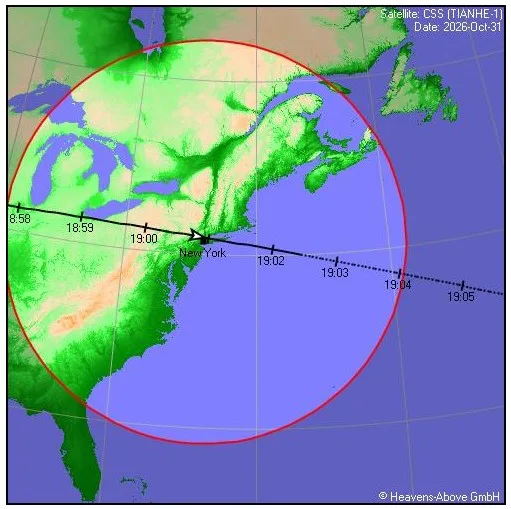
The wild card in the Halloween night sky is a predicted evening pass by Tiangong, China’s operational space station. Its Tianhe core module launched in April 2021 and functions as the station’s central living and control space. The forecast track places the station traveling generally west to east, near the Chicago-to-New York corridor, at an orbital altitude of roughly 240 miles.
Observers in or near the Northeast track could see it within a few minutes of 7 p.m. EDT, weather permitting. It will not blink like an aircraft, and it will not hover. Instead, expect a bright, steady, star-like light sliding across the sky with surprising speed. People south of the ground track should look north for its highest point; those north of it should look south.
That distinction between a satellite and an airplane sounds basic, but it is the difference between spending ten minutes explaining orbital mechanics and accidentally showing a kid a Delta flight. The Chinese station will move continuously and silently, reflecting sunlight even though the ground below has entered darkness.
Check the local timing before heading outside. Heavens-Above remains one of the most useful public tools for checking satellite predictions by location, and it also tracks the International Space Station, major satellites, comets and other objects. A map can tell you a pass exists; your exact coordinates determine whether it is worth craning your neck for.
How to make Halloween stargazing work with kids
Richard W. Schmude Jr., writing in the Astronomical League’s Reflector magazine, offered practical advice for public telescope sessions that applies perfectly here: use an inexpensive eyepiece, tell children not to touch the telescope, and consider a small stool for younger observers. This is not precious equipment snobbery. A bumped telescope loses Saturn instantly, which can turn an excited queue into a line of disappointed kids.
A Dobsonian telescope is a sensible choice because it is stable, intuitive to point and generally forgiving of a quick nudge. If you have a camera and monitor setup, a screen can be even better for a busy driveway. Nobody has to hover at the eyepiece, glasses don’t become an issue, and five people can see the result at once.
The Halloween night sky works best when the pitch is simple. Tell kids Saturn is a distant planet. Explain that a meteor is a tiny piece of space debris burning in our atmosphere. Then point to Tiangong, if it appears, and mention that people live and work aboard it. No lecture required.
My read is that this kind of accidental public outreach beats a polished planetarium show more often than astronomy groups may want to admit. A ringed planet beside a front porch, seen between costumes and doorbells, has a way of sticking. If clouds cooperate on Oct. 31, the Halloween night sky could give a lot of first-time observers a reason to look up again.
Frequently Asked Questions
What can I see in the Halloween night sky without a telescope?
Saturn should be visible as a bright yellow-white point in the east-southeast during the early evening. Under clear skies, viewers may also catch a Taurid meteor, while parts of the Northeast could see Tiangong moving steadily across the sky as a bright, star-like object.
Why do Saturn’s rings look thin in 2026?
Saturn’s rings currently appear somewhat edge-on, with their south face tilted only about 6.5 degrees toward our line of sight. They can appear to bisect the planet’s disk.
How can I find the Tiangong space station flyover time for my location?
Use a satellite-tracking service such as Heavens-Above and enter your location for specific details on when and where to see the station. NY2O.com also provides live information and predictions for Tianhe-1.