

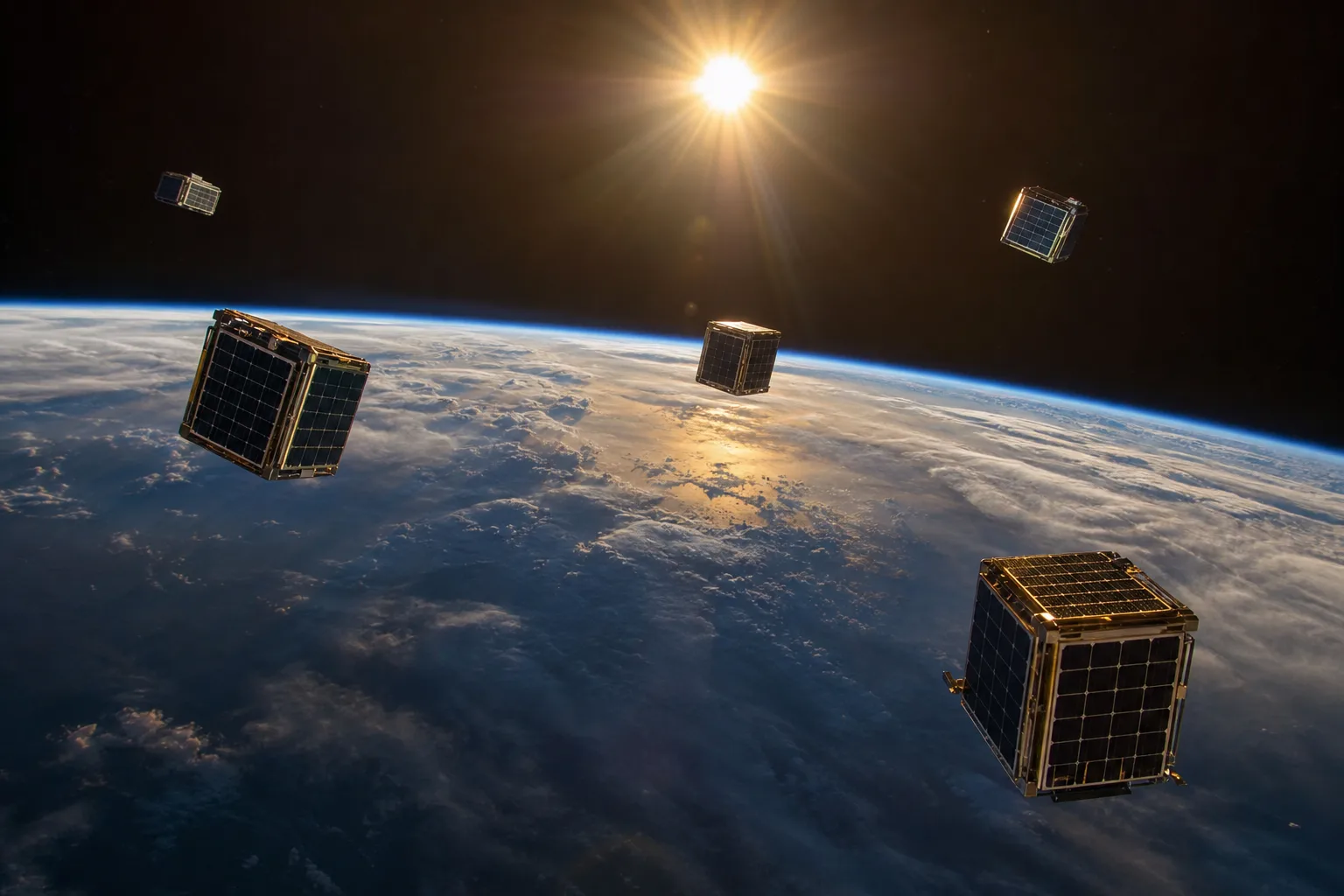
- Google’s space data centers concept would place AI compute hardware in solar-powered satellites rather than increasingly power-hungry terrestrial facilities.
- The appeal of space data centers is abundant sunlight, but cooling, radiation, launch costs and maintenance remain formidable obstacles.
- Google’s research effort reflects the AI industry’s growing concern that electricity supply could constrain future model training and inference.
- Early orbital computing experiments may prove useful, though they are unlikely to replace conventional cloud regions anytime soon.
Table of Contents
Google’s space data centers idea starts with an earthly problem
AI has a power problem, and Google’s answer may sound like something scribbled on a whiteboard at 2 a.m.: space data centers. The company is exploring whether clusters of solar-powered satellites could run AI workloads in orbit, where sunlight is plentiful and land-use fights are, for obvious reasons, less of an issue.
It’s a genuinely interesting idea. It is also a long way from a practical replacement for the giant warehouses full of servers Google operates around the world.
The basic pressure is easy to understand. Every major cloud company is racing to build more AI infrastructure, and that means acquiring not only Nvidia GPUs or Google TPUs but also substations, transmission lines, water access and electricity contracts. In many parts of the US and Europe, the grid is now the bottleneck. A company can order chips; it cannot magically build a new power plant next Tuesday.
Google’s reported orbital-computing work, sometimes described as Project Suncatcher, treats space as an alternate energy frontier. A satellite can collect sunlight without clouds, nighttime or a neighboring community asking why a new data center has doubled the demand on its local grid. That sounds alluring when you are trying to train and serve increasingly hungry AI models.
But sunlight is only one line item in a much nastier spreadsheet.
Why space data centers look attractive on paper
For decades, satellites have processed some data in orbit. Earth-observation spacecraft, for instance, can filter images before transmitting them to the ground. What Google appears to be considering is much more ambitious: distributed computing infrastructure in orbit, with satellites linked by laser communications and loaded with specialized AI chips.
The solar-energy argument is real. A spacecraft in the right orbit can spend far more time in direct sunlight than a solar farm on the ground. There is no weather to contend with, no seasonal snow on panels, and no need to buy acres of land near a high-capacity transmission line. In principle, space data centers could turn that energy into computation close to the source.
For advocates, space data centers offer the possibility of using that constant solar supply without adding to demand on already strained terrestrial grids.
That last phrase matters. Sending electricity back to Earth would be an entirely different, enormously complicated project. The more plausible concept is to use solar power in orbit to run computing in orbit, then send the finished output down as data. If an AI system is analyzing satellite imagery, communications traffic, weather information or other inherently space-based data, avoiding a constant downlink-uplink round trip could have benefits.
Google has plenty of relevant building blocks. It designs its own Tensor Processing Units, operates one of the world’s largest cloud platforms and has extensive experience in distributed systems. The company also has a history of entertaining projects that look absurd until a piece of the underlying technology catches up. Sometimes that produces Waymo. Sometimes it produces Google Glass. That’s the moonshot business.
The backdrop is getting harder to ignore. Microsoft, Amazon and Google are spending aggressively on terrestrial AI campuses, while utilities warn that connecting the biggest projects can take years. The International Energy Agency has projected that global data-center electricity consumption could rise sharply this decade, driven substantially by AI. Google’s own environmental reporting has made clear how difficult it is to reconcile expanding compute demand with emissions targets.
So yes, the company is looking up.
The ugly physics of space data centers
Frankly, space does not make the data-center problem disappear. It replaces familiar headaches with brutal ones.
For space data centers, start with heat. People often assume space is a natural refrigerator because it is cold. That is not how it works. On Earth, servers use air or water to carry heat away. In the vacuum of space, there is no air to convect that heat. A satellite has to radiate heat away, which requires large radiator surfaces and careful thermal engineering. A tightly packed rack of hot AI accelerators is hard enough to cool in Virginia; it gets harder when the only exit route for heat is radiation.
Then there is radiation. Consumer electronics do not get a friendly life in orbit. Chips face radiation that can corrupt memory, degrade components or cause operational failures. Radiation-hardened parts exist, but they tend to lag behind the newest commercial silicon in performance and cost. Google would need to prove that its accelerators can survive, or that a fleet can tolerate regular hardware losses without becoming an accounting disaster.
Maintenance is another awkward detail. When a server fails at a Google facility, a technician swaps it. When a processing unit fails hundreds of kilometers above Earth, you either designed around the failure, launched spares or accepted reduced capacity. Nobody is dispatching an orbital IT contractor with a replacement fan and a badge.
And launch economics remain central. SpaceX has pushed launch prices downward and made frequent launches more normal, but putting mass into orbit is still vastly more expensive than trucking a server rack to an Arizona data center. Any argument for space data centers has to beat not just an imagined future grid crisis, but the astonishingly efficient and mature logistics of building on Earth.
There is a networking challenge, too. Laser links between satellites can move data quickly, but they must maintain precise pointing while spacecraft move at extraordinary speed. Downlinks need ground stations. Some workloads tolerate delay; others do not. An orbital cluster may be useful for batch processing, simulation or space-native sensing, while serving a chatbot request from a phone in Chicago is a different proposition entirely.
AI demand is forcing stranger infrastructure bets
Google is not alone in thinking beyond the standard data-center blueprint. The AI boom has revived interest in nuclear power contracts, small modular reactor proposals, geothermal energy, gas generation at data-center sites and large-scale battery systems. Microsoft has backed a plan to restart a reactor at Three Mile Island to help power its operations. Amazon has invested in nuclear projects. Meta is shopping for nuclear developers.
These are not minor side quests. They are evidence that the old assumption — compute expands whenever a cloud provider wants it to — has broken down. Chips, land, grid connections and generation capacity now all matter. The leading AI firms are behaving less like software companies and more like industrial operators with unusually good machine-learning teams.
Space data centers belong in that same category of infrastructure speculation. They are not a promise that your Google search will soon be answered from orbit. They are a bet that electricity and physical constraints might become valuable enough to justify technology that currently seems extravagant.
My read is that Google’s near-term opportunity is narrower than the headline suggests. Orbital computing could make sense first for satellites that already collect enormous amounts of information and need to decide what is worth sending home. Think disaster mapping, climate observation, maritime tracking or communications management. Processing at the edge is useful when the edge is literally above the planet.
Replacing mainstream cloud regions is another matter. Google’s customers need predictable pricing, low latency, regulatory controls and serviceability. An orbital TPU cluster would have to offer a startling advantage to overcome its operational complexity. Cheap solar power is compelling, but it does not automatically produce cheap computing.
The first tests will matter more than the vision
The sensible way to view Google’s project is as research with a sharp commercial motive. The company does not need to prove that every future AI workload belongs in orbit. It needs to learn whether a useful slice of workloads can be handled there economically, reliably and with less strain on terrestrial grids.
If early demonstrations show that satellite-based processors can survive radiation, shed heat and communicate efficiently, the conversation changes. Launch costs could continue falling, specialized hardware could become more resilient, and the pressure on Earth-bound power systems is unlikely to fade.
Still, I would not bet on server farms drifting overhead anytime soon. The immediate lesson is more revealing: AI’s infrastructure appetite has become so intense that one of the world’s richest technology companies is seriously investigating space data centers. That is either a glimpse of computing’s next frontier, or a very expensive signal that we have not built enough power generation on this one.
Frequently Asked Questions
What are space data centers?
Space data centers are proposed networks of satellites carrying computing hardware, power systems and communications links. Instead of operating in terrestrial warehouses, they would process workloads in orbit, potentially using near-constant solar power and optical links between satellites.
Why does Google want data centers in space?
Google is exploring orbital computing because AI requires enormous and rising amounts of electricity. Satellites above much of Earth’s atmosphere can collect solar energy more consistently than ground installations, though turning that theoretical advantage into economical computing remains difficult.
Can satellites cool AI chips in space?
Not easily. Space is cold, but there is no air for conventional cooling systems to dump heat into. Satellite hardware must radiate heat away through specially designed surfaces, a difficult constraint for densely packed, power-hungry AI accelerators.
When could Google launch orbital AI computing?
Google has framed the work as an exploratory research project, not a near-term cloud product. Any practical deployment would need successful hardware demonstrations, cheaper launches, dependable inter-satellite networking and a credible answer to repair and replacement problems.

