

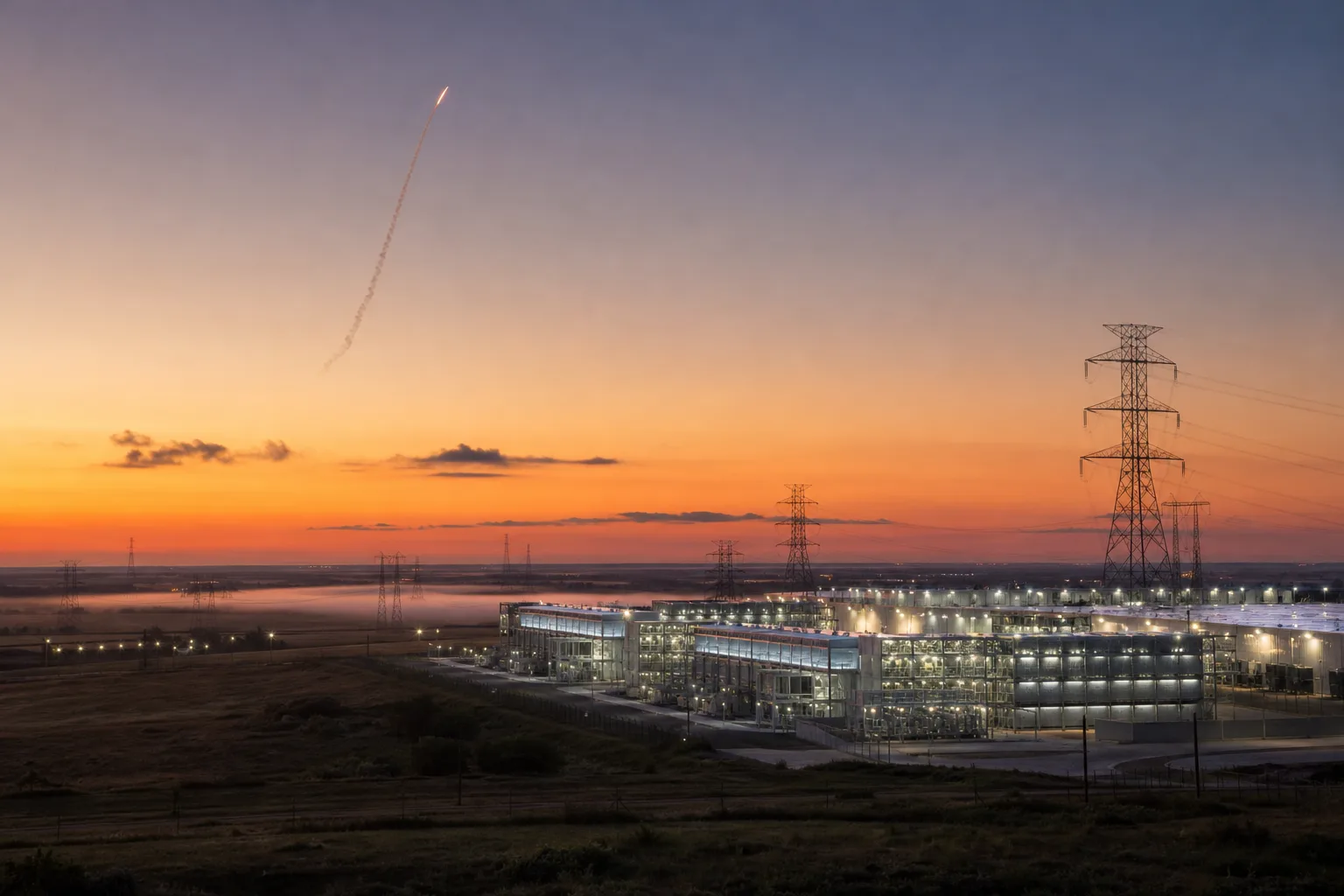
- Data centers in space have become a favored talking point as Texas voters and lawmakers push back against the growth of terrestrial facilities.
- The case for data centers in space comes down to solar power and distance from local politics. The drawbacks are harder to ignore: launch costs and cooling.
- Texas agencies and counties could gain new influence over data center permits, water use, grid demand, and environmental enforcement.
- SpaceX, Google, Blue Origin, and startups are pursuing orbital computing, though none has proved hyperscale computing works off Earth.
Table of Contents
Data centers in space are suddenly political cover
The overnight enthusiasm for data centers in space says less about a looming orbital-computing boom than it does about how rattled the AI infrastructure business has become on the ground. After Democratic candidates reportedly won races across the country, including contests in Texas where opposition to massive data campuses was a live issue, the familiar cast of techno-optimists went looking for an escape hatch. Their answer: put the servers above the atmosphere.
Elon Musk put the sentiment bluntly on X: “Data centers in space looking pretty appealing right now.” That post landed after a punishing election night for Republican candidates backed by Musk, who reportedly spent more than $400 million on their campaigns. Other investors, researchers and SpaceX-adjacent accounts quickly joined in, treating orbit as a way around local zoning fights, water concerns and a power grid already straining under the weight of AI demand.
That reaction is revealing. For years, the data center industry has sold communities on jobs, tax receipts and digital progress. Now residents in Texas, Virginia, Arizona and elsewhere are asking a far more basic question: why should their water, land and electricity subsidize someone else’s chatbot?

My read is that the rush toward space rhetoric is also an admission that the industry has not done a great job earning public trust. You can call opposition to a facility anti-growth if you like, but that line falls apart when a project arrives with opaque utility deals and consumption levels that resemble a small city.
Why Texas has become the data center fight to watch
Texas has become an unusually consequential front in the data center backlash. Cheap land, a comparatively business-friendly regulatory culture and vast renewable generation have drawn cloud companies and AI developers in droves. The state is also home to SpaceX’s Starbase operations, making Musk’s orbital answer feel more than theoretical, at least on social media.
But Texas’ appeal comes with a catch: its grid is finite, its drought risk is real, and many huge developments are being built beyond city boundaries. Robert Paterson, a University of Texas at Austin professor who studies land use and environmental planning, has pointed out that close to half of Texas data centers sit in unincorporated areas. Those locations are often beyond municipal zoning rules.
Counties have limited authority under Texas’ version of Dillon’s Rule, which means they can exercise only powers specifically granted by the state. They can regulate matters such as road access and floodplain construction, but they generally cannot use the kind of zoning authority that would let them closely scrutinize a giant server campus before it arrives.
That could change. Paterson has argued lawmakers could give counties limited authority over data center projects. And while control of Texas government may be split, concern about giant facilities is not neatly partisan. Rural conservatives, environmental advocates and suburban homeowners can all find reasons to dislike an energy-hungry warehouse complex appearing down the road.
Adrian Shelley, who leads Public Citizen’s Texas office, told Wired that state agencies could also matter a great deal. The Texas Commission on Environmental Quality, Public Utility Commission and Texas Water Development Board have enforcement powers that range from fines to, in extreme cases, permit revocations. Existing projects have substantial legal protections once approved, so nobody should expect a new administration to erase a construction pipeline with the stroke of a pen. Still, enforcement priorities can change fast.
The practical limits of data centers in space
For all the chest-thumping, data centers in space remain a brutally difficult engineering and economic proposition. Satellite hardware has to survive radiation, launch vibration, vacuum, extreme temperature swings and the simple inconvenience of being very far away when something fails. A failed rack at a terrestrial facility gets a technician and a replacement part. A failed server in orbit gets a prayer, a software patch, or a very costly mission plan.
The central pitch is not nonsense. Space offers abundant sunlight, and satellites can radiate heat into the cold vacuum of space. But vacuum does not make cooling easy; it removes the air that ordinary computers use to shed heat. Orbital systems need radiators, thermal control equipment and carefully managed power cycles. Those add mass. Mass adds launch cost. The physics has not been persuaded by a venture-capital slide deck.
Nor is bandwidth free. Most AI workloads involve vast volumes of data moving among users, storage systems and processors. Sending that traffic up to orbit and back down introduces latency and relies on expensive, capacity-constrained communications links. Space makes more sense for processing data already collected in orbit, such as Earth-observation imagery, weather measurements or military sensor feeds. It makes much less sense for serving everyday chatbot requests from millions of people on Earth.

A few projects are worth watching. Google has tested satellite hardware with what it described as a data-center-class TPU. SpaceX has said it wants to deploy thousands of AI satellites as early as late 2027. Blue Origin has filed with the Federal Communications Commission for a 50,000-satellite orbital system. Startup Starcloud has said it carried an Nvidia H100 GPU into orbit in late 2025. The concept has moved beyond science-fiction concept art, even if the business case remains unproven.
Yet none of this proves data centers in space can compete with a hyperscale facility in Texas or Northern Virginia. A modern hyperscale campus can expand module by module and receive constant maintenance. Building that kind of capacity in orbit would demand launch cadence, satellite manufacturing and power-management systems at a scale nobody has demonstrated.
Orbit will not solve an earthly accountability problem
There is a temptation to frame data centers in space as a clean break from local conflict: limitless solar energy, no neighborhood meetings, no county commissioners and no worries about drought. Frankly, that fantasy is part of the attraction. But moving compute upward does not make its impacts vanish. It shifts them into launch emissions, orbital debris risks, spectrum disputes and a space environment that is already getting crowded.
It also avoids the more useful question: what obligations should companies have when they build infrastructure that draws enormous public resources? Better disclosure around power demand, water use, tax incentives and grid upgrades would do more for public confidence than a thousand glossy satellite renderings. The US Department of Energy has reportedly identified data center efficiency and grid planning as priorities, and that is where the unglamorous work still sits.
Data centers will keep expanding because AI companies need compute and investors still believe demand is there. But data centers in space are not a near-term replacement for land-based facilities; they are, at best, a specialized future market. The more immediate test is whether the industry learns to negotiate with the communities powering its ambitions. If it cannot, expect the political gravity pulling against new campuses to get stronger than any rocket engine.