

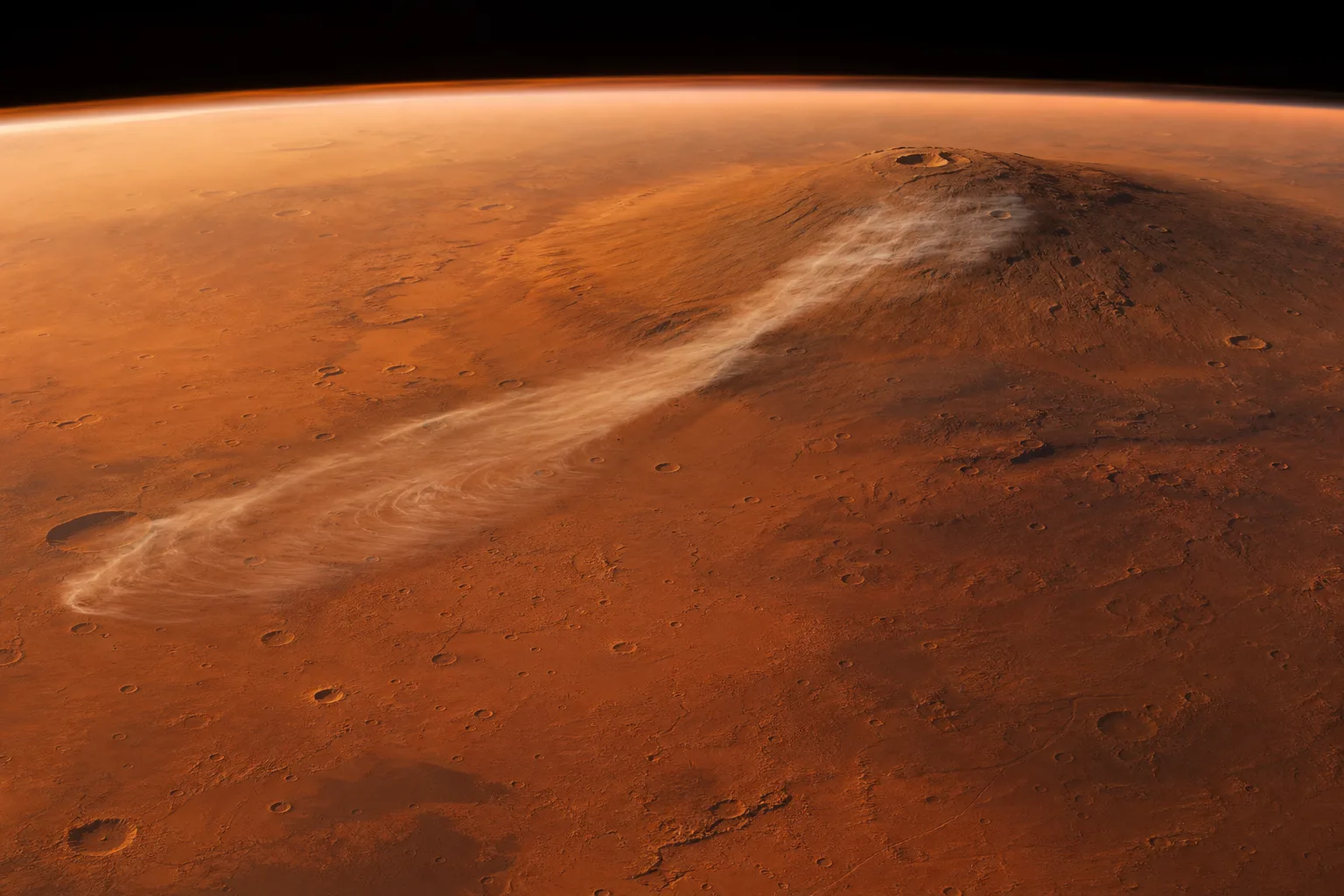
- Mars cloud formation can create extraordinarily long water-ice plumes when seasonal winds meet high Martian volcanoes at dawn.
- NASA’s featured Mars cloud formation image makes the planet’s thin atmosphere look surprisingly busy rather than inert.
- Long clouds near Arsia Mons are weather events, not volcanic eruptions, despite their dramatic shape and scale.
- Monitoring these plumes helps scientists refine atmospheric models needed for orbiters, landers, and eventually human missions.
Table of Contents
Mars cloud formation makes the planet look briefly alive
Mars cloud formation is easy to underestimate until you see one of these long, pale streamers stretched across the planet’s rusty surface. NASA’s Astronomy Picture of the Day feature for November 2 puts that contrast front and center: a narrow cloud plume trailing away from a Martian volcano, like exhaust from an engine that was never switched on.
That visual trick matters. Mars is often framed as a dead world — and geologically, its great volcanoes are nowhere near as lively as Earth’s. But its atmosphere still moves, cools, heats, carries dust, and occasionally builds clouds on a scale that looks frankly absurd against the planet’s thin blue-white haze. The long cloud isn’t smoke. It isn’t proof of an eruption. It is weather.
The likeliest setting for an image like this is the Tharsis region, home to the solar system’s biggest volcanic mountains. Arsia Mons, in particular, has become famous for producing an elongated morning cloud that can form under favorable conditions. From orbit, the effect resembles a brushstroke drawn westward from the volcano’s summit.
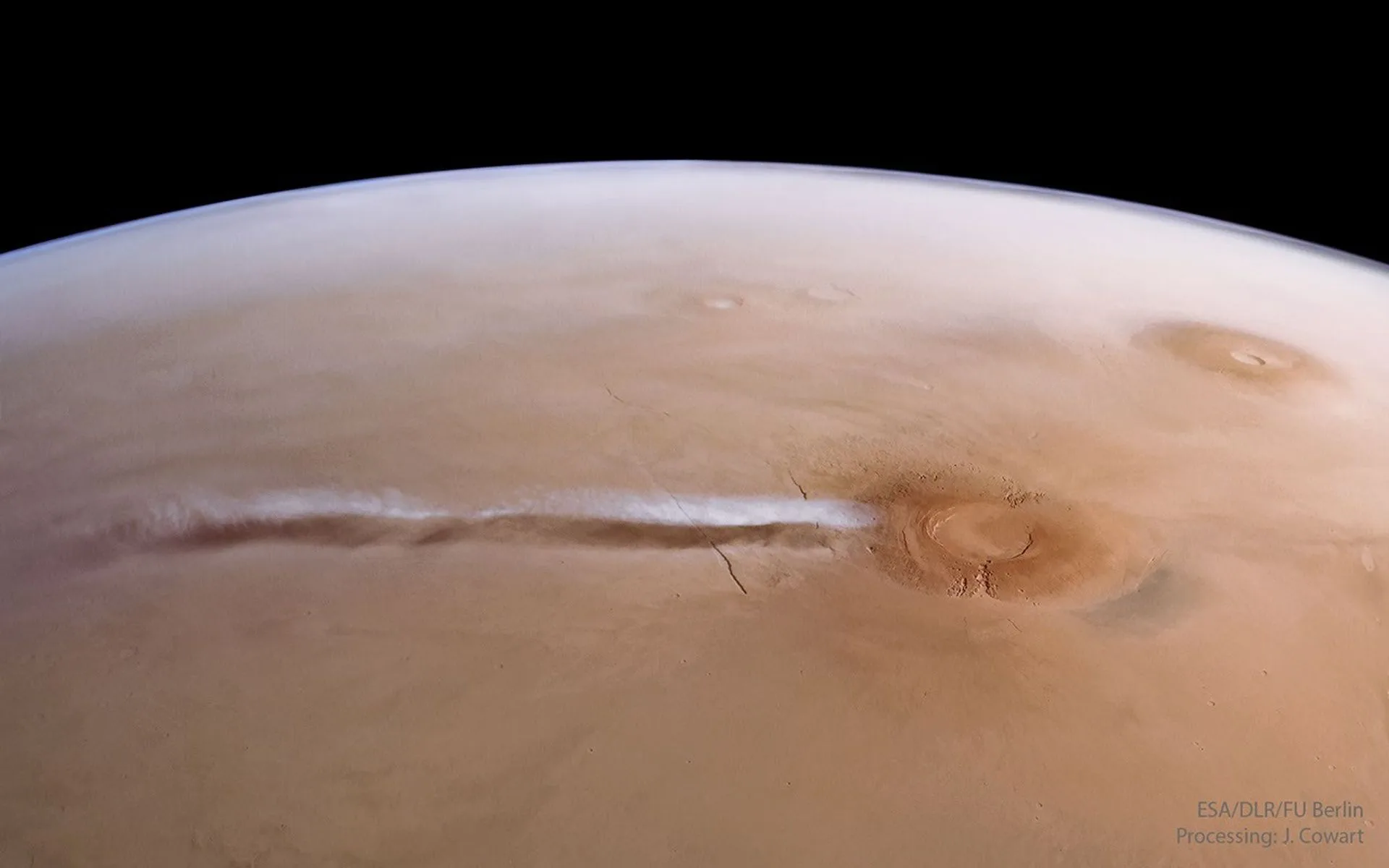
NASA’s Astronomy Picture of the Day entry is brief by design, but the image offers a useful reminder that Mars is not a frozen museum exhibit. It has a working atmosphere, just one far less forgiving than ours.
Why Mars cloud formation happens around volcanoes
On Earth, mountains force winds upward. Rising air expands and cools; if enough moisture is available, droplets or ice crystals form. Mars can pull off a related process, although its clouds are usually made of water-ice crystals in a much thinner, colder atmosphere. A volcano such as Arsia Mons acts as a colossal obstacle in the airflow, lifting air high enough for condensation to occur.
The timing is the clever part. These long clouds often emerge early in the Martian day, when the atmosphere is cool and local circulation is favorable. As the Sun climbs, the conditions change. The plume can weaken, shift, or disappear altogether. A single still image makes it look permanent. It’s closer to a morning fog bank that happens to be attached to a mountain taller than any peak on Earth.
Mars cloud formation also changes with the seasons. Mars has an axial tilt, so it gets seasons much as Earth does, though its more elliptical orbit makes them uneven. Atmospheric water vapor, airborne dust and solar heating all influence whether a cloud can grow. That makes these plumes useful visual markers for scientists studying how the Martian atmosphere behaves over time.
A weather story with mission-level consequences
Mars weather may sound like niche planetary meteorology, but it has direct operational consequences. Every spacecraft headed toward the surface has to contend with an atmosphere that can be calm one day and loaded with dust the next.
Clouds are not the same threat as global dust storms, of course. Yet they belong to the same broader puzzle: how energy, water and particles move through the Martian atmosphere. Better atmospheric models affect entry, descent and landing calculations. They also matter for solar-powered hardware and for any serious plan to put people on Mars for months at a time. Nobody wants to discover a seasonal weather blind spot after launching a multibillion-dollar mission.
There is a persistent temptation to treat Mars imagery as wallpaper. NASA releases so many striking planetary photographs that even genuinely informative scenes can get filed mentally under ‘nice space picture.’ I’d argue the long plume deserves more attention than that. It shows planetary science at its most satisfying: a familiar process, cloud-making, operating under alien conditions at an almost cartoonish scale.
The limits of a beautiful image
A photograph alone cannot settle every question about the plume. To understand Mars cloud formation properly, researchers need repeated observations at different times of day and across multiple seasons, alongside temperature, pressure and dust measurements. Orbiters can supply the broad view; surface missions contribute the close-up weather record. Neither perspective tells the whole story by itself.
There is also a healthy dose of uncertainty in interpreting any one image. A bright feature may include water ice, dust or both, and lighting geometry can exaggerate its apparent thickness. The basic explanation for the recurring volcano-associated plumes is well established, but the exact strength and shape of a given event depends on local conditions that can change fast.
Still, the larger takeaway is hard to miss. Mars remains a world of active systems, even without rivers flowing across its surface or eruptions lighting its horizon. Each new view of Mars cloud formation gives scientists another small dataset — and the rest of us a better reason to stop thinking of the Red Planet as simply red.
As Mars missions become more frequent and their imaging instruments more capable, these dawn plumes could shift from visual curiosities to routine weather records. That’s the direction worth watching: not whether Mars can produce a dramatic cloud, but how much its daily atmosphere still has to teach us before humans arrive and have to live under it.
Frequently Asked Questions
What causes Mars cloud formation near giant volcanoes?
Clouds near Mars’s giant volcanoes usually form when air is pushed upward along a mountain slope, cools, and condenses into water-ice particles. The process is especially common around dawn during the right seasonal conditions, when temperatures and atmospheric moisture align.
Is a long cloud on Mars evidence of a volcanic eruption?
Usually, no. A long bright plume extending from a Martian volcano can look like an eruption from orbit, but it is generally a water-ice cloud shaped by wind and terrain. Mars’s massive extinct volcanoes still strongly influence local weather despite their lack of current eruptions.
How long can a Mars cloud formation event last?
These events can develop and change quickly as sunlight warms the surface and shifts local air circulation. Some elongated clouds recur over many mornings during a season, while an individual plume may fade as the atmosphere warms and the water-ice particles disperse.