

- Moon colors are largely produced by Earth’s atmosphere, which filters and scatters sunlight before it reaches an observer.
- A decade-long Italian astrophotography collection shows Moon colors ranging from horizon red and yellow to rare atmospheric blue.
- The red Moon seen during a total lunar eclipse is sunlight bent through Earth’s atmosphere into the planet’s shadow.
- Purple lunar appearances remain harder to explain and may result from several atmospheric and photographic effects combined.
Table of Contents
Moon colors are a view through Earth’s atmosphere
The Moon is usually sold to us as silver, white, or perhaps the color of a late-night streetlamp. In reality, Moon colors are far more variable, and NASA’s Astronomy Picture of the Day is a useful reminder that the most dramatic changes often happen much closer to home than the lunar surface itself: in the air between your eyes and the sky.
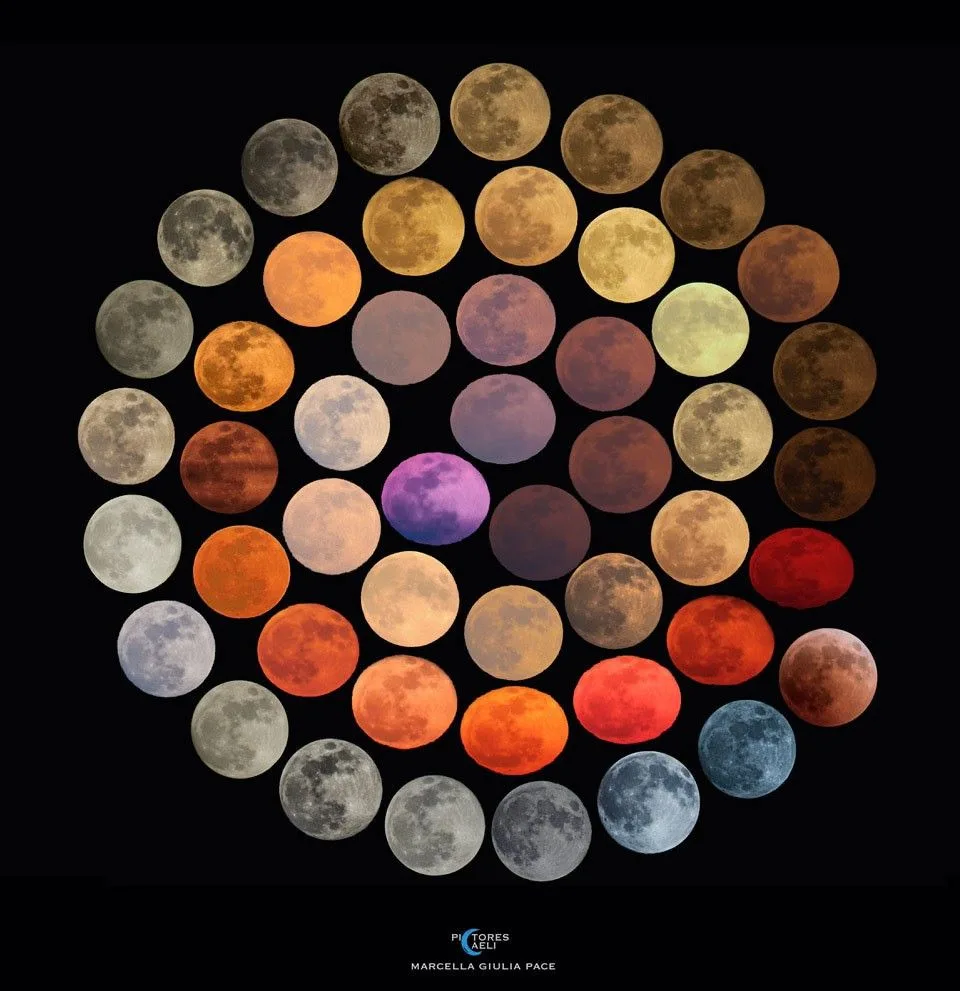
The featured composite gathers full-Moon photographs made over roughly 10 years from locations across Italy. Arranged together, the images make the point instantly. One Moon is ochre, another looks rusty red, another carries a pale yellow cast, and one appears blue. There is even a purple entry, which NASA says has no settled explanation. It’s the sort of image that makes a familiar object suddenly feel less settled — like noticing your kitchen wall is a different color at sunset.
NASA’s explanation starts with a simple fact. Outside Earth’s atmosphere, the lunar surface, lit by reflected sunlight, looks brownish gray. The colors people see from the ground are largely a product of atmospheric filtering, suspended particles, viewing angle, and, in a few cases, camera processing choices. That last caveat matters. Astrophotography can faithfully reveal faint differences our eyes miss, but a heavily edited image can also turn a modest tint into a social-media spectacle.
The core phenomenon, though, is real. Moon colors are a small, accessible demonstration of atmospheric physics that anyone can catch from a balcony, a city sidewalk, or a dark field with no telescope required.
Why the horizon turns the Moon red or yellow
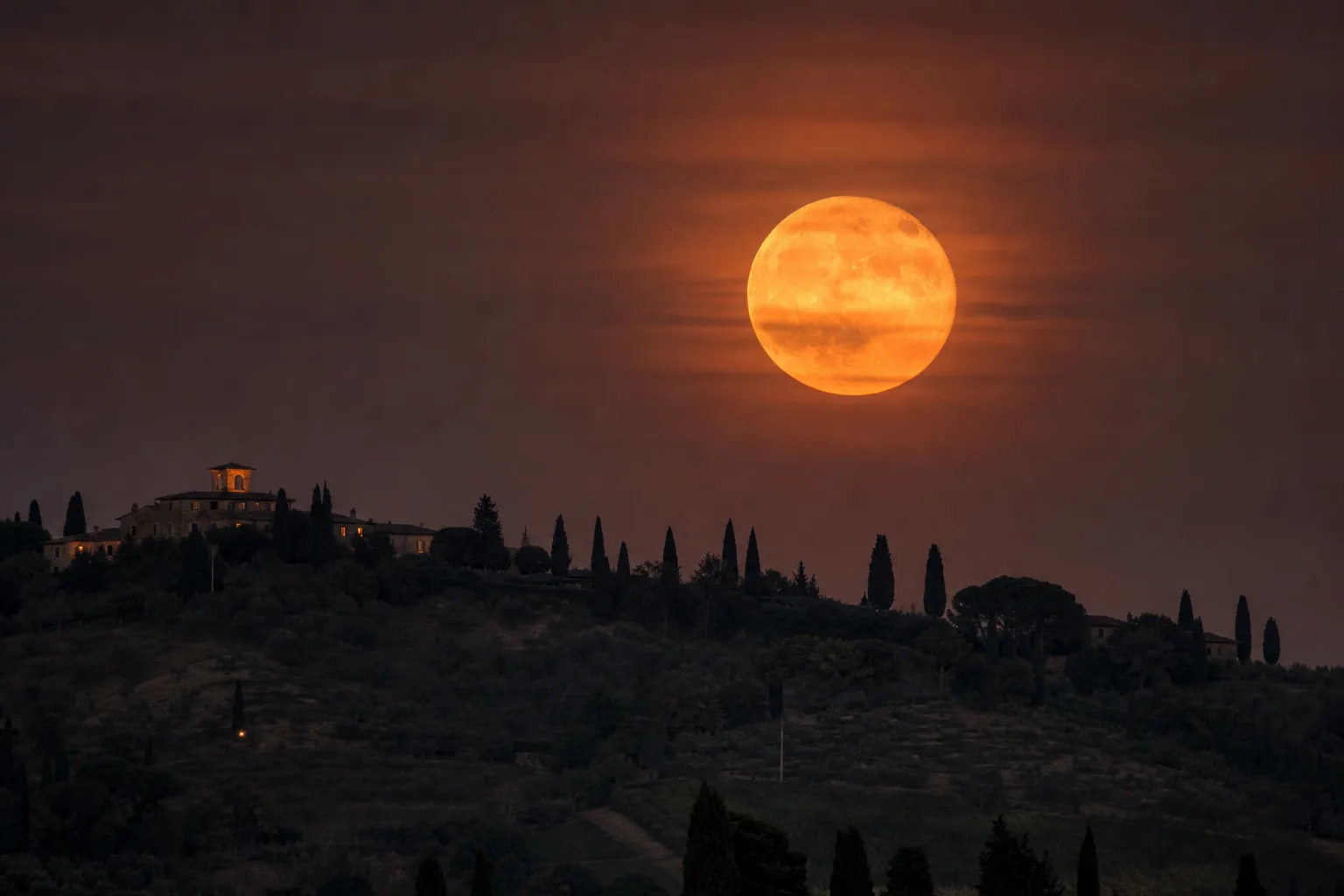
When the full Moon sits low over the horizon, its light must cross a thicker slice of the atmosphere than it does when the Moon is overhead. Shorter blue wavelengths scatter readily through that long path, leaving more of the yellow, orange, and red wavelengths to continue toward an observer. It is the same broad mechanism behind a red sunset, although the geometry is reversed: you are looking at sunlight reflected off the Moon rather than straight at the Sun.
Dust, haze, pollution, smoke, and moisture can intensify the effect. That’s why Moon colors often become more memorable after a distant wildfire season, a dust event, or a particularly hazy summer evening. It’s also why two people separated by a few miles can report noticeably different views. The atmosphere is not a uniform glass dome; it’s a messy, moving soup.
The low Moon can also look enormous, although that part is a perceptual trick rather than a physical enlargement. The well-known Moon illusion makes the horizon Moon seem bigger when it has buildings, trees, hills, or other familiar objects nearby for scale. Add warm atmospheric color to that optical brain glitch and you get one of astronomy’s most reliable crowd-pleasers.
Moon colors get stranger when particles get larger
A blue Moon in the visual sense is rare. And no, it has nothing to do with the calendar phrase for a second full Moon in a month. NASA points instead to larger dust particles in the atmosphere, which can preferentially remove enough red light to give the Moon a bluish cast.
That can happen after volcanic eruptions or amid smoke and dust conditions, though the exact look depends on particle size, concentration, local weather, and how much of the Moon’s light survives the trip. Aerosols from fires, dust storms, and volcanoes affect the color and clarity of skies around the world. A blue-looking Moon is basically an atmospheric incident report written in light.
The purple Moon in NASA’s collection is more intriguing precisely because the agency does not pretend to have a crisp one-line answer. Its account suggests a combination of effects may be at work. That restraint is welcome. Space photography has a bad habit of being packaged as certainty even when an image is really the result of variable weather, optics, exposure settings, white balance, and a little luck.
For people trying to photograph unusual Moon colors, a phone’s automatic image processing is another wrinkle. Modern smartphones routinely adjust white balance, contrast, and saturation before you ever tap the shutter. The result can look closer to what you felt you saw than what a calibrated instrument measured. Those are not always the same thing.
The eclipse Moon is red for a different reason
The final frame in the collection comes from the total lunar eclipse of July 2018, when the Moon passed fully through Earth’s shadow. This familiar “blood Moon” appearance has a related but distinct cause. Direct sunlight is blocked, yet some light skims through the ring of Earth’s atmosphere and is refracted, or bent, into the shadow. By the time it reaches the Moon, much of the blue light has been scattered away.
The effect is a faint red or copper lunar disk, and it can vary significantly from eclipse to eclipse. A cleaner atmosphere can produce a brighter, more orange-red Moon; extra dust or aerosols can leave it darker and browner. In that sense, eclipse Moon colors are not merely pretty. They contain clues about the state of Earth’s atmosphere across the planet’s day-night boundary.
NASA’s daily image project earns its keep through that deceptively simple format: one arresting image and a compact explanation. Astronomy Picture of the Day has spent decades using it to bridge planetary science, optics, orbital mechanics, and plain old curiosity. NASA’s broader image archive spans operational work as well, from Hubble’s future servicing questions to Mars geology, but the Moon is still the agency’s best reminder that scientific observation begins with looking carefully.
What to watch for on the next clear night
If you want to see shifting Moon colors yourself, start near moonrise or moonset. Check the local horizon, not just the forecast: haze or thin clouds may ruin a deep-sky observing session but can make lunar color more obvious. Give your eyes time, compare the Moon against nearby clouds, and resist assuming that every bold photo online represents an unedited view.
A binocular view can reveal lunar terrain beautifully, but it will not manufacture a red or blue Moon. Those colors are generally about the journey light takes through the atmosphere. A camera on manual settings can help document what you see; just record the exposure and white-balance settings if you want the picture to mean anything beyond a nice post.
My read is that this is the quiet appeal of NASA’s collection. It doesn’t need a new rocket, a billion-dollar observatory, or a breathless claim about an Earth-like exoplanet. Moon colors turn the world’s most familiar celestial object into a changing display of the atmosphere we live under — and the next unusual one may be waiting at tonight’s horizon.
Frequently Asked Questions
Why do Moon colors change during the night?
Moon colors change mainly because the Moon’s light travels through different amounts of Earth’s atmosphere. Near the horizon, that path is much longer, allowing more blue light to scatter away and leaving warmer yellow, orange, or red tones visible.
What causes a blue Moon appearance?
A genuinely blue-looking Moon can occur when unusually large particles in the atmosphere scatter red light more effectively than normal. Volcanic ash, wildfire smoke, or fine dust can create the right conditions, though the effect is uncommon and usually subtle.
Why are Moon colors red during a lunar eclipse?
During a total lunar eclipse, Earth blocks direct sunlight from reaching the Moon. Some sunlight passes through the planet’s atmosphere, bends into Earth’s shadow, and arrives stripped of much of its blue light, giving the lunar surface a dim coppery red appearance.