


- Microsoft Perception uses four agents to translate ARTEX threat reporting into exposure checks, detection proposals, and remediation priorities.
- Microsoft Perception was tested in a simulated enterprise environment, so Microsoft’s findings do not establish production-world performance.
- ARTEX combines familiar offensive tools with autonomous planning, potentially compressing attack reconnaissance and exploitation into machine-speed workflows.
- Microsoft has not disclosed Microsoft Perception pricing, general availability, supported licensing tiers, or independent validation of its agent outputs.
Table of Contents
Microsoft Perception confronts a new kind of attack tempo
The unsettling part of ARTEX is not that it invented new hacking techniques. It didn’t. The concern is the pace: an AI-directed framework that can string together scanning, exploitation, credential attacks, and data collection without waiting for an operator to decide every next step. Microsoft Perception is Microsoft’s answer to that operational problem, at least in the company’s latest demonstration.
In a detailed Microsoft post, the company said its multi-agent security system can take a threat report as its starting point, assess an organization’s likely exposure, draft detections, and prioritize the configuration or vulnerability work that deserves attention first. The basic idea is practical: turn intelligence that normally sits in a report into a repeatable defensive workflow.
That’s a sensible target. Security teams are drowning in reports, indicators, and alerts, while many basic internet-facing mistakes remain stubbornly common. A detailed write-up explaining an attacker’s methods is useful, but it doesn’t tell a particular bank, software vendor, or retailer whether its own environment has the same open door. Closing that gap often means separate teams doing separate jobs, usually under pressure.
ARTEX changes the urgency because it automates the early stages of that work for attackers. Microsoft says the framework moved from an open-source GitHub project to a usable attack tool within weeks, using a planning agent to direct worker agents and conventional utilities such as nmap, curl, and Impacket. The tools are familiar; the orchestration is the story.
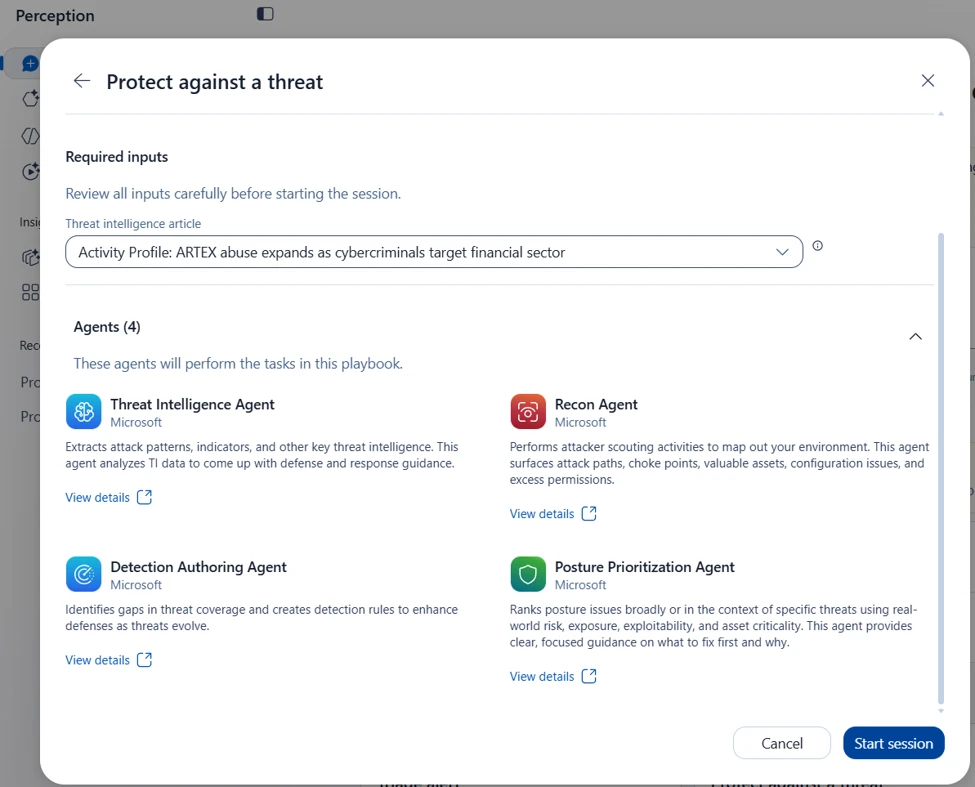
How Microsoft Perception turns a report into a workflow
Microsoft Perception’s Protect against a threat playbook accepts a single input: either a Microsoft Defender threat report selected from a menu or a pasted article URL. From there, four agents divide the work. The Threat Intelligence Agent extracts actors, indicators, malware, vulnerabilities, and tactics. Recon looks for relevant exposure. Detection Authoring proposes monitoring rules. Posture Prioritization sorts the resulting risks into an order a security team can act on.
Put less ceremoniously, Microsoft is trying to build a security operations assembly line. A human analyst still needs to inspect the result, decide what is real, and make changes. But the system is meant to avoid the repetitive first pass of translating prose into queries, asset lists, and ticket-worthy problems.
The company ran the workflow against two ARTEX-related sources: a Defender Activity Profile concerning financial-sector targeting and a Wiz Research report focused on IT and software vendors. That second source matters because it suggests Microsoft Perception is not limited to Microsoft-authored intelligence. In practice, the quality of an outside article will heavily shape the output. An agent cannot extract indicators or techniques that a thin, vague report never supplies.
Microsoft’s account also contains a naming wrinkle. The post’s opening references Storm-0940, while its detailed Defender scenario identifies Storm-3358, a financially motivated Cambodia-based cluster. Threat-actor labels are often provisional, overlapping, and vendor-specific, but readers should not mistake these identifiers for a settled, universal taxonomy.
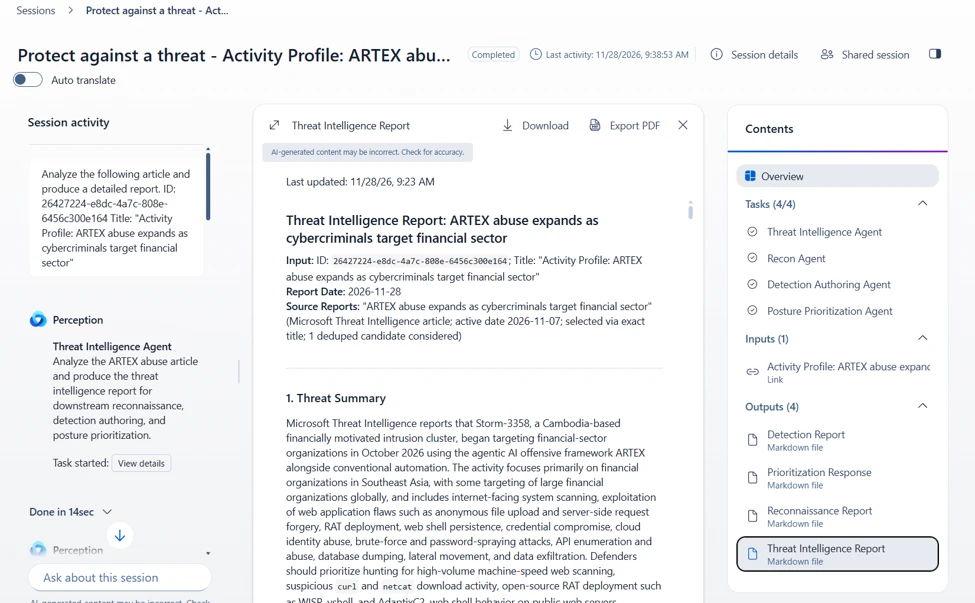
What the ARTEX simulation actually found
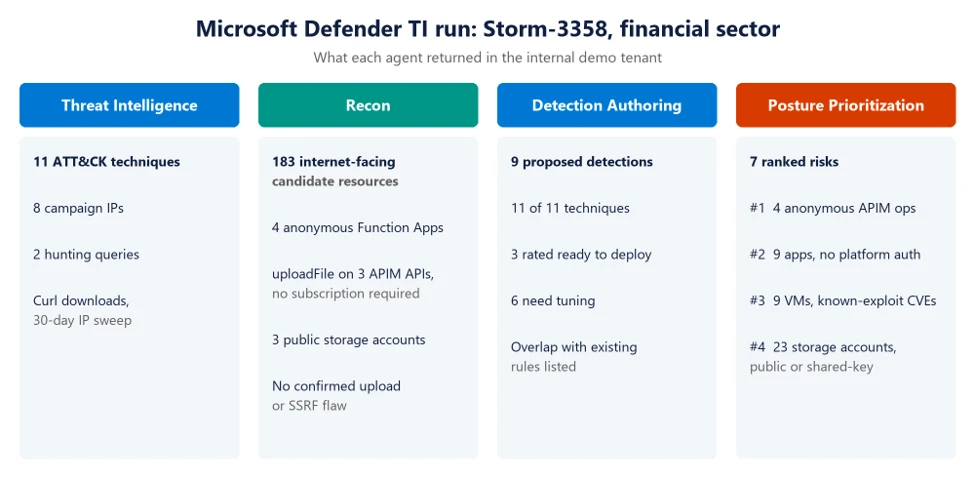
In Microsoft’s Defender-based simulation, the Threat Intelligence Agent mapped 11 MITRE ATT&CK techniques and extracted eight campaign IP addresses. The scenario described ARTEX scanning public web applications for anonymous file-upload and server-side request forgery flaws, then using tools including curl and netcat to retrieve web shells or remote-access malware. Password spraying, API enumeration, database dumping, and data theft were also part of the modeled behavior.
Recon then identified 183 internet-facing candidate resources in Microsoft’s demonstration tenant. That number sounds dramatic, but it needs a large asterisk. Configuration records can show a public endpoint, anonymous API operation, or storage container; they cannot by themselves prove a specific upload or SSRF vulnerability is exploitable. Microsoft says its agent explicitly acknowledged that limit, which is exactly the restraint one would want from this kind of system.
Among the items flagged were four Azure Function Apps accepting anonymous HTTP calls, including one route called “upload-screenshot”; API Management upload operations that did not require subscriptions; and public storage containers with names including “financials” and “staging.” The posture agent also highlighted anonymous API operations, applications without platform authentication, internet-reachable virtual machines carrying high or critical known-exploited CVEs, and storage accounts permitting public or shared-key access.
Those are not exotic failures. They’re the sort of neglected lock, side entrance, and spare key that attackers have always looked for. ARTEX’s apparent value to criminals is that it can check more doors, more quickly, and keep going when a human operator would need sleep, context, or a fresh coffee.
Detection proposals are useful, but not proof
The detection agent suggested nine rules covering the 11 techniques in the Defender scenario. Microsoft classified three as ready for deployment: alerts for a web server launching a shell, executable files written into web roots, and a password spray followed by a successful sign-in. The remaining six required tuning.
That distinction is more meaningful than a long list of shiny detections. A detection that fires constantly becomes background noise; one that never fires may provide false reassurance. Microsoft says the simulated tenant lacked the baseline needed to measure alert noise, so its readiness labels were estimates rather than a demonstration of detection quality in a live organization.
Security teams should treat this as an analyst accelerator, not an oracle. The best proposals are behavior-based, which makes sense because ARTEX can direct common utilities rather than rely on a single distinctive malware signature. Microsoft’s approach resembles the direction security operations has been moving for years: detect suspicious combinations of activity, not merely a known bad filename or IP address. The MITRE ATT&CK framework remains useful precisely because it gives defenders a shared language for those behaviors.
The unanswered questions around Microsoft Perception
Microsoft’s post demonstrates a plausible workflow, but it is still a vendor-run simulation built to represent a typical enterprise. It is not evidence of how Microsoft Perception will behave amid the messy realities of a production network: incomplete inventory, shadow IT, conflicting policies, custom applications, and a SOC already overloaded with alerts.
Just as significant, the announcement does not specify general availability, pricing, licensing requirements, supported environments, or how much human approval is required before recommendations become operational changes. It also does not provide independent accuracy results, false-positive rates, or timings for the four-agent workflow. Those details will determine whether this becomes a serious operational tool or another promising dashboard feature.
Still, the premise is hard to dismiss. If attackers can use agents to collapse reconnaissance and exploitation into one continuous loop, defenders need ways to collapse intelligence, validation, detection, and remediation into their own loop. Microsoft Perception may be an early attempt at that. The real test is whether it can reduce the work without creating a new pile of AI-generated work for already stretched security teams to verify.