


- Walmart AI shopping will let Meta Muse users search Black Friday deals, compare products, and build purchases through conversational prompts.
- The Walmart AI shopping rollout uses Agent Gateway, a platform designed to let outside assistants connect directly with Walmart’s digital storefront.
- Walmart says Muse cannot view customers’ retail histories and offers spending caps, approval requirements, and order review controls.
- The partnership sharpens Walmart’s contrast with Amazon, which has been more cautious about third-party agents completing purchases.
Table of Contents
Black Friday becomes a test bed for Walmart AI shopping
Walmart AI shopping is moving from a feature demo to one of retail’s most demanding real-world environments: Black Friday. Walmart is partnering with Meta to put its deals inside Muse, Meta’s AI agent, allowing customers to ask for products, compare options, and assemble orders without starting on Walmart’s own site.
According to TechCrunch, the process starts with a user opening Muse, signing into a Walmart account, then returning to the assistant with a request. Muse passes that request to Walmart, which supplies relevant products and helps form the cart. On paper, that sounds straightforward. In practice, Black Friday is where the messy bits live: inventory changes by the minute, product variants are confusing, and a cheap-looking deal can conceal a bad return policy or a third-party seller.
The timing matters because Black Friday exposes the gap between finding a product and making a good purchase. Walmart AI shopping has spent the past couple of years being framed as an inevitable convenience, like autofill for commerce. But a good agent has to do more than find a link. It has to understand that somebody asking for a television under $500 may care about screen size, local delivery, gaming features, mounting costs, or whether the “deal” is actually discounted from a credible prior price.

Walmart is betting that consumers will accept an assistant sitting between them and the storefront if it gets them to the right purchase faster. I’d argue the retailer is also making a more strategic bet: the storefront itself may no longer be the main front door to online retail.
How Walmart AI shopping differs from Amazon’s approach
The timing puts Walmart in useful contrast with Amazon. Amazon has pushed hard into its own AI features, including its Rufus shopping assistant, but it has also resisted third-party agents making purchases on behalf of customers. That distinction may sound technical. It is not.
When a retailer controls the shopping interface, it controls product ranking, advertising placements, subscriptions, recommendations, and the fine print that surrounds checkout. Let an outside agent become the interface and some of that control shifts. The retailer may still own inventory and fulfillment, but it risks becoming the warehouse behind somebody else’s conversational layer.
For Walmart AI shopping, that trade-off looks intentional. Its newly launched Agent Gateway is meant to provide a direct connection between external AI assistants and Walmart’s commerce systems. Walmart says it intends to make the gateway available to additional developers and AI platforms, suggesting Muse is a starting point rather than an exclusive destination.
That could make Walmart an unusually open retailer in a market where companies are still deciding whether agents are partners, pests, or both. An agent gateway turns that philosophy into infrastructure.
There is a catch, though. Openness only works if the retailer can preserve accurate pricing, availability, identity checks, and service quality across every assistant that plugs in. A shopper will blame Walmart when an order is wrong, even if the bad interpretation came from an outside model. Nobody says, ‘Well, the protocol layer had a rough day,’ after the wrong air fryer arrives.
Consumer controls are the part that cannot be optional
Walmart says Meta’s Muse will not receive a customer’s Walmart shopping history or other personal information. Users can set spending limits, require approval before a transaction, review purchases made by the agent, and delete the agent profile. Those are sensible guardrails, and frankly they should be table stakes for any system authorized to spend money.
Still, privacy in agent commerce is more complicated than whether an assistant can see a past order list. A prompt such as ‘find gluten-free snacks for my child’s school trip’ can reveal plenty on its own. So can recurring requests for medical supplies, baby products, or low-cost essentials. The relevant question is not simply what data is shared, but how prompts, product selections, payment permissions, and inferred preferences are retained and used.
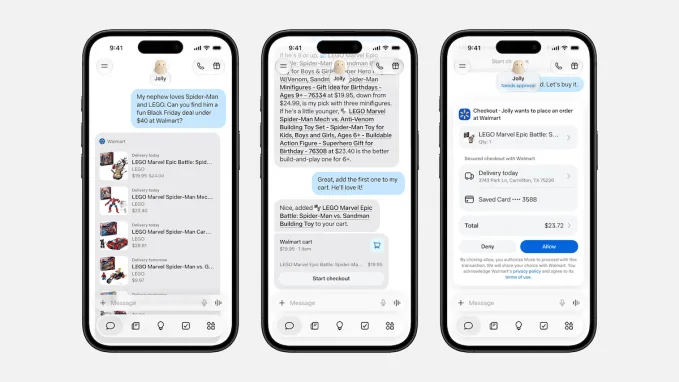
Walmart AI shopping will also need to establish what ‘approval’ means in practice. Is the agent permitted to substitute a comparable item if stock disappears? Can it split a cart between shipping and local pickup? Does a spending cap include delivery fees, tax, or a Walmart+ membership charge? These are ordinary checkout details, but autonomous systems have a talent for making ordinary details suddenly very consequential.
Meta and Walmart have not presented this as a fully autonomous purchasing free-for-all, and that restraint is wise. The better early model is probably supervised delegation: let the agent research, filter, organize, and prepare a cart, while the human remains one tap away from the final decision. Automation is useful. Surprise charges are not.
Sparky shows Walmart is building on two fronts
The Meta arrangement is only one piece of Walmart’s broader AI push. Its in-house assistant, Sparky, has gained tools to convert handwritten shopping lists into carts, search through photos and voice requests, and help customers locate items in a local store. Walmart also offers an aisle map and a ‘Flash Price Tag’ feature intended to illuminate the shelf label for a selected product.
That physical-store angle may be more important than the Muse announcement initially suggests. Walmart’s advantage over pure e-commerce rivals is not merely its catalog. It has thousands of locations, grocery operations, pickup capacity, and an enormous stream of shoppers who still need to find detergent in aisle 12 rather than summon it from a browser tab. A capable assistant that works before, during, and after a store visit could connect those worlds in a way that a chat window alone cannot.
But Walmart AI shopping will not improve the experience simply by adding a conversational interface. Retail search already has a trust problem: sponsored placement can overwhelm relevance, marketplace listings can be inconsistent, and product comparisons often flatten meaningful differences into a handful of checkboxes. If Muse becomes another route to the same promotional clutter, consumers will notice.
The more interesting possibility is that Walmart uses Agent Gateway to set practical rules for agent commerce before competitors do. Clear permissions, reliable catalog data, transparent substitutions, and a checkout record that a human can audit would be a strong foundation for Walmart AI shopping. Black Friday will offer a loud, chaotic first test. If the system handles that without turning bargain hunting into a customer-support nightmare, Walmart may have found a credible path for AI agents to earn a place in retail.