

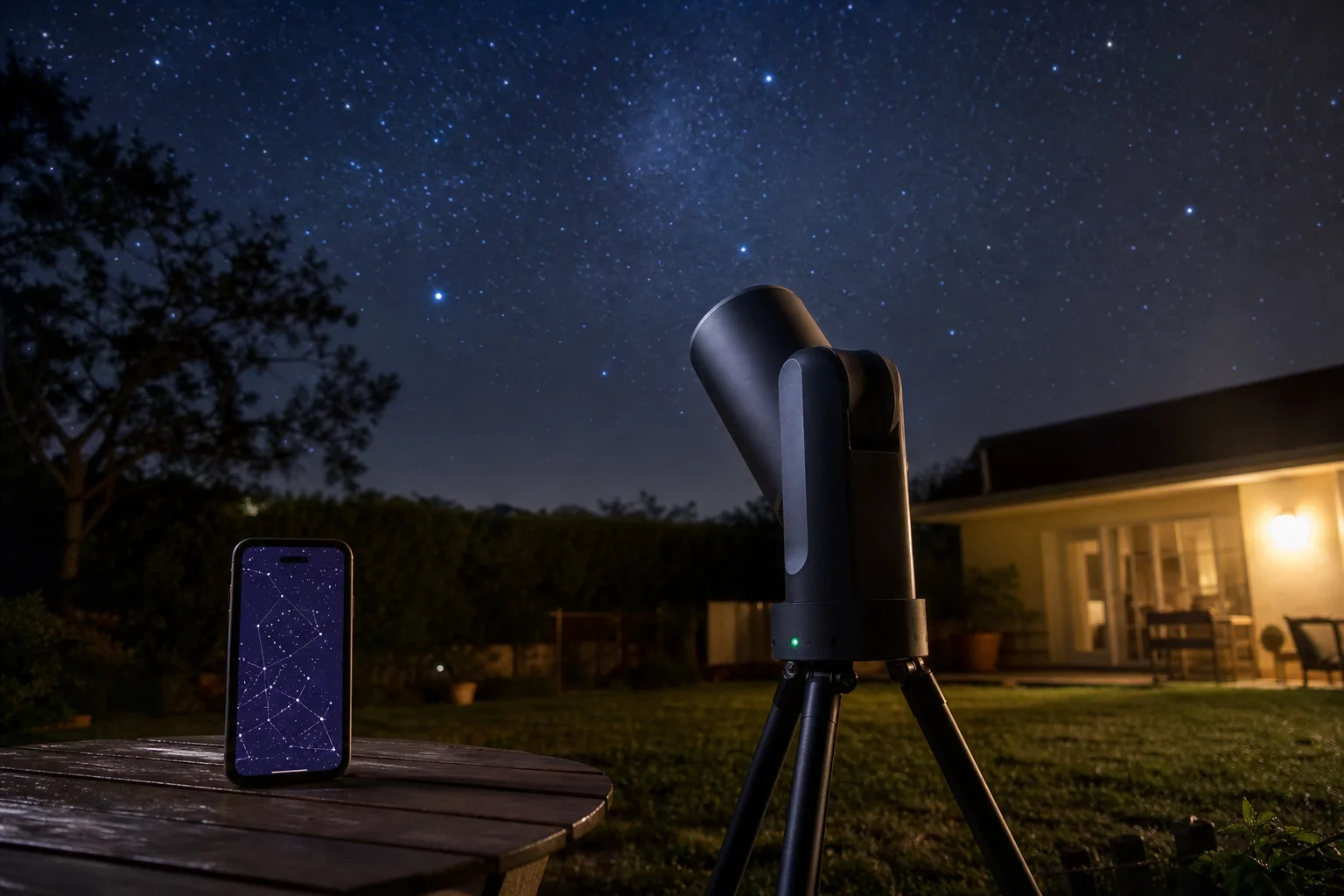
- Black Friday telescope deals can be worthwhile, but a large percentage discount says little about whether a device suits your sky and budget.
- The strongest Black Friday telescope deals target smart scopes, binoculars, cameras and accessories rather than one universal stargazing starter kit.
- Smart telescopes reduce setup friction, but they bring apps, subscriptions, processing and battery management into what was once a simple hobby.
- Buyers should verify historical pricing, return policies and included accessories before Cyber Monday urgency turns a discount into an expensive compromise.
Table of Contents
Black Friday telescope deals are not all created equal
The danger with Black Friday telescope deals is not that the discounts are imaginary. Some are very real. The problem is that astronomy gear is unusually easy to buy for the wrong reason: a huge percentage badge, a dramatic product photo, or the seductive promise that an app can turn a suburban backyard into an observatory. As Space reported, the remaining seasonal offers span premium smart telescopes, compact imaging scopes, binoculars, cameras, projectors, drones and sci-fi merchandise.
That breadth matters. A deal roundup may put a Unistellar smart telescope next to a Disney and Hulu streaming bundle, but those purchases solve wildly different problems. One is a serious investment in a hobby with a learning curve; the other is a low-commitment subscription discount. Treating both as equally urgent is how shoppers end up with a box in the closet and a faint sense of buyer’s remorse by January.
For prospective stargazers, the best Black Friday telescope deals are the ones that match the practical reality of where and how they will observe. Someone in a city apartment may get more actual use from a small automated telescope or a quality pair of 12×56 binoculars than from a larger conventional scope that needs careful alignment, a stable mount and a trip away from streetlights. Astronomy remains gloriously resistant to marketing. Clouds do not care what you paid.

Smart scopes are selling convenience, not magic
The headline hardware in the reported sale list is Unistellar’s top-tier smart telescope, discounted by $1,000. Space highlighted its 7.7-megapixel camera, 4.5-inch aperture and the unusual inclusion of an eyepiece, a nod to people who want digital assistance without giving up the old-fashioned act of looking through an optical instrument.
That hybrid approach gets at the central trade-off in this category. Smart telescopes use motors, sensors and software to find objects, track them and stack multiple exposures into a brighter image. For a newcomer, that can remove the most intimidating parts of astrophotography: polar alignment, hunting for faint targets and learning several specialist software packages. The Unistellar site has the company’s product details.
But convenience has a cost beyond the retail price. You are buying into an app, firmware updates, a battery, a phone or tablet workflow and, potentially, a company’s longer-term support decisions. Remember when Google killed Stadia? A telescope is not a cloud gaming service, obviously, but connected hardware deserves the same basic question: what remains useful if the software experience changes?
The Dwarflab Dwarf Mini represents the other end of the smart-scope pitch: small, portable and comparatively accessible. Space described it as a backpack-friendly route into astrophotography and said an offer on the model was nearing its allocation limit. These kinds of Black Friday telescope deals appeal because they lower the barrier to entry, particularly for people who care more about sharing a processed image of the Orion Nebula than mastering a manual equatorial mount.
Frankly, that is a perfectly legitimate way to do astronomy. The purist argument that every beginner must learn every mechanical step first has never made much sense. Still, buyers should be clear-eyed about what software-assisted astronomy delivers: a more guided imaging experience, not a personal Hubble.
Binoculars may be the sensible purchase nobody brags about
Among the flashier products, Space also pointed to Celestron’s Nature DX 12×56 binoculars. It is an easy item to overlook, which is precisely why it may be one of the more rational picks in the wider batch of Black Friday telescope deals. Binoculars work immediately. No app pairing. No mount. No calibration ritual while your viewing window disappears behind a cloud bank.
A 56mm objective lens can gather enough light to make the Moon, star fields and brighter deep-sky targets more engaging than many people expect, provided the observer can hold 12x magnification steadily. They also remain useful in daylight for wildlife and travel. That versatility is not glamorous, but it is valuable. A product that works in several parts of your life tends to escape the closet.
There is a similar lesson in the sale’s Nikon Z8 camera and DJI Mavic 4 Pro drone references. Both are premium tools, and neither should be bought merely because the discount number looks impressive. The Nikon may be a compelling purchase for a photographer who already has compatible lenses and a real shooting need. The drone’s claimed 100MP imaging and up-to-6K video specifications will matter to a creator with legal places to fly and a workflow that can handle enormous files. For everybody else, a lower-tier product might be the smarter option.
A good deal is not a coupon. It is a fit.
Check the bundle, the return window and the hidden requirements
Seasonal promotion pages encourage speed, and sometimes stock genuinely is limited. Space cited a rapidly claimed Dwarf Mini offer, while Cyber Monday timing naturally adds pressure. Yet buyers should slow down just long enough to inspect the dull details. With Black Friday telescope deals, that means confirming whether a tripod, storage, filters, power adapter or carrying case is included. A discounted optical tube can become much less affordable once the necessary extras hit the cart.
For smart telescopes, look for device compatibility and check whether core features require an internet connection at setup. Read the return policy before opening anything, particularly if the purchase is intended as a gift. When comparing Black Friday telescope deals, check the retailer’s price against the manufacturer’s own store and at least one established specialist. Some promotions are true reductions; others are bundles that only look cheaper because the comparison price is inflated or vague.
The same skepticism applies to fun adjacent purchases. A Pococo Galaxy Projector may be a more educational living-room device than a basic laser projector because it uses image discs rather than generic dots, but it is not astronomy equipment. Lego’s Project Hail Mary set and a Baylan Skoll lightsaber are, obviously, fandom purchases. Nothing wrong with that. Just do not let a page of telescope offers persuade you that a collectible is somehow an investment in science.
The real opportunity is getting people outside
There is a positive case for this entire category. A smart telescope that gets a teenager observing Jupiter, a reliable pair of binoculars that lives by the door, or a camera that motivates someone to learn the night sky can all be better purchases than another generic gadget. The strongest Black Friday telescope deals make that first step less financially painful.
Still, the industry should resist the temptation to present astronomy as an instant-content machine. The best nights involve patience, changing conditions and a little wonder that refuses to be optimized. If a discounted smart scope gets more people looking up, great. But the bigger question is whether manufacturers can keep their software, accessories and support trustworthy enough that those buyers are still looking up years from now.
Frequently Asked Questions
Are Black Friday telescope deals actually cheaper than Cyber Monday offers?
They can be, but there is no universal rule. Retailers often extend the same promotion across the weekend, alter bundles, or reserve limited stock for Cyber Monday. Check the specific model’s price history and compare the included accessories, rather than assuming a later date will produce a better deal.
What should beginners look for in a smart telescope?
Beginners should focus on portability, guided setup, battery life, app compatibility and the kinds of objects they want to photograph. A smart telescope can simplify locating targets and image processing, but it cannot remove the effects of clouds, poor local viewing conditions or heavy light pollution.
Do larger telescope apertures always produce better astronomy images?
A larger aperture gathers more light, which can help reveal faint targets, but it is only one part of the equation. Mount stability, tracking accuracy, camera quality, local sky conditions and image processing often matter just as much for practical astrophotography results.