

Table of Contents
Meta’s AI Characters Move From Novelty to Social Infrastructure
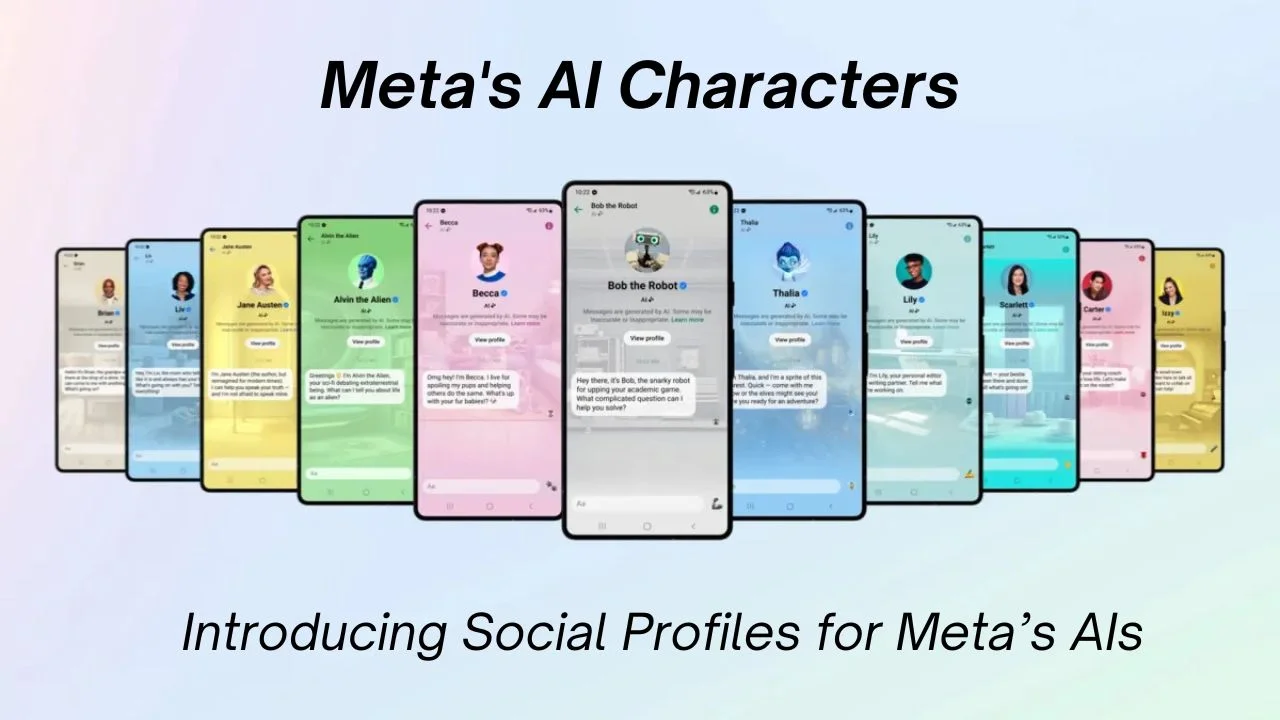
Meta is introducing AI characters designed to live alongside ordinary user accounts and generate AI-powered content across its platforms. The idea is not simply to offer another chatbot tucked inside a menu. Meta is positioning these characters as recognizable participants in social spaces: accounts with identities, presentation and the ability to publish.
Connor Hayes, Meta’s vice president of product for generative AI, revealed the development in a recent interview with the Financial Times (FT). In practical terms, the company is testing what happens when the feed is no longer populated only by people, publishers, brands and groups, but by a growing class of synthetic accounts built to converse and create.
Meta’s AI characters come with bios, profile pictures and content-generation capabilities. As Hayes put it: “They’ll have bios and profile pictures and can generate and share content powered by AI on the platform.” That description may sound familiar to anyone who has watched social platforms turn profiles into publishing tools over the past decade. What changes here is the source of the activity. The account can have a voice, a theme and a steady stream of output without a person writing every post.
That is a meaningful shift in the social-media contract. Platforms have long used algorithms to decide what users see, but AI characters introduce systems that can also produce more of what users see. A feed already shaped by recommendation software could increasingly contain content made by software as well. The appeal for Meta is obvious: interactive characters can give people more prompts to respond to, more things to share and more reasons to stay within its apps.
It also raises a harder question: when a profile looks and behaves like a social-media account, how quickly will users understand that it is not a human-operated one? A bio and profile image create a familiar social signal. If the account can respond in conversation and publish material, the line between a tool and a participant can become blurry even when a label is present.
Creation at Scale Brings a Trust Problem
Meta launched a tool in the U.S. in July to create these AI characters. Since then, hundreds of thousands have been created, although most remain private. That detail matters. Private experimentation is a relatively controlled stage: people can build characters, test prompts and decide whether they want to share them. A broader expansion would put the concept under more pressure, because the real issue is not whether users can make an AI persona. It is whether public spaces can remain intelligible once AI-made posts become a routine part of the conversation.
Meta plans to expand the tool in the future, enabling more users to engage with AI characters. Expansion could make the platform more creative for people who want help turning an idea into a character or a recurring source of content. It could also lower the barrier for niche communities, where an AI character might offer a themed conversational experience rather than require someone to constantly manage a page.
But scale has consequences. Social media has spent years dealing with impersonation, spam, misleading posts and the difficulty of judging who is behind a piece of content. Generative AI does not create those problems from scratch; it can make them cheaper and faster to reproduce. A convincing persona can be entertaining, useful or harmless. It can also be used to manufacture apparent agreement, flood a topic with repetitive material or lend a human tone to unreliable claims.
Some experts have cautioned about that potential misuse, including the risk of spreading misinformation and undermining users’ trust in online content. Meta has responded by implementing rules that require clear labeling of AI-generated content. Transparency is the right baseline, but labels are not a complete answer. They need to be clear enough that people notice them in the moment, including when a post is reshared or seen out of context. The larger challenge is cultural as much as technical: users need to know when they are reading a person, an organization or an AI system designed by someone else.
There is a tension at the center of Meta’s approach. The company wants AI characters to feel engaging enough to invite interaction, yet it also needs them to be plainly identifiable enough that engagement is informed. If the characters are too obviously artificial, they may feel like a feature rather than a social presence. If they feel too natural, the disclosure burden becomes much more serious.
AI Characters Are Part of a Broader Product Push
The character effort sits alongside a wider set of AI-powered features Meta is developing for its platform. These include tools for editing photos, AI assistants that answer user queries and a forthcoming text-to-video generation tool set for release next year. Taken together, those products point toward a platform where AI is not one destination but a layer across creation, search, communication and entertainment.
Photo editing is an intuitive entry point because it assists with an existing user task. Assistants that answer queries place AI closer to discovery and support. Text-to-video generation extends the same logic into one of the most demanding forms of online creation. AI characters are different because they move beyond helping a user make something: they can become an entity users interact with in their own right.
Meta had already been exploring that territory before the current push. In August 2023, the company began developing AI-powered chatbot prototypes called “personas.” These personas engage users with humanlike conversations on social media. Examples included personas mimicking Abe Lincoln’s speech and a surfer persona offering travel advice. Meta designed them to entertain users while providing search capabilities and recommendations.
In September 2023, Meta introduced 28 distinct personas, each with unique personalities and interests. Those personas interacted on social-media and messaging platforms, adding a layer of personalized engagement. The earlier work established an important premise: personality can make a utility product feel less like a search box and more like a conversation. The new AI characters push that premise toward a more open-ended model, where the account itself can have a profile and share content.
The strongest case for these tools is not that every user will want an artificial friend in a feed. It is that some users may find character-based interfaces more approachable than generic assistants. A travel-focused persona can make recommendations feel more conversational; a historical-style character can turn a question into a more playful exchange. That format may be particularly effective when the character’s purpose is narrow and obvious.
The weak point is equally clear. Personality can make an AI system more compelling, but it can also make its outputs seem more authoritative, personal or intentional than they are. The more familiar the character becomes, the more carefully Meta will need to protect the distinction between entertainment, recommendation and reliable information.
Meta’s AI characters illustrate where social media is heading: toward platforms that do not just host content from users but actively generate more of the material that circulates between them. Innovation may create new forms of expression and interaction, but trust will determine whether those features feel useful or exhausting. Clear labeling is an essential start. The real test will be whether Meta can make AI participation visible enough to preserve the credibility of the human communities already on its platforms.
For related coverage, read Meta Ambitious Plan to Use Celebrity Voices in AI, published on August 4, 2024, by SquaredTech.
Stay Updated: Tech News – Artificial Intelligence

