Table of Contents
Peri puts a neglected health transition at the centre of wearable tech
The Article Tells The Story of:
- PERI, a new wearable for women, targets perimenopause symptoms.
- Unlike other devices, it focuses on women’s reproductive health.
- A CES 2025 Innovation Award highlights its potential.
- Its real test will be whether tracking translates into useful support in daily life.
Peri: A Smart Solution for Women’s Reproductive Health
The Peri wearable for women, introduced at CES 2025 by startup identifyHer, has attracted significant interest because it tackles a part of health that consumer technology has often treated as an afterthought: perimenopause. The device is specifically designed for women in the perimenopause stage, with the stated aim of identifying patterns connected to symptoms that can be difficult to predict, explain, or manage.
That focus matters. Wearables have made a convincing case for tracking broad health signals, and many also offer period tracking and fertility window insights. Yet reproductive health is not a single, neatly contained category. A person’s needs can change substantially over time, and perimenopause can bring a set of concerns that do not fit comfortably into the usual activity, sleep, and general wellness dashboards. Peri is trying to address that gap rather than simply adding another menstrual-health feature to a general-purpose device.
Check Out Latest Article of CES 2025: A Game-Changing Tech Showcase Awaits in Las Vegas Published on January 6, 2025, SquaredTech
Perimenopause is the transitional phase before menopause, when the ovaries gradually lose function and key hormones including estrogen and progesterone are affected. The symptoms described in connection with this transition include anxiety, sleep disturbances, hot flashes, and brain fog. For many women, the issue is not merely whether a symptom occurs; it is how it affects a working day, a night’s sleep, relationships, concentration, and overall well-being.
This is where a purpose-built wearable could be useful. People can remember the most disruptive moments, but it is harder to spot recurring patterns across days and nights. A system that records symptoms consistently may help turn vague impressions into a clearer account of what is happening. That does not make data a substitute for care or personal judgment. It can, however, give users a more structured starting point for understanding their own experience.
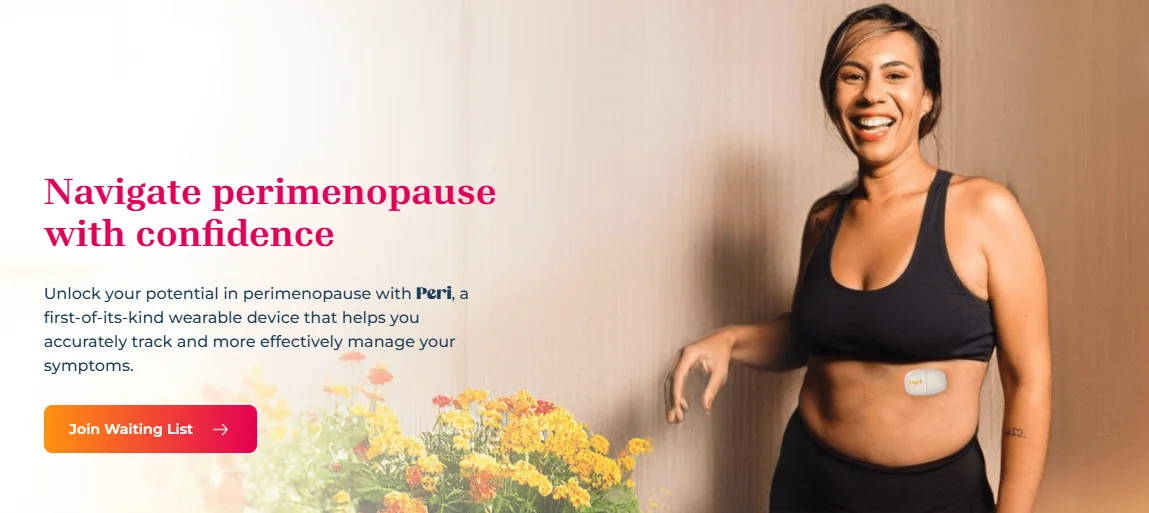
Peri is designed to be worn on the torso and paired with a smartphone app. The company says the goal is to monitor perimenopause symptoms more accurately and provide actionable insights through that app. Its argument is that the location is not incidental: wrist-based devices have limitations in detecting perimenopause-specific patterns, while Peri’s torso placement is intended to account for those limitations.
That is a sharper proposition than the standard wearable pitch. Most mainstream devices are built to serve the widest possible audience, which means their health features tend to concentrate on measures that are broadly applicable. Peri’s value will rest on whether specialization produces information that feels genuinely relevant to women navigating perimenopause. If the insights are too generic, the device risks becoming another health dashboard that asks users to do the interpretive work themselves. If they are clear and timely, it could help women make more sense of symptoms that are often experienced as unpredictable.
The Technology Behind Peri Wearable for Women
Peri’s development involved three years of research and development. During that period, the company identified what it calls unique “digital fingerprints” associated with perimenopause symptoms. Algorithms monitor those fingerprints to track specific symptoms including hot flashes, night sweats, and anxiety.
The phrase “digital fingerprints” deserves some caution as well as interest. In health technology, the usefulness of a pattern-recognition system depends on whether the pattern is meaningful to the person wearing it. A device can collect information continuously, but users still need to understand what the result means, when to pay attention, and what they might reasonably do with it. Peri’s paired app is therefore not a side feature. It is where the product’s promise either becomes practical or falls flat.
The company has kept details of the sensors confidential. Cofounder Heidi Davis has said that the technology uses existing sensor components. The claimed breakthrough lies in proprietary algorithms rather than the hardware itself.
That distinction is important because it shifts the scrutiny away from the physical device alone. Existing components are not necessarily a weakness; much of consumer technology advances when familiar hardware is applied to a problem in a more thoughtful way. But it also means the algorithms carry a heavy burden. The company will need to show that its approach can distinguish the symptom patterns it is designed to monitor in a way that users find credible and useful.
Peri’s CES 2025 Innovation Award gives the concept visibility and signals that the device stood out in a crowded technology event. Awards can help bring attention to overlooked categories, particularly women’s health, where products have often been expected to prove their relevance against a market shaped around more general health metrics. Still, an Innovation Award is recognition of potential, not a final answer on effectiveness.
Challenges and Future Prospects
Peri also faces practical questions that cannot be solved by algorithms alone. Its pill-shaped design and use of replaceable batteries raise obvious concerns about comfort and usability. Critics have noted potential discomfort during sleep or extended wear. That is not a minor detail for a product intended to monitor symptoms that may occur at night, including night sweats and sleep disturbances.
Wearable technology succeeds when it fits into life without demanding constant attention. A user may tolerate an awkward device for a short experiment, but long-term tracking depends on whether wearing it becomes routine. The torso placement that may support Peri’s approach to detection also creates a higher bar for comfort. The product has to make its case every evening, every workday, and every time a user decides whether the information it provides is worth the effort of keeping it on.
Peri is expected to launch this summer, though its price remains undisclosed. Until it reaches the market, the central questions remain open: how effective its tracking capabilities will be, whether its app produces understandable and actionable insights, and how its design will hold up during extended use. Those factors, rather than CES attention alone, will determine its success.
Even at this early stage, Peri represents a useful challenge to the wearable industry’s usual assumptions. Women’s reproductive health should not be reduced to period tracking and fertility windows, and perimenopause should not be treated as an invisible gap between categories. Peri may or may not meet the expectations now attached to it. But its CES 2025 Innovation Award and its decision to focus directly on perimenopause point toward a health-tech market that is finally being asked to take this stage of life seriously.
Stay Updated: Tech News