

Table of Contents
LG’s Lifestyle Projectors Put Flexibility Ahead of the Traditional TV Setup
LG Electronics is bringing a distinctly different pitch to CES 2025: projectors that are meant to live in the room, not disappear into a ceiling mount or sit in a dedicated home-theater cabinet. Its latest lifestyle projector lineup includes the LG CineBeam Qube, model HU710PB, alongside the PF600U and the CineBeam S, model PU615U. Each takes a different approach to the familiar problem of getting a large image into a home without committing a large wall to a television.
That framing matters. Projectors have long offered screen sizes that televisions struggle to match, but they usually ask for compromises: a dark room, careful placement, external speakers, cables, and a willingness to tolerate equipment that looks like equipment. LG’s new models are trying to make the projector part of the furnishing. The trade-off is that these are not interchangeable products. The Qube is aimed at picture quality and portability, the PF600U is a multipurpose room object, and the CineBeam S focuses on the practical appeal of ultra-short throw projection.
LG has held back specific pricing and availability details ahead of the official Las Vegas debut at CES 2025. That leaves important questions unanswered, especially because “lifestyle” hardware can range from a useful alternative to a television to an expensive design statement. Still, the feature split gives a fairly clear picture of what LG is trying to cover.
CineBeam Qube: a portable projector built around 4K
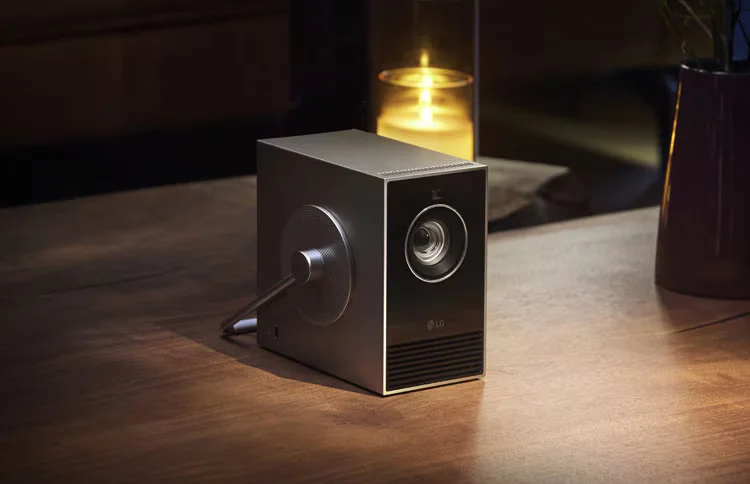
The CineBeam Qube is the most conventional projector of the group in one sense: it is built to deliver a cinematic image rather than perform several unrelated jobs. But its physical design pushes against the usual home-theater stereotype. LG presents it as both a high-performance display and a stylish interior accessory, with a minimalist form and a 360-degree rotatable handle. That handle is more than visual decoration if the projector is regularly moved between rooms or put away after use.
Its core specifications are serious for a compact model. The Qube delivers 4K UHD resolution, a 450,000:1 contrast ratio, and 154 percent coverage of the DCI-P3 color gamut. It can create images from 50 to 120 inches and uses an RGB laser light source. Taken together, those claims position the Qube around the things buyers tend to notice most when moving from a TV to projection: image detail, color, black levels, and the ability to scale up beyond a typical living-room screen.
A large projected image is only useful if setup does not become a ritual. LG includes Auto Screen Adjustment and auto-focus, features intended to optimize image placement and size automatically. That does not erase the importance of a suitable wall or screen, or the impact of room lighting, but it can make an occasional movie-night setup less fussy. For renters and people who do not want a permanently installed display, that convenience may be as important as the 4K label.
The Qube runs on webOS 6.0, with control over streaming services including Netflix and Disney+. Built-in smart software is now close to table stakes for a consumer display, yet it has an especially useful role in a portable projector. It reduces the need to connect a separate streaming stick or source device every time the projector changes rooms. The result is a product that is trying to behave less like projection hardware and more like a self-contained entertainment appliance.
The PF600U treats the projector as furniture
The PF600U is LG’s more unusual idea. It combines a full HD projector, Bluetooth speaker, and standing lamp in a single 16-pound unit. That combination will not appeal to the buyer seeking the highest resolution or the brightest possible image. It is aimed at a different kind of use: a room where one object can provide lighting, audio, and casual viewing without leaving a projector sitting visibly on a table.
Its projector delivers 1920 x 1080 resolution at 300 ANSI lumens. The article’s own caveat is important: its versatility is best suited to blackout conditions. Brightness is not a minor footnote in projector shopping. A projector’s image competes with every lamp, window, and reflection in the space, and lower-output models are naturally more dependent on a darkened room. The PF600U’s appeal therefore rests less on replacing a television in every situation than on making a bedroom, apartment, or secondary space more adaptable.
There is also a sensible argument for this kind of hybrid, even if it sounds eccentric at first. Many home gadgets add another box, another power cable, and another remote. The PF600U tries to consolidate three roles into one object. Whether that is a genuinely elegant solution will depend on how well its lamp, speaker, and projector functions work in everyday use, but the concept is more coherent than simply attaching a projector to a novelty form factor.
CineBeam S targets the hardest placement problem
The miniature CineBeam S, model PU615U, addresses another recurring obstacle: throw distance. Many rooms do not have enough depth to place a conventional projector far enough from the wall for a large image. The CineBeam S uses ultra-short throw capabilities to project 4K images mere inches from a wall, making it a potentially more natural fit for compact spaces and furniture layouts that cannot accommodate a projector placed across the room.
It also uses laser RGB light sources and includes stereo speakers with Dolby Atmos support. The projector produces 500 ANSI lumens, though LG’s own positioning recognizes that ambient lighting may affect brightness. Ultra-short throw projection can make installation easier, but it does not repeal the basic physics of projected light. Buyers expecting daytime television-like performance in a bright room should be realistic about that limitation.
Even so, the CineBeam S makes a strong case for why ultra-short throw remains one of the most compelling projector categories. It keeps the projector close to the wall, reduces the chance that someone walks through the beam, and avoids the need for a long cable run across a room. In a small apartment or an intimate viewing area, those practical advantages can outweigh the appeal of a more traditional long-throw setup.
What LG is really testing at CES 2025
LG’s lineup is less about one universal projector than about the expanding definition of what a projector can be. The Qube prioritizes a portable 4K viewing experience. The PF600U turns projection into one part of a lamp-and-speaker package. The CineBeam S leans into ultra-short throw convenience. Each reflects the idea that home entertainment is no longer confined to a dedicated media room.
YS Lee, vice president of LG Electronics Business Solutions, emphasizes the products’ spatial integration and versatility, with cinematic viewing quality at the center of the pitch. That language is marketing, but it identifies a real consumer tension. People want larger screens, yet many do not want their rooms arranged around a black rectangle or permanent projection equipment.
CES 2025 should clarify where these devices land in the market once pricing and availability are revealed. Until then, the interesting part is not simply that LG has more projectors. It is that the company is treating the projector as décor, as a multipurpose household device, and as a way to reclaim wall space from the television.
Stay Updated: Gadgets

