


- AMD Vivado Linux support is disappearing from the free tier starting with the 2026.1 release.
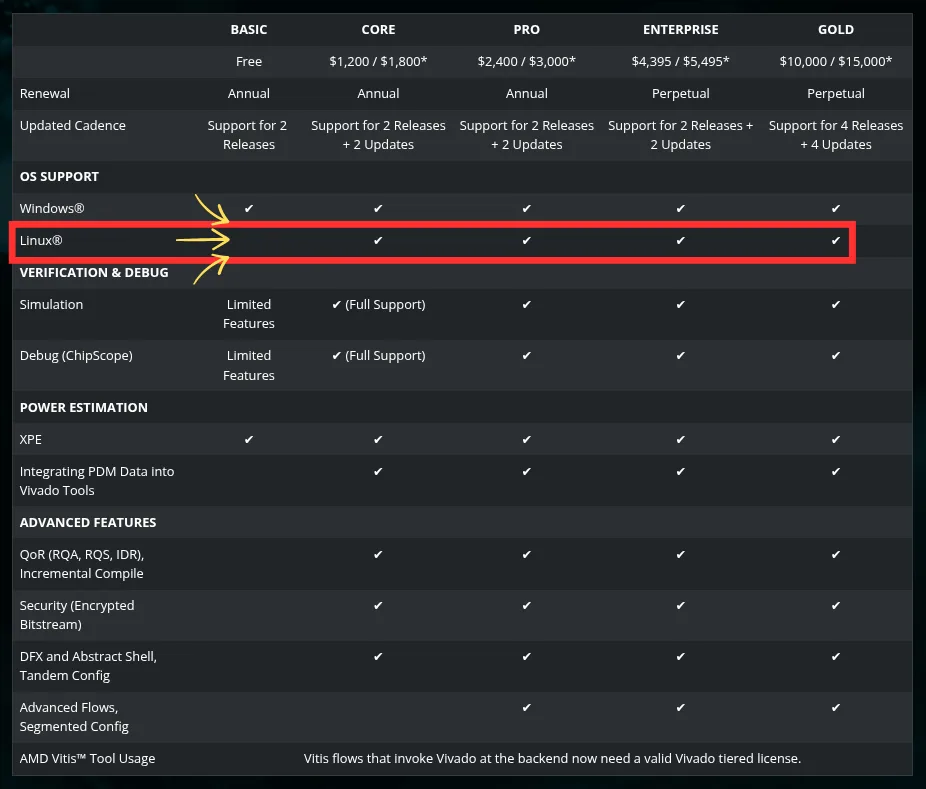
- AMD Vivado Linux users must now pay $1,200–$1,800 per year to access the Core tier with Linux support.
- AMD’s forum moderator deflected community criticism with PR-coded responses rather than genuine answers.
- Students, researchers, and hobbyists who built workflows around Vivado on Linux now face an abrupt dead end.
Table of Contents
AMD Vivado Linux Support Just Got a Price Tag
AMD Vivado Linux users woke up recently to discover that the design tool they’ve relied on — sometimes for years — is about to become a paid product for them specifically. Starting with the 2026.1 release of Vivado, AMD’s flagship FPGA and adaptive SoC design suite, Linux support is no longer included in the free Basic tier. If you want to keep using AMD Vivado on Linux, you’ll need to open your wallet to the tune of $1,200 to $1,800 per year for the Core tier. Windows users? They keep the free ride.
This isn’t a minor policy tweak buried in a changelog. For a significant portion of Vivado’s user base — engineers, graduate researchers, hardware hobbyists, university students — Linux isn’t just a preference. It’s the environment their entire toolchain runs in. Pulling Linux support from the free tier effectively tells those users: pay up or move on.
What Vivado Is and Why This Actually Matters
If you’re not deep in the hardware world, a quick explainer. Vivado is AMD’s primary design environment for working with FPGAs — field-programmable gate arrays — and adaptive SoCs. These are the chips that power everything from data center accelerators to custom signal processing hardware and embedded systems. Vivado is where engineers write HDL code, synthesize it, simulate designs, and generate bitstreams to program the hardware.
Until now, the Standard Edition of Vivado was free on both Windows and Linux. That accessibility mattered enormously. It meant a student at a university with limited IT budgets could prototype hardware designs on a personal laptop running Ubuntu. It meant an independent hardware developer could build and iterate without a corporate license agreement. AMD — and before it, Xilinx, which AMD acquired in 2022 — built genuine goodwill in the open-source and Linux communities partly because of this accessibility.
That goodwill is now taking a direct hit. The AMD Vivado Linux free tier was a cornerstone of that accessibility, and its removal changes the calculus for a large slice of the user base.
The Bait-and-Switch Playbook
There’s a pattern here that the tech industry has run before. Offer something valuable for free. Watch adoption grow. Build dependency. Then change the terms once switching costs are high enough that most users won’t bother leaving. It’s what Redis did in March 2024 when it abandoned its long-standing BSD license for a more restrictive dual-licensing model. The community’s response was swift — they forked Redis into Valkey within weeks and the project now has backing from the Linux Foundation. Whether AMD Vivado Linux faces a similar community response remains to be seen, but the playbook is identical.
What makes AMD’s move particularly frustrating is the framing. On its download page, AMD described the licensing overhaul as a shift toward more flexible options. On its dedicated licensing page, the messaging to free-tier users suggested the only real change was an annual license renewal requirement. Neither framing mentioned upfront that Linux was being removed from the free tier entirely. Users had to dig into the details — or stumble across a forum thread — to find out what was actually happening.
The Forum Response Made Things Worse
When users started asking pointed questions in AMD’s support forums, the company sent in forum moderator Anatoli Curran to manage the conversation. His opening move wasn’t to clarify the policy. It was to warn the community about “bad language or abusive behaviour towards AMD.” That kind of tone-setting, before addressing any substance, tends to read as defensive posturing rather than genuine community engagement — and predictably, it did not go over well.
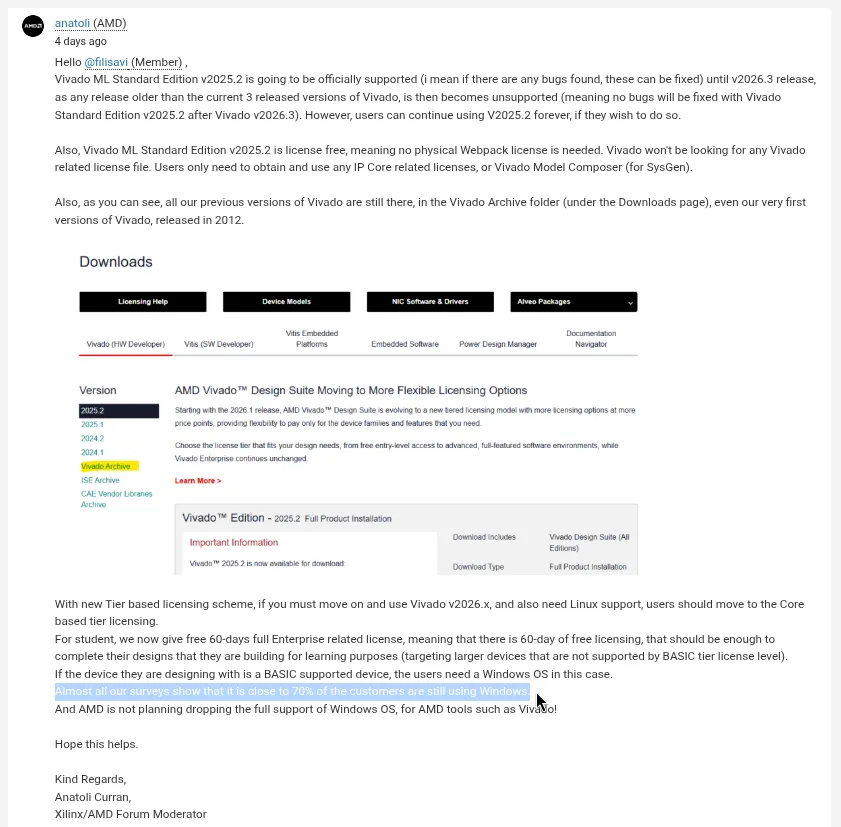
When users pushed for real answers, Curran’s main suggestion was to stay on Vivado 2025.2 rather than upgrade. Technically, that works — for now. But he did acknowledge, buried in a reply rather than stated prominently, that 2025.2 will lose official support once Vivado 2026.3 ships. That’s not a solution. That’s a countdown timer.
Curran also offered a statistic to justify the decision: 70% of AMD’s Vivado customers still use Windows. That’s the kind of number that sounds like it justifies a business decision until you think about it for two seconds. Someone in the thread did exactly that, pointing out that if the overwhelming majority of users are on Windows anyway, why is AMD Vivado Linux support specifically being placed behind a paywall? The answer Curran gave back was the kind of non-answer that PR teams produce when they don’t have a real one:
“From Core and higher tiers, both Windows and Linux are supported platforms. As stated already, AMD expectation is that the BASIC tier is used for simple, entry‑level needs. While more advanced, production workflows are aligned with paid tiers… Only BASIC tier limited to Windows ONLY platform support.”
That response doesn’t address the core complaint. Nobody was arguing that enterprise customers shouldn’t pay for enterprise features. The complaint was about removing Linux from free access when the free tier on Windows remains intact. Treating OS choice as a proxy for workflow complexity is a flimsy justification, and the community saw straight through it.
Who Gets Hurt the Most
Linux users are disproportionately hit by these moves for a structural reason: they represent a smaller commercial segment, which means companies feel less financial pressure to accommodate them when costs need cutting. Enterprise procurement teams aren’t usually running FPGA design tools on personal Linux boxes — they have Windows deployments, IT departments, and existing vendor relationships. The people most likely to be using AMD Vivado Linux for free are students, academic researchers, independent developers, and hardware tinkerers.
That’s not a commercially irrelevant group, though. It’s exactly the group that feeds the talent pipeline into hardware engineering. The student who builds their first FPGA project using AMD Vivado on Linux becomes the engineer who specifies FPGA vendors five years later. AMD is, in effect, making it harder for the next generation of hardware engineers to build familiarity with its ecosystem during the years when that familiarity is being formed. Xilinx understood this. Whether AMD’s current leadership does is becoming less clear.
AMD Vivado Linux and the Broader FPGA Ecosystem Question
AMD Vivado Linux users do have some alternatives to consider. Intel’s Quartus Prime Lite is still available free on Linux and covers Intel/Altera FPGAs. There are also open-source FPGA toolchains — the F4PGA project and tools like Yosys and nextpnr — that work with a growing range of devices, though they remain less mature than vendor tools for production designs. None of these are drop-in replacements for Vivado if you’re working with AMD/Xilinx silicon, but the competitive pressure is real.
If AMD proceeds with the 2026.1 changes as currently described and keeps AMD Vivado Linux locked behind the Core tier paywall, it hands Intel a clear talking point for recruiting Linux-native FPGA developers. That’s a strange own goal for a company that spent years building credibility in open-source communities through the Xilinx brand.
As of now, AMD hasn’t issued a formal statement walking back or clarifying the change. The forum thread continues to grow, the story has gained significant traction on Hacker News, and the PR pressure is building. Companies in this position often eventually produce a blog post that softens the edges without fully reversing course — a free Linux tier with some limitation, perhaps, or an academic licensing program. Whether that happens here may depend on how loud the response gets over the next few weeks. The community has made its position clear. The question is whether AMD is actually listening.

