

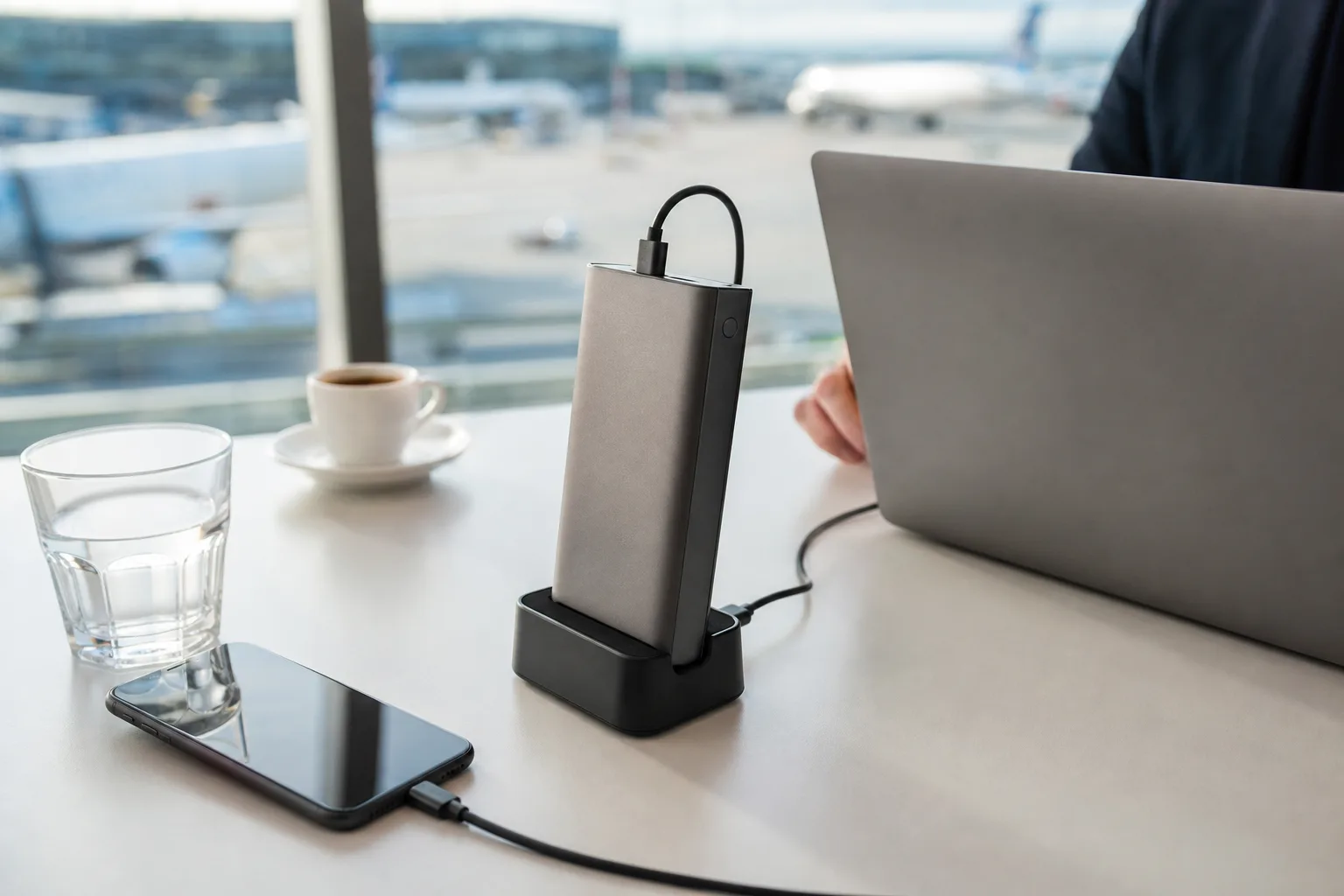
- The Anker Prime power bank and charging base package has fallen to $229.99, its lowest reported price so far.
- At 26,250mAh, the Anker Prime power bank targets people charging laptops, phones, tablets, and multiple accessories.
- The price reduction matters because high-output battery packs remain materially more expensive than basic phone-focused portable chargers.
- Buyers should check airline battery restrictions and confirm their devices can accept the charger’s available USB-C power before purchasing.
Table of Contents
Anker Prime power bank falls to $229.99
Portable chargers are usually an impulse buy at the airport checkout line. The Anker Prime power bank is very much not that sort of accessory: it is a large-capacity, high-output battery pack built for people who travel with a laptop, tablet, phone, camera gear, and the usual nest of USB-C cables. Its bundle with a charging base is now listed at $229.99, $30 below the previous deal.
According to Android Authority, that is reportedly a new low for this configuration. The outlet says the deal is $30 below the previous discount it tracked. In a premium accessory category where sale prices tend to bounce around wildly around Black Friday, that extra cut is the part worth paying attention to.
The package pairs Anker’s 26,250mAh Prime battery with a charging base. That capacity puts it in a different bracket from the $20-to-$50 battery packs designed mainly to rescue one phone at the end of a long day. This is closer to a portable power strip with a battery inside it.
Frankly, $229.99 is still a lot of money to spend on a power bank. But it is a more defensible price when the buyer genuinely needs a shared power source rather than another pocketable phone charger.
Why the Anker Prime power bank costs more
Capacity is only one part of the calculation. The 26,250mAh figure describes the cells inside the pack, while useful charging time depends on conversion losses, the voltage a device needs, cable quality, and what else is connected. A laptop drawing meaningful power can drain a battery far faster than a phone sipping power overnight. Anyone expecting a four-figure milliamp-hour label to translate neatly into a certain number of laptop charges is setting themselves up for disappointment.
Output capacity matters just as much. Modern USB-C charging has turned a single port into a surprisingly flexible tool, but only when every piece of the chain cooperates. A lower-end battery can charge a laptop slowly, or merely stop it from losing ground during a video call. A higher-output model is meant to have enough headroom for several demanding devices at once.
That does not mean every connected gadget will suddenly charge at its maximum advertised rate. Charging is negotiated between the battery, cable, and device. A laptop with a 65W USB-C adapter does not become a 140W machine because the battery can provide more; likewise, an older cable can become the bottleneck. Before buying an Anker Prime power bank for work travel, buyers should check the power requirement printed on their laptop adapter and make sure their USB-C cables are rated for the job.
The charging base adds convenience rather than raw battery capacity. Instead of finding another cable and adapter to refill a large pack, owners can return it to a dedicated dock. That is a useful distinction for a battery meant to live on a desk or in a travel kit. Accessories are most useful when they are ready before the trip, not discovered empty in a backpack five minutes before boarding.
A practical fit for travel, with one important caveat
The Anker Prime power bank may require air travelers to consider airline battery rules. Airlines and regulators typically use watt-hours, rather than milliamp-hours, when setting battery rules. Relevant battery guidance is available through the FAA’s PackSafe battery page.
A 26,250mAh rating does not guarantee trouble-free travel on every route. Policies can differ by airline and country, and gate agents do not work from a gadget reviewer’s spec sheet. Check the watt-hour rating printed on the actual product and confirm the airline’s policy before a long international trip. It is boring advice, admittedly, but so is arguing about battery capacity at a gate.
There is also a portability trade-off. A battery capable of supporting laptop-class charging is not competing with a lipstick-sized phone charger. It will take up bag space and add weight, which means this deal makes the most sense for people who will use the capacity often: frequent flyers, mobile creators, field workers, students moving between campus and library, or families managing several devices away from wall outlets.
The deal is good, but the use case matters more
Black Friday has trained shoppers to treat every triple-digit discount as a command to buy. That is how drawers fill up with accessories that seemed urgent for about twelve minutes. The Anker Prime power bank deserves a more deliberate decision.
If the job is keeping an iPhone or Android phone alive through a commute, a smaller 10,000mAh or 20,000mAh pack will cost far less and be easier to carry. If the job is powering a USB-C laptop while charging a phone and camera batteries from the same unit, the economics change quickly. One reliable battery that replaces a tangle of chargers can be worth the premium, particularly when a charging base is included.
At $229.99, this is the kind of discount that makes a specialist product plausible for more people, rather than turning it into a universal recommendation. Anker’s larger challenge is that USB-C power is becoming easier to find in airports, hotels, cars, and public spaces. The company has to convince buyers that dependable power they carry themselves is still worth roughly the price of a budget tablet. For anyone who has watched a laptop hit 5% before a flight, the answer may be obvious. For everyone else, waiting for a smaller battery deal is probably the smarter move.