

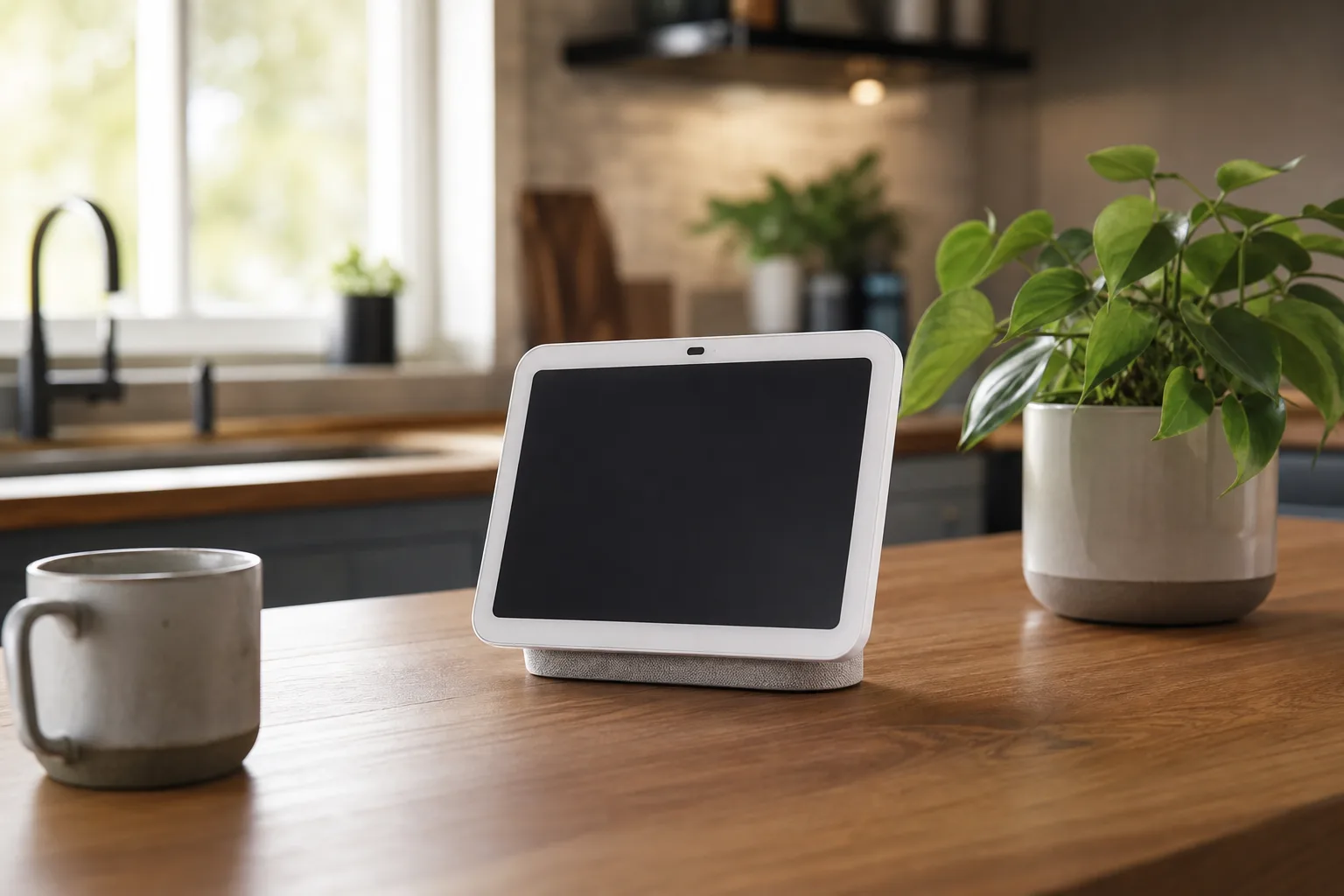
- The Apple Home Hub is reportedly targeting an October launch window, though Apple could push it into early next year.
- Apple Home Hub hardware may pair a 7-inch screen with HomePod-style audio and a redesigned Siri experience.
- Apple reportedly expects households to place multiple units around rooms, treating the device as a shared home screen.
- Everything depends on whether Apple can make Siri genuinely useful after years of smart assistant frustration.
Table of Contents
Apple Home Hub could finally give Siri a proper home
Apple has spent years selling the HomePod as a premium speaker, but the Apple Home Hub reportedly points to a much more ambitious role: a screen-equipped household computer that happens to play music. Bloomberg’s Mark Gurman reports that Apple could ship the device as soon as October, with early next year still possible if the schedule slips.
The rough concept is familiar. Think of a HomePod crossed with an Amazon Echo Show or Google’s old Nest Hub: a roughly 7-inch display, speakers, widgets, apps and a voice assistant meant to handle the little domestic jobs that pile up around a home. Timers. Lights. Video calls. Camera feeds. Music controls. A recipe when your hands are covered in flour.
What makes this interesting is not the screen itself. Apple is late to that party, and frankly, it knows it. The real question is whether the company’s much-promised Siri overhaul can turn a category full of dusty countertop gadgets into something people actually depend on.
What the Apple Home Hub is expected to look like
Gurman’s reporting describes the Apple Home Hub as a HomePod-like smart speaker with a 7-inch display. Its software is said to be new, though based on tvOS, and its visual language may borrow from the iPhone, Apple Watch and Apple TV. That points to a grid of apps alongside glanceable widgets, plus customizable clock faces for the moments when the device is doing nothing more dramatic than sitting on a kitchen counter.
On paper, that would be a welcome cleanup. Apple’s existing smart-home experience is fragmented across the Home app, Control Center, the Apple TV and whatever Siri can manage to understand on a given day. A dedicated display could make the system more visible and less dependent on someone remembering the exact voice command Apple expects.
Reports have also suggested Apple wants the device used in multiple rooms. That strategy makes practical sense: one screen in the kitchen, another near an entryway or bedside table, perhaps a third in a living room. Apple has already trained its customers to accept this sort of distributed hardware model with HomePods, Apple TVs and AirTags. The difference is that a display can become a shared place for information rather than another black puck waiting for someone to say “Hey Siri.”
The catch is obvious: a screen in every room can quickly feel less like ambient computing and more like a small army of glowing alarm clocks. Apple will need to make its interface calm, useful and respectful of attention. Google understood that instinct with the original Nest Hub. Amazon, by contrast, has often treated its Echo Show displays like tiny digital billboards. Apple should resist that temptation with every fiber of its design department.
Siri is the whole point
The Apple Home Hub appears set to lean heavily on a new Siri, which the report says will be the device’s main selling point. That is both the product’s best argument and its largest risk.
A more capable Siri is precisely what a household assistant needs. Asking for a playlist is easy. Asking an assistant to find the message where a family member sent a flight number, check whether the plane is delayed and tell everyone when to leave for the airport is the hard part.
So if this device arrives before its most useful software abilities are ready, the Apple Home Hub could land with a familiar problem: polished hardware waiting on software that has not caught up.
That would be especially damaging because Apple’s smart-home competitors have not stood still. Amazon is pushing Alexa toward generative AI through Alexa+, while Google has been reworking its assistant strategy around Gemini. Neither company has fully proven that large-language-model assistants belong in the home; confident wrong answers are a lot less charming when they involve your front-door lock or calendar. Still, both have a head start in the basic smart-display market Apple is entering.
My read is that Apple has one advantage these rivals can’t casually replicate: its tight integration with the iPhone. If the Apple Home Hub can securely surface the right family photos, reminders, messages, HomeKit controls and personal requests without becoming invasive, it could feel like an extension of the devices people already carry. That’s a better proposition than another standalone chatbot with a speaker attached.
The smart-home opportunity is real, but Apple has work to do
Apple’s existing Home ecosystem has its loyalists, particularly among users who value local controls and privacy. The company’s HomePod lineup also delivers notably good sound for its size. But Apple has never made smart-home setup feel as universal or frictionless as it should. The Matter standard was supposed to smooth compatibility across brands, yet real-world smart-home ownership still involves too many apps, firmware updates and oddly specific limitations.
A well-executed Apple Home Hub could offer a visual control center for that mess. Seeing which lights are on, who rang the doorbell or whether a garage door is closed is often more reassuring than asking a voice assistant and hoping it heard the right room. Displays solve problems voice alone cannot.
Pricing may decide whether this works. Apple could plausibly charge a premium for better speakers, a higher-quality screen and privacy-minded processing. But it cannot price this like an iPad and expect it to become a multi-room fixture. The whole reported premise depends on people buying more than one. At that point, each extra unit needs to feel closer to a useful appliance than an expensive experiment.
Apple is chasing a category it once ignored
For years, Apple seemed content to let Amazon and Google define smart displays while it focused on the iPhone, wearables and services. That decision was understandable: the category has not exactly produced a blockbuster hit, and plenty of Echo Shows now spend their lives displaying weather forecasts nobody requested.
But the rise of AI gives Apple a reason to revisit the idea. A voice assistant with real context needs a place in the home where it can be seen, heard and shared. The Apple Home Hub may be that place, provided Apple can deliver the assistant it has been promising rather than another elegant vessel for Siri’s old limitations.
Apple does not need to invent the smart display. It needs to make one that feels less like a gadget you manage and more like a household tool you notice only when it saves you a step. If it gets that balance right, the 7-inch screen may be the least important thing about it.

