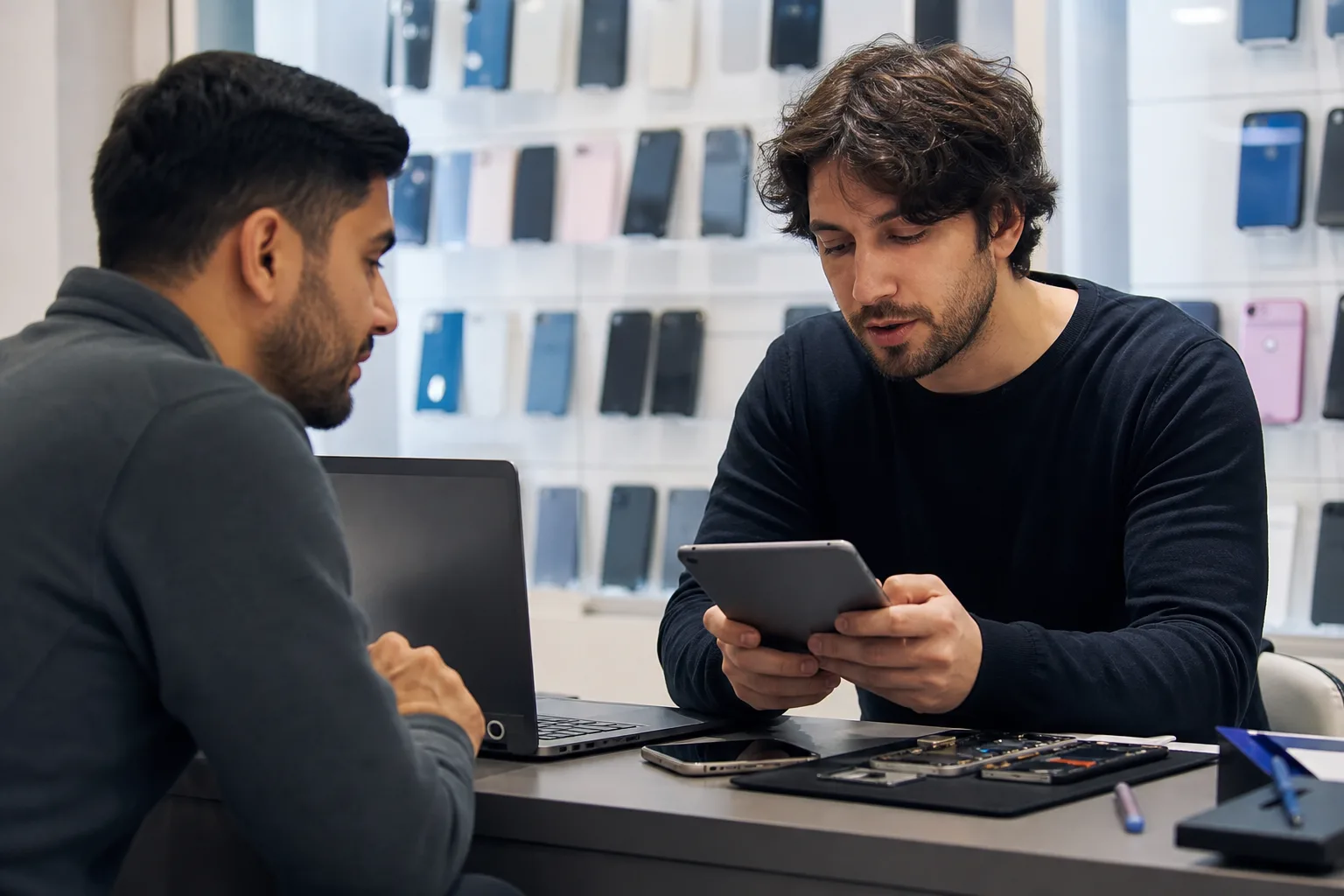
- Apple Live Notes reportedly records opt-in Genius Bar conversations and adds a transcript to the employee’s repair-session record.
- Apple Live Notes could reduce administrative work for retail staff, though the feature raises familiar questions about consent, retention and accuracy.
- The reported trial fits Apple’s broader effort to put AI to work in practical workflows instead of treating it as a consumer novelty.
- Customers may benefit from clearer repair records, especially when a device problem requires follow-up visits or escalation to Apple Support.
Table of Contents
Apple Live Notes brings AI into a very human support desk
The Genius Bar has always had a slightly awkward split personality: part technical workshop, part customer-service confessional. You arrive with an iPhone that won’t charge, a MacBook that has developed a mysterious new noise, or an iCloud problem nobody in your family can explain, and an Apple employee has to listen, diagnose, type, and reassure you at the same time. Apple Live Notes, reportedly being tested at some Apple stores, appears designed to remove one of those jobs from the employee’s plate.
According to Bloomberg’s Mark Gurman, the opt-in system can transcribe a conversation between a Genius Bar employee and a customer. If both people agree, that transcript is placed on the employee’s iPad as part of the repair appointment record. The stated idea is straightforward: fewer moments spent pecking at notes, more attention paid to the person across the table.
That sounds almost boringly sensible, which is probably why it matters. Apple’s consumer-facing AI push has received plenty of attention around Apple Intelligence, writing tools, image generation and Siri’s still-unfinished transformation. But the most useful AI deployments may turn out to be mundane internal systems such as Apple Live Notes: tools that make a front-line job less repetitive without asking customers to learn a new app or change their habits.
Why a transcript could improve Apple Store repairs
A device repair appointment often involves more than a broken component. The customer describes when the issue started, what troubleshooting they attempted, whether the phone was dropped, which accessories were involved, and whether a backup exists. Some of that information can determine the next step; all of it needs to be documented cleanly enough that another employee can pick up the case later.
Today, that means a technician must alternate between eye contact and note-taking. Anyone who has watched a support worker type while a frustrated customer talks knows how quickly that can feel transactional. Apple Live Notes could preserve more of the conversation while giving the employee room to ask better questions and demonstrate a fix in real time.
The value is especially clear for complicated cases. A customer may return after a battery replacement, speak with a different Genius, or need to contact Apple Support from home. A detailed account of the original symptoms and advice could prevent the familiar ritual of explaining the whole problem again. That is the kind of tiny efficiency gain customers actually notice, even if they never see the software doing its work.
There’s also a quality-control angle. Repair records are operationally important when Apple is assessing warranty coverage, arranging a mail-in repair, or tracking a recurring hardware issue. A transcript may be more complete than hurried manual notes, although Apple would still need to ensure that its staff review the record rather than treating speech-to-text output as gospel. Anyone who has used voice dictation around product names, serial numbers or accented names knows the limits here.
Apple Live Notes will live or die on consent and retention
The good news is that the reported test is opt-in for both the customer and the employee. That is the minimum acceptable bar. A Genius Bar conversation can include account details, device condition, personal circumstances and, occasionally, the sort of accidental oversharing that happens when someone is trying to recover years of photos from a dead phone.
Still, consent is only the first question. What matters next is how long Apple Live Notes data is retained, who can access it, whether the audio itself is stored or only the text, and how Apple handles transcription errors or a customer’s request to remove information. Apple has built much of its public brand around privacy, and its privacy policy makes broad commitments around limiting data collection and giving users control. A retail transcription system will test how convincingly those principles carry into a real-world support operation.
My read is that Apple has a better chance than most companies of making customers comfortable with this, but it cannot coast on its reputation. Retail staff need a plain-language explanation that takes seconds, not a legal recital delivered while someone is worried about a lost work laptop. Customers should also be able to decline without sensing that they’ve made the appointment harder for the employee.
There is a subtle labor question, too. Tools sold internally as time-savers can become performance-monitoring systems if leadership starts mining transcripts for compliance, sales language or employee behavior. Apple hasn’t described the trial publicly, and there’s no indication that is its plan. But workers have learned to be skeptical when a new piece of workplace software promises only convenience.
A practical AI test, not a flashy one
Apple Live Notes fits a wider industry pattern. Microsoft, Google and Zoom have all spent years pitching automated meeting notes, summaries and transcription as relief from the burden of documentation. In healthcare, customer support and field service, similar systems are already common because employees spend a remarkable amount of time writing down what just happened rather than doing the work itself.
Apple’s situation is distinct because the Genius Bar is a premium retail experience as much as a repair counter. People go there expecting a person to solve a problem, not a voice assistant to file paperwork in the background. If the tool works as intended, customers may only notice that the employee is more present and the repair history is less muddled. That’s the best outcome.
The trial is reportedly limited for now, so there is no reason to assume a broad rollout is imminent. Apple may find that transcription quality, consent rates or staff feedback make the system less useful than it appears on paper. But if the company can protect privacy while making support interactions feel less like an insurance claim, Apple Live Notes could be a far more convincing AI story than another novelty feature tucked into a software update. The interesting question is whether Apple keeps it confined to the Genius Bar—or starts quietly rebuilding every customer-support workflow around the same idea.