

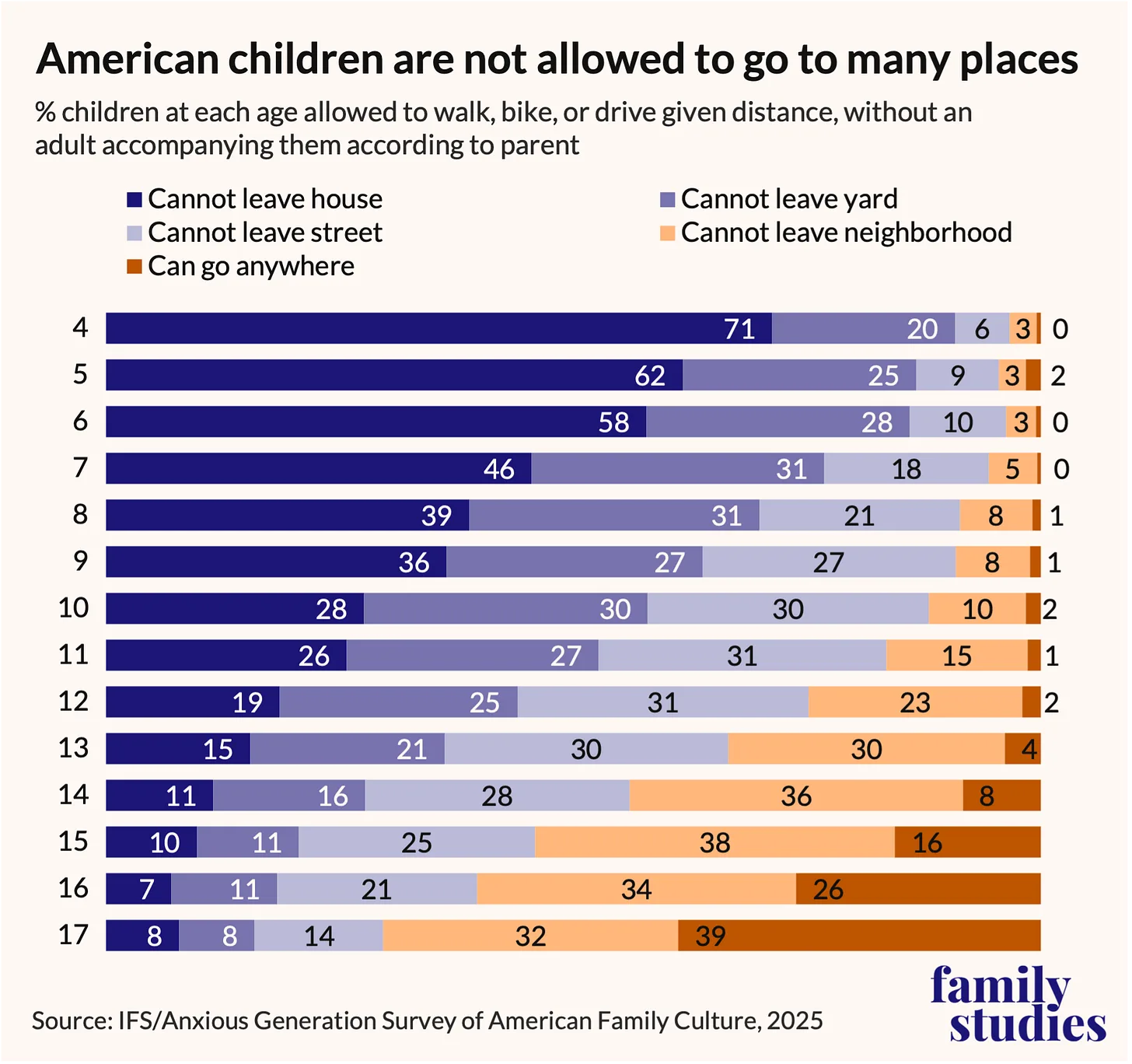
- Kids’ free-range freedom has collapsed — 84% of 11-year-olds can’t leave their street, despite crime being at historic lows.
- Kids’ free-range freedom is being eroded not by real danger, but by media-driven fear, social judgment, and inconsistent laws.
- Around 38% of all children will be investigated by child protective services before they turn 18, mostly for being unsupervised.
- Four out of five parents agree that unsupervised free time benefits kids — yet almost none of them actually allow it.
Table of Contents
Kids’ Free-Range Freedom Is Almost Gone — And We Did It Ourselves
Kids’ free-range freedom — the kind where an 11-year-old hops on a bike, rides a mile and a half to a sandlot, and doesn’t check in until dinner — has effectively vanished in the span of a single generation. The numbers are stark. Today, 84% of 11-year-olds aren’t permitted to leave their street. More than half — 53% — can’t even leave the front yard. Among 14-year-olds, 92% are confined to their neighborhood, and 55% can’t leave their street at all. These aren’t figures from a dystopian thought experiment. They’re from current survey data on how American families actually operate.
The instinct is to blame smartphones, or TikTok, or some ambient cultural softness. That’s the easy read. But writer and performance coach Steve Magness, whose work has been circulating widely on this topic, makes a more uncomfortable argument: this isn’t a story about technology or danger. It’s a story about adults — parents, institutions, and communities — who decided, somewhere around the turn of the millennium, that the correct amount of kids’ free-range freedom for a 10-year-old is whatever can be monitored from the kitchen window.
The World Got Safer. We Got More Afraid.
The most important thing to understand about the collapse of kids’ free-range freedom is that it happened while the actual threat environment was improving, not deteriorating. Violent crime against children in the United States has been falling steadily since the early 1990s. Stranger abductions — the nightmare scenario that flashes through every parent’s mind at the school gate — were statistically rare in 1985 and are even rarer now. The UK tells the same story from a different angle: in 1971, 86% of primary-age children traveled home from school unaccompanied. By 1990 that figure had dropped to 35%. By 2010, it was 25%. The world didn’t become more predatory. Our perception of it did.
That gap between perception and reality has a name. In the 1970s, University of Pennsylvania professor of communication George Gerbner coined the term mean world syndrome to describe how heavy television viewers come to believe the world is far more violent and threatening than it actually is. A Pew Research landscape of media habits shows this dynamic has only accelerated with 24-hour news cycles, neighborhood crime apps, and local Facebook groups pinging residents every time a car gets broken into two streets over. A 2008 study found that media exposure specifically drives Americans to overestimate danger abroad. More recent research draws a direct line between the volume of crime reported in the news and the intensity of people’s fear — not just as an abstract worry but as a behavioral driver. People exposed to more crime coverage actually change what they do, avoiding places and situations they might otherwise engage with freely.
Social media has turbocharged this. A recent analysis found that social media consumption correlates with an increased fear of street violence. And unlike passive television, these platforms are personalized, urgent, and designed to provoke a reaction. When a Nextdoor notification about a suspicious van reaches 3,000 households at 8 a.m., the rational mind might contextualize it. The lizard brain — especially the one processing information about its children — does not. A 2025 study confirmed the effect directly: fear of stranger danger more than doubled the likelihood of risk-averse parenting and keeping children physically close to home. The cumulative result is that kids’ free-range freedom gets treated as a liability rather than a developmental necessity.
It’s Not Just Bike Rides — It’s Knives and Grocery Aisles Too
If kids’ free-range freedom were only about outdoor roaming, you might attribute the decline to legitimate structural concerns — and there are some. Traffic genuinely is a problem. More drivers are distracted, and in many American suburbs and towns, the built environment simply wasn’t designed with pedestrians in mind, let alone unsupervised children. Urban planners and advocates have been pushing for better sidewalks, traffic calming, and accessible parks for years, and that’s a valid fight.
But the data suggests something far broader than traffic anxiety is at work. Children’s autonomy has declined across almost every dimension — not just the high-stakes ones. Kids are less likely to make their own lunches, less likely to navigate a different aisle in a supermarket alone, and — this one stands out — significantly less likely to use a knife unsupervised than their counterparts a generation ago. This isn’t about danger. A child using a kitchen knife under minimal supervision is not a child at risk. It’s a child learning basic competence. When even low-stakes kids’ free-range freedom has been stripped away, it signals something systemic about how adults now relate to children’s autonomy as a concept.
The Legal and Social Machinery That Punishes Parents for Letting Go
Some of this is irrational fear. But some of it is a rational response to a genuinely punishing environment for parents who do try to give their kids space. A 2023 study found that state laws governing child supervision are wildly inconsistent and mostly disconnected from developmental science. Maryland law effectively prohibits children under 8 from being alone. Minnesota permits 6-year-olds to be unsupervised. There is no national standard, and the laws that exist were largely written without consulting child development research. The message to parents about kids’ free-range freedom is muddled at best, threatening at worst.
The consequences of getting it wrong are not abstract. According to a 2017 study, approximately 38% of all children in the United States will be investigated by Child Protective Services before they turn 18. The majority of those cases don’t involve abuse. They involve supervisory neglect — children being found somewhere without an adult present. A parent who lets their 9-year-old walk to the park is not just risking social disapproval. They’re risking a CPS investigation. That’s a rational deterrent, and it works.
Social pressure piles on top of legal risk. Data suggests that 25% of parents have personally criticized another parent for not adequately supervising their child. One in four. That’s not a fringe behavior — it’s a meaningful portion of the parent population actively enforcing a norm of maximum supervision on everyone around them. And research published in 2024 shows that intensive parenting attitudes generate measurable stress, anxiety, depression, and guilt in mothers specifically. The psychological architecture here is self-perpetuating: we feel guilty when we’re not constantly present, that guilt drives anxiety, and that anxiety drives us further toward over-protection, which earns social approval and temporarily quiets the guilt. Kids’ free-range freedom loses ground at every turn of this cycle.
The Paradox: Parents Know, But Don’t Change
Here’s the part that should unsettle everyone involved in this conversation — parents, policymakers, pediatricians, and the tech platforms that feed daily doses of fear into people’s phones. In a survey of parents with children aged 5 to 11, four out of five agreed that unsupervised free time is good for kids. Eighty percent. They know. The information is there. The belief is there. The behavior doesn’t follow.
That’s not a knowledge gap. That’s a structural problem — a system of legal uncertainty, social surveillance, media-driven anxiety, and platform incentives that makes doing the thing you know to be right feel too costly to actually do. No individual parent is the villain here. But collectively, we’ve built a set of conditions where the rational, self-protective choice is to keep kids’ free-range freedom permanently curtailed.
The developmental costs of this are real and accumulating. Kids’ free-range freedom in childhood is associated with better spatial cognition, stronger social skills, greater resilience, and a more calibrated sense of personal risk. Kids who are never allowed to navigate uncertainty don’t learn to manage it — they grow up anxious about it. The research on this has been consistent for decades. We’re not protecting children from harm. We’re just deferring a different kind of harm to later in their lives, when the stakes are higher and the scaffolding is gone.
What changes this isn’t a viral article or a podcast episode — it’s structural. Free-range parenting laws, like those passed in Utah, Oklahoma, and Texas in recent years, attempt to give legal cover to parents who want to let their kids walk to school or play unsupervised in a park. But those laws exist in a landscape of neighborhood apps, social media judgment, and CPS referral systems that haven’t changed. Until those systems align with the developmental science, the gap between what parents believe about kids’ free-range freedom and what they actually do is going to stay exactly where it is.

