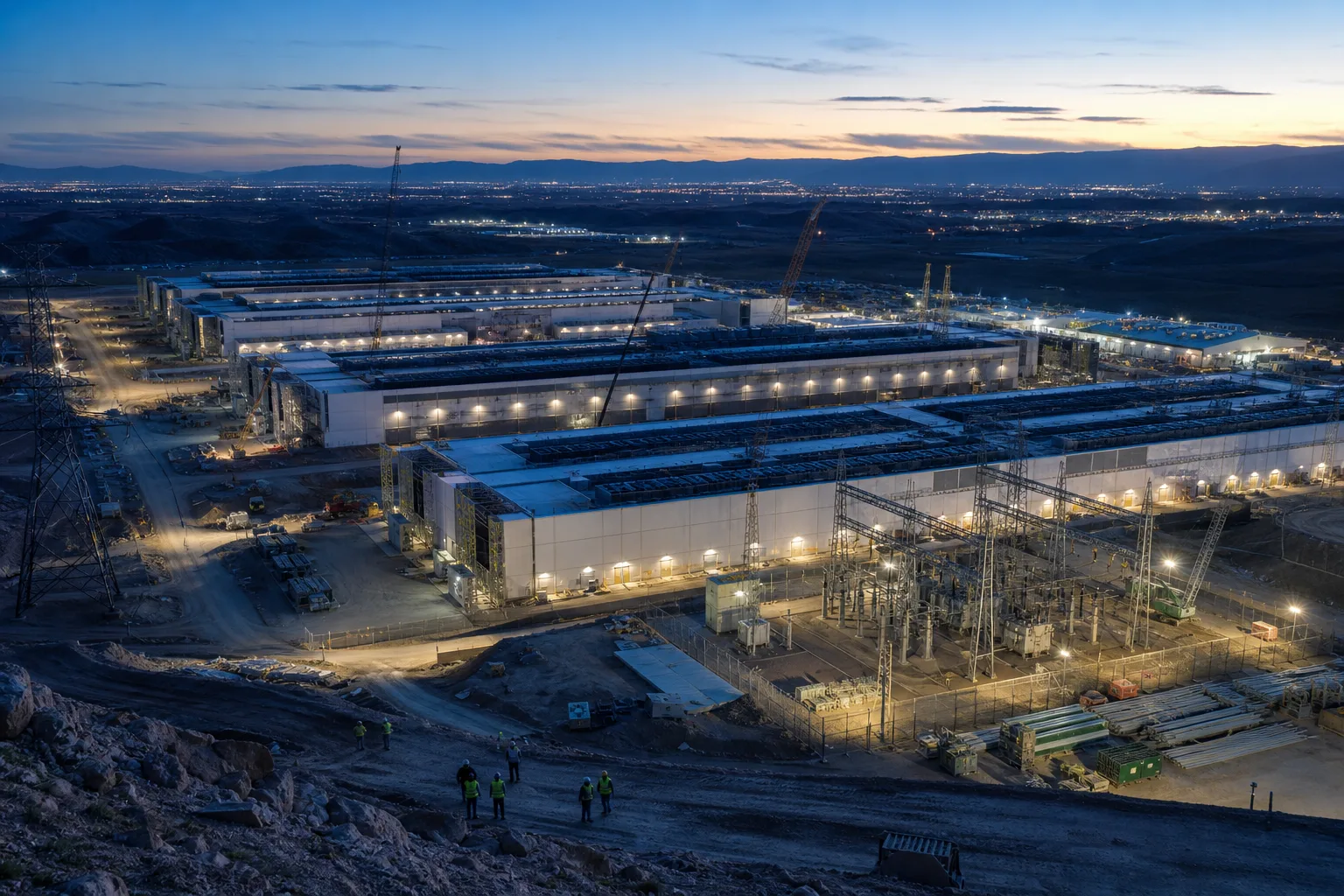
- The reported OpenAI data center agreement points to an infrastructure bill that could reach $500 billion over its lifetime.
- Nvidia’s involvement in the OpenAI data center effort would further blur the line between chip supplier, investor, and ecosystem kingmaker.
- The proposed buildout reflects an industry racing to secure electricity, land, networking, and advanced GPUs for larger AI models.
- OpenAI still faces the hard part: translating colossal infrastructure commitments into products and revenue that can sustain them.
Table of Contents
OpenAI data center plans are becoming an industrial project
Artificial intelligence has spent the past three years living mostly on screens: chat windows, image generators, coding assistants and breathless product demos. But the reported OpenAI data center deal now nearing completion is a reminder that the real AI race is being fought in substations, construction sites and server halls. According to a New York Times report, OpenAI is close to securing a data-center arrangement backed by Nvidia that could carry a price tag of roughly $500 billion.
That number is so large it almost stops meaning anything. Put it beside the capital spending of the biggest cloud companies, though, and the direction of travel is clear. Microsoft, Amazon, Google and Meta have each committed tens of billions of dollars annually to data centers and AI equipment. A half-trillion-dollar OpenAI data center infrastructure program would take that arms race into a different category: less like launching a software service, more like financing a national rail network.
The figure should also be read carefully. It appears to describe the potential scale of a long-running buildout, rather than a single check written tomorrow morning. Even so, it tells us where the pressure is. Training frontier models and serving them to hundreds of millions of people consumes a frightening amount of computing capacity. OpenAI has become one of the most visible buyers in that market, and it plainly does not want its future constrained by somebody else’s cloud allocation.
Why Nvidia’s role matters so much
Nvidia sits at the center of this story because it has spent years turning its GPUs into the default machinery for modern AI. Its chips are only one piece of the stack — networking gear, memory, cooling systems, power contracts and data-center software all matter — but they remain the hardest part to replace at scale. Nvidia’s data-center business has become the company’s engine precisely because companies such as OpenAI need vast clusters, not a few experimental servers in a lab.
If Nvidia is helping support an OpenAI data center transaction financially as well as supplying hardware, that deserves scrutiny. There is nothing inherently improper about a supplier investing in a major customer. It happens constantly in tech. But it does create a remarkably tight loop: Nvidia funds an AI developer, the developer expands its compute footprint, and much of that spending can flow back toward Nvidia hardware.
Frankly, it is the sort of circularity investors tend to celebrate until growth slows. Nvidia’s revenue is real, and the demand for AI capacity is real. Yet the industry should not confuse a massive financing announcement with proof that every planned cluster will earn an attractive return. Data centers are physical assets with long lives, huge depreciation bills and stubborn operating costs. They do not become profitable merely because a model can write a passable email.
The cloud dependency problem is coming to a head
OpenAI’s relationship with Microsoft has been fundamental to its rise. Microsoft supplied cloud capacity through Azure, while OpenAI supplied models that helped make Copilot a household name in enterprise software. But the incentives of the two companies have never been perfectly aligned. OpenAI wants enough compute to build and distribute its own products; Microsoft wants access to leading models and the cloud usage that comes with them.
A giant OpenAI data center buildout would give OpenAI more room to maneuver. It could diversify capacity, negotiate from a stronger position and plan model-training runs that are no longer entirely tied to one partner’s infrastructure timetable. That does not mean OpenAI can simply walk away from Azure. Building hyperscale capacity is slow, expensive and fiendishly complicated. Ask anyone who has tried to secure transformer equipment, water access, fiber routes and local permits at the same time.
The newly reported OpenAI data center arrangement seems to serve that same purpose, although the precise corporate structures and funding commitments remain unknown.
That distinction matters. Grand infrastructure partnerships often combine firm contracts, options, project financing and aspirational targets. Readers should resist treating every headline figure as money already committed and sitting in an account. Until the parties disclose terms, the $500 billion figure is best understood as a measure of ambition — a very serious one — rather than an audited construction budget.
Electricity may be the real limiting factor
There is a tendency to describe AI as a software story because software is what people touch. The limiting resource may be electricity. A serious OpenAI data center campus needs not only racks of accelerators but dependable power measured in hundreds of megawatts, potentially more. That puts OpenAI and its partners in direct competition with manufacturers, utilities, crypto miners and other hyperscalers for generation capacity and grid connections.
It also sharpens an uncomfortable question: what happens if model economics lag behind infrastructure spending? The AI industry is betting that more compute produces more capable systems, and that more capable systems unlock demand in coding, science, customer support, search, advertising and office work. That is a plausible bet. It is not a settled one.
OpenAI’s consumer products have demonstrated extraordinary reach, while its enterprise business is growing quickly. Still, the cost of serving AI at scale remains a problem no chatbot interface can hide. Every additional query, generated image and agent task consumes expensive compute. Companies have to find a balance between giving users increasingly capable systems and avoiding a bill that resembles a small country’s infrastructure program.
A test of whether AI can pay for its own ambition
The reported OpenAI data center deal is not really about one company getting more GPUs. It is a referendum on the thesis driving Silicon Valley’s spending spree: that the best AI systems will become important enough to justify building an entirely new layer of industrial infrastructure around them.
My read is that OpenAI has little choice but to pursue capacity at this scale if it intends to remain a frontier-model leader. Competitors including Google, Anthropic, Meta and xAI are not waiting politely in line. But necessity does not erase risk. Nvidia may supply the picks and shovels, Oracle and Microsoft may supply clouds, and financiers may supply the capital. OpenAI still has to prove that the machines being built can generate durable value at a scale that matches their appetite for power.
That is the actual $500 billion question, and no amount of silicon can answer it on its own.