
Claude shared chats are supposed to be a convenient way to send a useful conversation or an AI-built project to another person. Over the weekend, they became a pointed reminder that a link intended for one colleague can turn into a document for the entire web. Google searches reportedly surfaced Claude conversations and Artifacts containing medical material, internal company files, and personal details involving children.
The search results now appear to be gone. But the episode leaves behind a much larger question for Anthropic and every other AI company: why are products handling intimate, unstructured user data still so casual about what ‘anyone with the link’ really means?
- Google searches reportedly surfaced Claude shared chats, revealing sensitive health, workplace, and children’s personal information.
- Anthropic says Claude shared chats are indexed only after users post public links somewhere web crawlers can access.
- The incident is a reminder that AI platforms need clearer warnings and safer defaults for links that can expose private conversations.
- Users can review and remove public conversation links through Claude’s Settings, Privacy, and Shared Chats controls.
Table of Contents
Claude shared chats turned private work into searchable pages
The issue was first spotted by Reddit users, then reported by 404 Media. Search operators targeting Claude’s public sharing URLs returned a collection of conversations that should make any privacy team wince. Futurism reported finding a detailed patient medical report, clinical-trial results with patient names, internal business documents, employee reviews, and names and phone numbers associated with primary school-aged children.
Artifacts were caught up in the exposure, too. These are Claude’s interactive outputs: lightweight apps, documents, code projects, and other things users can make inside the chatbot. That makes this more consequential than a stray embarrassing prompt. A shared Artifact can carry source code, planning notes, business logic, or material that was never meant to leave a small working group.
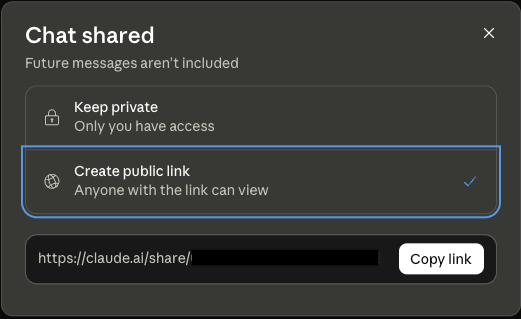
Anthropic’s sharing interface does include a warning: ‘Anyone with the link can view.’ Technically, that is plain English. Practically, it’s incomplete. Most people read that language as an instruction about forwarding a URL to friends or teammates, not as a warning that Claude shared chats may one day be discoverable through Google, Bing, or an archival service.
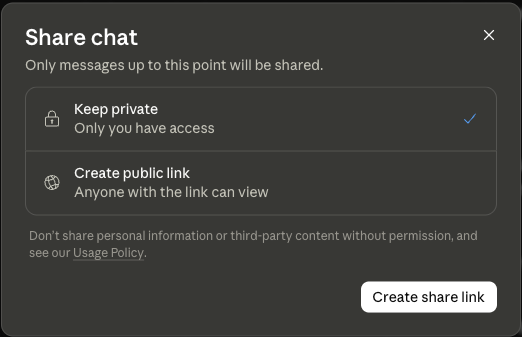
There’s a meaningful difference between a page being reachable and a page being findable. Leaving your house unlocked is bad; putting its address on a billboard is worse. A public link can become the latter remarkably quickly once it lands in a Slack export, a public forum, a social post, an email archive, or any other crawlable corner of the internet.
Anthropic says public links are the user’s choice
Anthropic’s response is, in effect, that it did not create a searchable directory of users’ conversations. Spokeswoman Amie Rotherham said the company does not provide chat directories or sitemaps to search engines, and that links are not guessable or discoverable unless a user chooses to share them.
‘When someone shares a conversation, they are making that content publicly accessible, and like other public web content, it may be archived by third-party services,’ Rotherham said.
That account may explain the technical path into search results, but it doesn’t entirely settle the product-design question. Google’s Ned Adriance made the platform’s position equally clear: ‘Neither Google nor any other search engine controls what pages are made public on the web.’ Google says site owners have controls to decide whether pages can be crawled or indexed, and that it respects those directives.
So, yes, people should be cautious before creating a public URL. But AI companies know their products are used for drafts, personal reflection, workplace analysis, customer information, medical questions, and all the other messy stuff people would never publish deliberately. Putting the full burden on users of Claude shared chats feels like the old social-media privacy playbook: offer a feature, make the implications fuzzy, then point to the settings page after something goes wrong.
Claude is not the first AI service to make this mistake
What makes the latest Claude shared chats discovery especially frustrating is that it doesn’t look like a novel category of failure. Forbes reported a similar incident last year involving hundreds of Claude conversations indexed by search engines; Google reportedly estimated it had indexed just under 600 before those pages vanished from results.
ChatGPT has had its own version of this headache. In 2024, 404 Media reported that a researcher scraped roughly 100,000 ChatGPT conversations that people had chosen to share publicly. These aren’t necessarily database breaches in the traditional sense. No attacker needs to crack encryption if a platform presents a broadly accessible web page and someone, somewhere, lets a crawler find it.
That distinction matters legally and operationally, but it won’t matter much to a person whose medical file or internal performance review ends up in a search result. For ordinary users, the outcome is the outcome.
There was another awkward detail in the Claude material: Fortune found at least one conversation marked ‘shared by Anthropic’ in which Claude generated erotica. Anthropic’s own usage policy bars sexually explicit content. We don’t know how that output was produced, and repeated or adversarial prompting has tripped up nearly every major model at some point. Still, public examples of policy-bending model behavior acquire a longer shelf life when they’re searchable.

What Claude users should do now
If you have ever made a link from Claude, check it. Anthropic directs users to Settings → Privacy → Shared Chats, where they can review conversations that have public links; its privacy policy also explains how the company handles user information. Delete links for anything containing proprietary work, personal information, client material, health details, or simply a conversation you would not want indexed beside your name.
Going forward, treat Claude shared chats and any other share link as public publishing unless the product explicitly says it blocks indexing and gives you a credible reason to trust that claim. Don’t paste sensitive records into consumer AI tools without approval from your employer or the affected person. And if you need to share an Artifact, remove identifying details first. It’s tedious, I know. So is explaining a search-result leak to your legal department.
Anthropic can do better here, too. The sensible default is to apply no-index protections to shared conversations unless a user takes an explicit second step to make them searchable. The company could also label sharing choices more bluntly: ‘Anyone on the internet may find this page,’ rather than language that sounds like an ordinary private-link handoff.
AI assistants are becoming filing cabinets, brainstorming partners, junior analysts, and occasionally confession booths. If companies want users to put that much of their lives into a chatbot, privacy controls can’t be designed like an escape-room puzzle. The next test for Anthropic is whether it merely removes this batch of results or changes the system that made Claude shared chats so easy to misjudge in the first place.