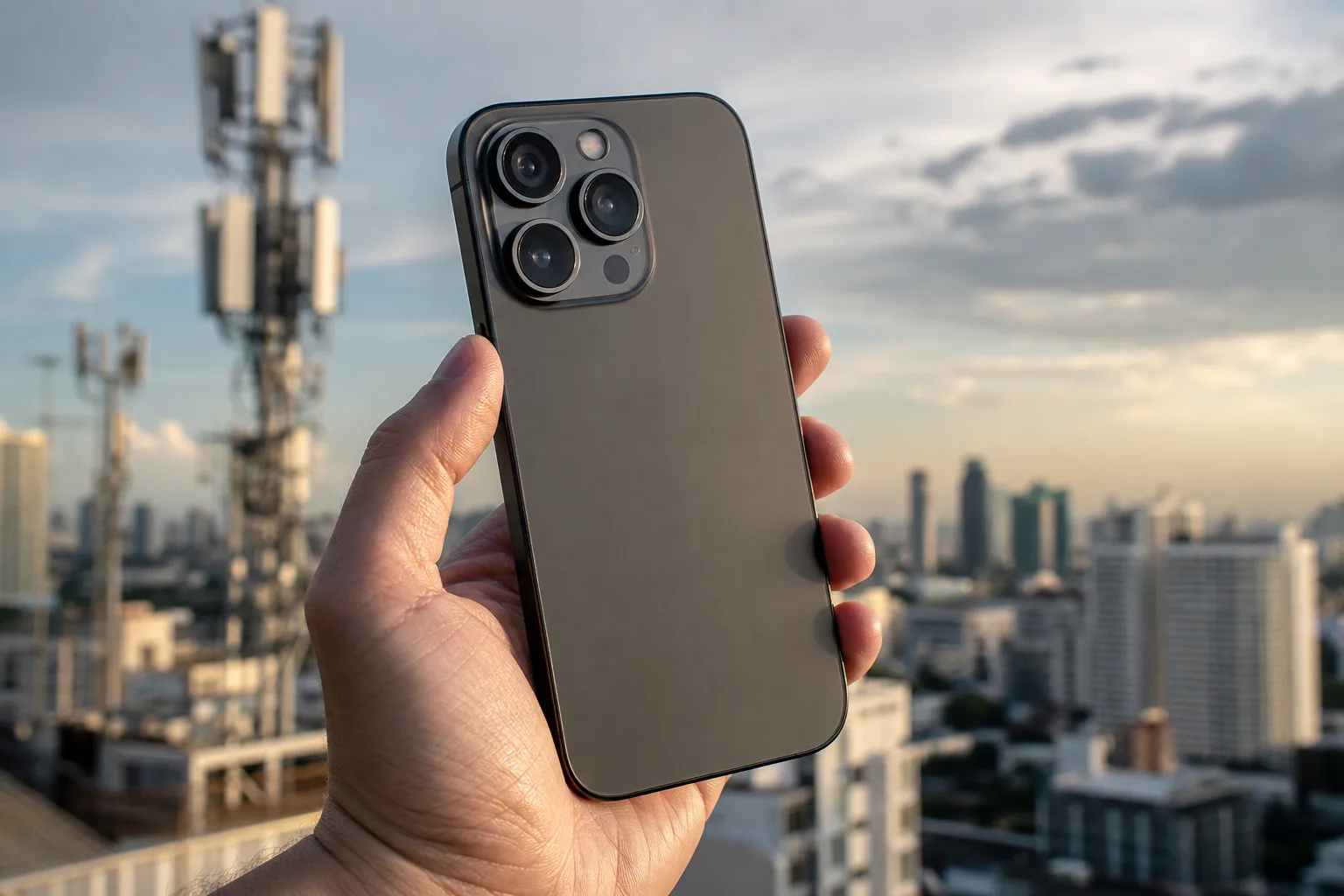
The iPhone 18 Pro Max has acquired a rather unusual regional difference: buyers in the United States may be getting a Qualcomm modem, while the rest of the world gets Apple’s new in-house C2 cellular chip. Same phone, same cameras, same titanium shell — but a distinctly different piece of networking hardware tucked inside.
Apple seems to have confirmed the arrangement in its technical specifications after reporting by Numerama’s Nicolas Lellouche drew attention to the discrepancy. The iPhone 18 Pro uses Apple’s C2 modem everywhere. The larger Pro Max, however, is listed with the C2 outside the U.S. Software sleuth @itspdfu has also pointed to iOS 27 code identifying Qualcomm hardware in American Pro Max models.
That’s not the kind of distinction most people will spot on a store shelf. But modems govern the part of a phone that has to work when everything else fails: calls, maps, messages, hotspot duty, and getting a photo uploaded before the moment has passed.
- Apple’s iPhone 18 Pro Max uses its C2 modem globally, except in U.S. units reportedly fitted with Qualcomm silicon.
- The iPhone 18 Pro Max split may reflect Apple’s remaining Qualcomm supply commitment through 2026 rather than a consumer-facing feature change.
- Apple says its C2 modem delivers meaningfully faster uploads than C1X while using 15% less energy.
- Real-world testing will determine whether Qualcomm’s likely Snapdragon X85 provides a practical advantage over Apple’s C2.
Table of Contents
Why the iPhone 18 Pro Max modem matters
The modem is the chip that translates a carrier’s radio network into usable data on your phone. It is a deeply unglamorous component until it isn’t. Anyone who has watched a flagship phone lose signal at a crowded stadium knows the feeling: you paid for the premium model, and now it’s behaving like a very expensive camera with no way to send pictures.
Apple’s move away from Qualcomm has been years in the making. The company began its public cellular-chip era with the C1 in the iPhone 16e in early 2025, followed by C1X in the iPhone Air later that year. C2 is its third attempt, and Apple says the new modem offers “meaningfully faster uploads” than C1X while consuming 15% less energy.
There is one particularly American wrinkle: mmWave 5G. That ultra-high-frequency flavor of 5G can deliver startling speed in the right locations, but its range is famously limited. Think of it as Wi-Fi with a cape: impressive close up, much less useful once you move away from the access point. U.S. carriers, especially Verizon, invested heavily in mmWave branding during the early 5G rush, and Apple’s earlier in-house C1 and C1X hardware did not support it.
The C2 does support mmWave, according to Apple, putting its modem closer to feature parity with Qualcomm’s established iPhone modems. The iPhone 18 Pro Max therefore does not need Qualcomm hardware merely to handle America’s distinctive 5G bands. That is what makes the split interesting.
A likely Qualcomm contract hangover
My read is that this looks less like an engineering failure and more like supply-chain choreography. Qualcomm announced in 2023 that it would provide Apple with Snapdragon 5G modem systems through 2026. But contracts of this size rarely disappear because one side would prefer a cleaner product story.
Putting Qualcomm in the U.S. iPhone 18 Pro Max looks like a practical compromise. Apple keeps deploying its own modem across the broadest possible footprint, gathers more data on C2 performance, and still buys enough Qualcomm parts to satisfy whatever obligations remain. The Pro Max is also likely a high-volume handset in Apple’s home market, so it would be a meaningful place to absorb those components.
If the Qualcomm part is the Snapdragon X85, as reporting has suggested, American buyers may receive a very capable modem. Qualcomm has spent decades doing this work; Apple is effectively trying to replace the plumbing while the house remains occupied.
That does not automatically mean the Qualcomm-equipped version is better. Modem performance depends on carrier aggregation, antenna tuning, local spectrum, power management, software, and the often chaotic state of a given network on a given afternoon. A speed-test screenshot from one city won’t settle the matter.
What U.S. buyers should watch for
U.S. shoppers should not assume their iPhone 18 Pro Max will have faster service simply because Qualcomm’s name may be attached to it. Apple’s C2 is meant to be a serious step forward, not a placeholder. The company’s own claim of improved upload performance and lower power use is exactly the sort of promise that needs independent testing across Verizon, AT&T, and T-Mobile.
The useful comparisons will be boring but decisive: sustained download and upload speeds, weak-signal behavior indoors, battery drain during 5G use, call reliability, and hotspot stability. Testers should also compare the U.S. iPhone 18 Pro Max against an imported C2-equipped unit where possible. That is harder than running a benchmark app, but it is how we’ll learn whether this is a footnote or a meaningful hardware fork.
Apple’s foldable iPhone Duo reportedly uses C2 worldwide, which makes the Pro Max exception look temporary rather than a vote of no confidence in Apple’s own silicon. Still, it’s an awkward moment for a company that prefers absolute product uniformity. Apple can tell customers that every Pro phone is premium; it cannot quite say every one has the same modem.
The bigger test is Apple’s independence
The iPhone 18 Pro Max situation is really a progress report on Apple’s most difficult silicon project. Designing an application processor is hard. Designing a global modem that works reliably across dozens of carriers, spectrum bands, roaming arrangements, and regulatory regimes is a different kind of hard — the kind where a tiny bug can become a dropped emergency call.
Apple has the money, patience, and vertical-integration obsession to get there. But Qualcomm’s continued presence in a U.S. flagship suggests the handoff is still being managed carefully. Frankly, that is probably smarter than rushing a symbolic break and asking customers to beta-test a radio stack with their daily lives.
Once reviews and carrier tests arrive, the question will become clearer: does the iPhone 18 Pro Max modem split expose Apple’s remaining dependence on Qualcomm, or does it show a company confident enough in C2 to make Qualcomm’s role a temporary logistical detail? The answer may determine how quickly Apple can make this difference disappear.