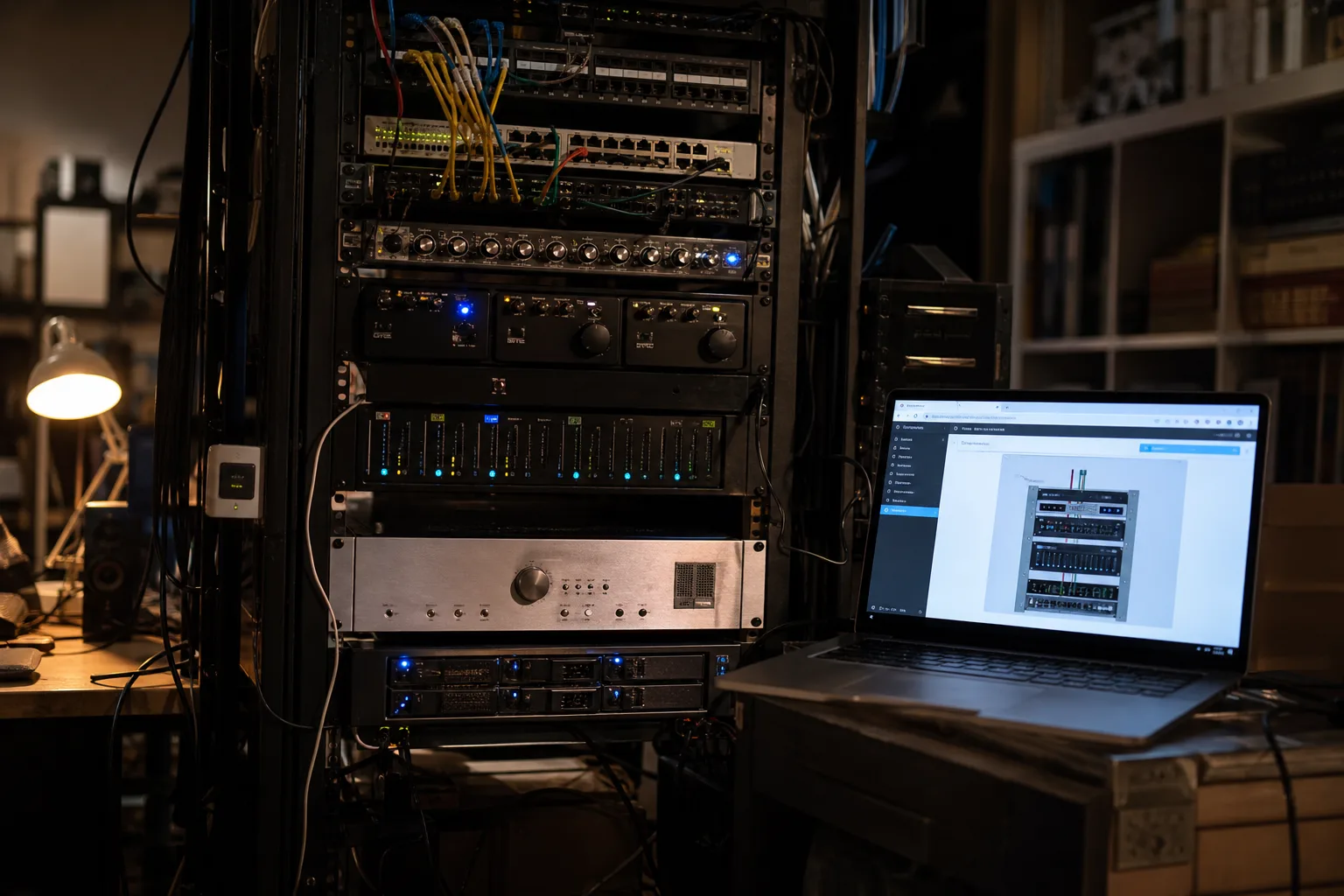
- Rackula server rack visualizer was born from a simple need: helping one developer’s dad organize heavy audio and networking equipment.
- The Rackula server rack tool was built using AI-assisted coding, offering a candid look at both the promise and pitfalls of that workflow.
- Scope creep, cross-browser SVG headaches, and an ill-fitting name were just some of the hurdles cleared across 1,040 commits.
- The tool’s core design principle is radical simplicity — usable by non-technical people without a manual.
Table of Contents
The Rackula Server Rack Tool Nobody Knew They Needed
The Rackula server rack visualizer didn’t start with a product roadmap or a pitch deck. It started with a messy pile of audio amplifiers and networking gear in someone’s dad’s study. Gareth Evans, the developer behind the project, wanted to figure out how to arrange the equipment in a rack without physically hauling heavy boxes around. He went looking for a tool. There wasn’t one that fit the bill — easy to use, capable of exporting images, and not locked to some proprietary cloud format. So he built it himself. That origin story is almost aggressively ordinary, which is exactly what makes the Rackula server rack project interesting.
This is how a huge proportion of the best open-source software gets made. Not by a startup chasing a market opportunity, but by someone with a real, specific problem and enough stubbornness to solve it properly. The homelab and self-hosted communities — thriving corners of Reddit, Discord, and GitHub — run almost entirely on this energy. Tools like NetBox, the popular open-source network documentation platform, were born from similar pragmatic frustration. Rackula even borrowed conceptually from NetBox’s data model: what a rack is, what a device is, how they relate to each other. The code couldn’t be more different, but the mental model carries over cleanly.
Vibe Coding, AI Assistance, and the Honest Reckoning
Evans built the Rackula server rack visualizer during a period when AI coding tools were genuinely starting to prove themselves. Late 2025 was a moment of real inflection for tools like Claude Code — not hype, but actual capability. He’d read Harper Reed’s widely-shared blog post about using AI to brainstorm and spec out projects before touching any code, and that approach shaped his workflow. The idea: spend serious time defining what you want to build, generate a proper specification, then use the LLM to turn that spec into working code. Write the brief well, and the AI has something to work with.
It’s a smarter framing than the pure “vibe coding” approach that Andrej Karpathy famously described in February 2025 — the mode where you “fully give in to the vibes, embrace exponentials, and forget that the code even exists.” Karpathy meant it as a genuine description of a new workflow, not a warning. But for many developers, unstructured AI-assisted coding has delivered exactly the kind of experience that the author of the original piece on Rackula described: opening a project, looking at AI-generated code, and feeling completely disconnected from it. You reviewed it. You know what it does. But it’s not yours, and the moment something breaks, that distance becomes a real problem.
Evans found a middle path. The Rackula server rack tool is genuinely his — 1,040 commits worth of iteration, decision-making, and debugging. The AI accelerated parts of the build, but the architecture came from a human being who understood the problem domain. That distinction matters more than the AI debate often acknowledges.
Why Schema Design Is the Hard Part
One of the most honest observations Evans makes about the build process is about data modeling. Early on, he realized that “a well-defined schema was crucial for building a scalable and maintainable system.” That sounds obvious in retrospect. It always does. But it’s the thing that AI tools genuinely struggle with when starting from scratch.
LLMs are very good at generating code that satisfies a prompt. They’re much weaker at designing the underlying conceptual model — deciding what entities exist, what properties they carry, and how they relate to each other over time. That’s not a function of model intelligence. It’s a function of context. A well-defined schema requires you to have deeply thought through your problem before you start generating solutions. Most people haven’t done that thinking when they first sit down to build something.
For the Rackula server rack visualizer, the schema work drew on NetBox’s conceptual model as a reference point. That’s a smart shortcut — borrow the thinking that already exists in a mature, well-understood system, then adapt it to your specific constraints. It’s the same principle behind using established design patterns in software architecture. You’re not copying the implementation; you’re learning from someone else’s problem-solving.
Scope Creep, Safari Bugs, and 1,040 Commits
Evans is refreshingly candid about where the Rackula server rack project got away from him. “Ideas are easy,” he says. “It is much harder to limit scope creep. What began as a simple idea quickly grew into a complex system with many moving parts.” He’d wanted to model networking and power connectivity in detail — valuable features, but not core to what Rackula actually needed to do. Looking back, he’d have been more deliberate about cutting those ideas earlier.
This is one of the genuinely underappreciated ways AI tools can make solo development harder, not easier. When generating features feels cheap and fast, the psychological cost of adding scope drops. The question stops being “should I build this?” and becomes “why wouldn’t I build this?” That’s a subtle but meaningful shift that can quietly turn a focused tool into an overbuilt one.
Then there’s the browser problem. The Rackula server rack visualizer is built around SVG rendering and drag-and-drop in the browser. That sounds manageable until you actually try to make drag-and-drop work consistently across Chrome, Firefox, and Safari. Evans maintains a GitHub issue label — “damnit/safari” — dedicated entirely to WebKit inconsistencies. Anyone who’s spent time building browser-based interactive tools will recognize that label instantly. Safari’s SVG and drag-and-drop behavior has been a source of developer misery for years, and it’s a particularly sharp edge for a tool whose entire interface depends on moving things around a canvas.
The name changed too. Evans originally called it Rackarr — a nod to the popular *arr suite of self-hosted media tools like Sonarr and Radarr. The Reddit community pushed back almost immediately. The *arr naming carries specific connotations in the homelab world: it implies a certain type of tool, a certain ecosystem relationship. Rackula had neither, so the name didn’t fit. The rename to Rackula was the right call — more distinctive, easier to remember, and free of associations it couldn’t live up to.
What Good Small Software Actually Looks Like
The Rackula server rack visualizer isn’t trying to be NetBox. It’s not trying to be a SaaS product or a VC-backed startup. It’s a focused tool that does one thing well: lets you lay out the contents of a rack visually, move things around, and export the result in a format you actually own. No account required. No lock-in. No subscription.
Evans set a deliberately high bar for usability: the Rackula server rack tool should be something his parents could figure out without help. That’s not a low bar dressed up as a humble one — it’s a genuinely demanding design constraint. Non-technical users have no patience for unclear affordances, confusing terminology, or interfaces that require prior knowledge of the domain. Building for them means every interaction has to be self-explanatory.
That philosophy puts Rackula in good company. The best small software has always been built this way — opinionated about what it does, disciplined about what it doesn’t, and clear enough that the people who need it can just use it. In a homelab ecosystem increasingly dominated by powerful but complex tools, there’s real value in something that doesn’t require a setup guide.
The broader lesson from the Rackula server rack development story is one the AI tooling conversation rarely gets to: the bottleneck in software development was never typing. It was thinking. Knowing what to build, defining it precisely, and having the discipline to stop when it’s done. AI can accelerate execution. It can’t substitute for that upstream clarity. Evans found that out firsthand, and Rackula — 1,040 commits, one renamed project, and a GitHub label full of Safari frustrations later — is the proof of work.