
The Tencent Hy3 model landed quietly last week, but its numbers are anything but quiet. With 295 billion total parameters and just 21 billion active at inference time, it’s the latest entry in a growing class of efficient open-source AI models that are making the raw parameter count conversation feel increasingly outdated.
- The Tencent Hy3 model uses a Mixture-of-Experts architecture with 295 billion total parameters but only 21 billion active at once.
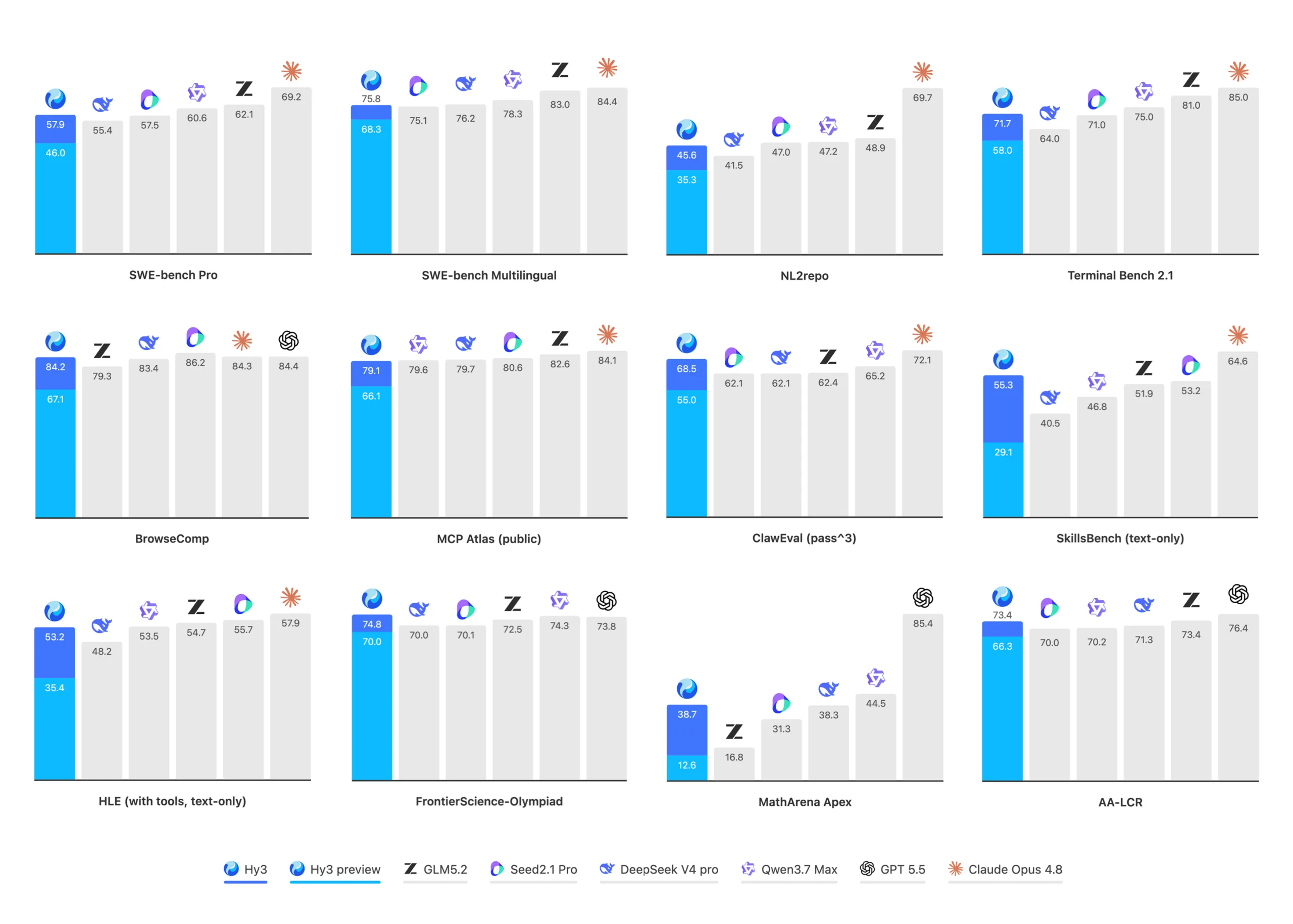
- Tencent Hy3 model benchmarks suggest it matches the performance of models two to five times its active parameter size.
- Hy3 cut its hallucination rate from 12.5 percent to 5.4 percent in internal testing — a meaningful reliability improvement.
- Released under an Apache 2.0 licence, Hy3 is available on Hugging Face, ModelScope, and GitHub with an FP8-quantized option.
Table of Contents
What the Tencent Hy3 Model Actually Is
Hy3 is built on a Mixture-of-Experts (MoE) architecture — a design that’s been gaining serious traction across the industry since DeepSeek’s models helped prove the concept at scale earlier this year. The core idea is straightforward: instead of running every parameter in the network for every token, you route each input through a small subset of ‘expert’ sub-networks. The rest of the model stays dormant. The result is a network that looks enormous on paper but behaves much leaner in practice.
In Hy3’s case, that means 21 billion active parameters per forward pass, plus an additional 3.8 billion dedicated to a multi-token prediction (MTP) layer — a technique that helps the model generate text more efficiently by predicting multiple tokens simultaneously rather than one at a time. It’s the kind of architectural detail that doesn’t make headlines but genuinely matters for deployment speed.
Context length comes in at 256,000 tokens, which is substantial. For reference, that’s in the same territory as Anthropic’s Claude 3.5 and well ahead of many open-source alternatives. Processing a full legal contract, a large codebase, or an hour-long transcript without truncation is the kind of real-world capability that enterprise users actually care about. The Tencent Hy3 model’s context window alone makes it a compelling option for document-heavy workflows.

The Benchmark Claims — and Why They Deserve Scrutiny
Tencent says the Tencent Hy3 model matches models two to five times its active parameter size. That’s a bold claim, and it’s the kind of statement that tends to get repeated uncritically in press cycles before the research community has had a chance to poke holes in it.
To its credit, Tencent didn’t rely entirely on automated benchmarks. A blind evaluation involving 270 domain experts placed Hy3 at 2.67 out of 4 — ahead of GLM-5.1, which scored 2.51. GLM-5.1 is Zhipu AI’s flagship model, so beating it is a meaningful data point rather than a low bar. Human preference evaluations are generally considered more informative than standard benchmarks like MMLU or HumanEval, which have well-documented saturation problems and can be gamed through targeted training data.
The hallucination figures are the other headline stat. Internal testing showed the Tencent Hy3 model’s hallucination rate dropped from 12.5 percent to 5.4 percent compared to a prior version. A drop of that magnitude — more than halving the rate — would be genuinely significant if it holds up under external scrutiny. Hallucination has historically been one of the harder problems to move the needle on, and most labs report incremental improvements rather than step-changes. Whether that 5.4 percent figure survives independent replication is a question worth watching.
Open-Source, Apache 2.0, and What That Actually Means
The Tencent Hy3 model is available now on Hugging Face, ModelScope, and GitHub under an Apache 2.0 licence. That’s the most commercially permissive end of the open-source spectrum — it allows unrestricted commercial use, modification, and redistribution, with no copyleft obligations. Compare that to Meta’s Llama licences, which have historically included usage restrictions and required special agreements beyond a certain user threshold. Apache 2.0 is a genuinely clean release.
An FP8-quantized version is also available, which matters a lot for anyone trying to run this on hardware that isn’t a cluster of H100s. FP8 quantization cuts memory requirements substantially with minimal quality degradation — making a 21-billion active-parameter model far more accessible to researchers and startups who can’t throw enterprise-grade GPU infrastructure at every experiment.
Tencent has also signalled plans to add support for OpenRouter and Cline, two platforms that have become go-to integration layers for developers building AI-powered applications. That suggests Tencent is actively courting the developer ecosystem rather than treating the open-source release as a PR exercise.
Already Running in Production — at Enormous Scale
One of the underreported aspects of this launch is that the Tencent Hy3 model isn’t a research preview. It’s already deployed inside several of Tencent’s own products: WorkBuddy, the enterprise productivity tool; Yuanbao, Tencent’s consumer AI assistant; WeChat, which has north of 1.3 billion monthly active users; and even as a game assistant for ‘Path of Exile: Advent.’
That last one is interesting. Game assistants are a surprisingly demanding use case — players want fast, accurate, contextually aware responses during active gameplay sessions. Latency tolerance is low. If the Tencent Hy3 model is running acceptably in that environment, the efficient inference profile of the MoE architecture is clearly doing real work.
Running a model at WeChat’s scale isn’t a soft launch. It’s effectively the largest stress test any model can go through, and the fact that Tencent chose Hy3 for that deployment rather than an older, more battle-tested internal model says something about the confidence they have in it.
Where This Fits in the Broader Open-Source AI Race
China’s AI labs have been unusually aggressive about open-source releases in 2025. DeepSeek’s R2 and the V3 architecture set a high bar earlier in the year. Alibaba’s Qwen series has been steadily building a strong developer following. Now Tencent is throwing its weight behind the trend.
The pattern is worth paying attention to. Western labs — OpenAI, Anthropic, Google — have largely moved away from open-weight releases, betting on API access and proprietary infrastructure as their moat. Chinese labs are taking the opposite bet: release the weights, build the ecosystem, and win on deployment breadth rather than access control.
Whether that strategy pays off long-term remains genuinely unclear. But in the near term, it’s creating a very competitive open-source landscape that benefits developers everywhere. The Tencent Hy3 model is the latest example of that dynamic — and if its performance claims hold up under independent evaluation, it’s going to put serious pressure on anyone still charging API fees for comparable capability.