

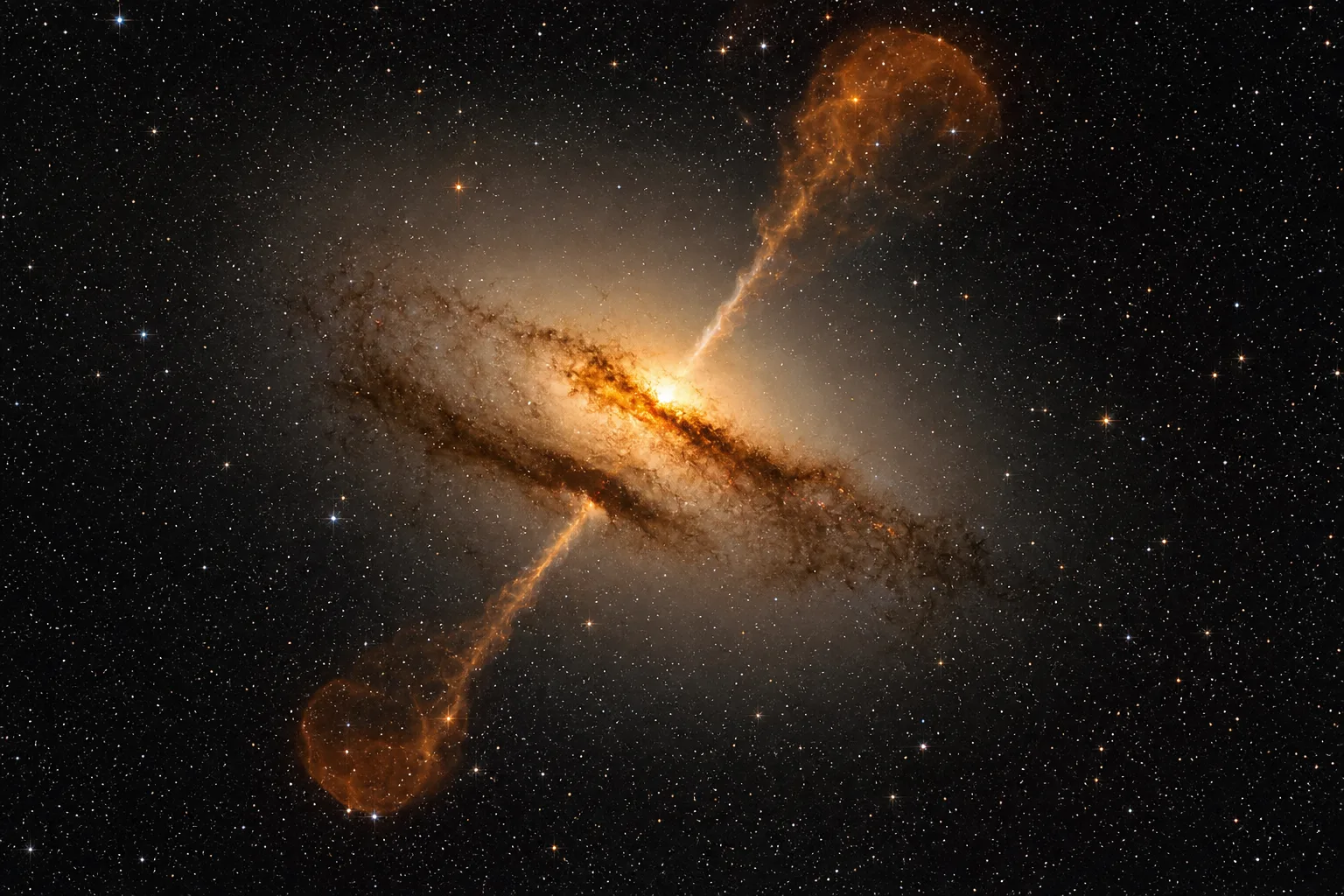
A galaxy collision set off a chain of events still playing out today. NASA’s James Webb Space Telescope has now given us our clearest look yet at the aftermath — peeling back the thick dust that has long hidden the heart of the Centaurus A galaxy and revealing a densely packed, actively churning core that no observatory has ever properly seen before.
- Webb’s infrared vision has revealed the Centaurus A galaxy’s dust-shrouded core in unprecedented detail for the first time.
- The Centaurus A galaxy’s chaotic structure is the direct result of a collision with another galaxy.
- Webb marks four years of science operations with performance that has consistently exceeded engineers’ original expectations.
- Individual stars and an actively evolving galactic nucleus are now visible where only thick dust lanes existed before.
Table of Contents
What Webb Actually Showed — and Why It Matters
The Centaurus A galaxy sits in the constellation Centaurus, making it one of the closest radio galaxies to Earth and one of the most studied objects in the southern sky. But ‘studied’ is relative. For decades, the galaxy’s center has been effectively off-limits to optical telescopes, buried behind dense curtains of interstellar dust that scatter and absorb visible light. Hubble could trace the galaxy’s dramatic dark dust lanes cutting across its elliptical body, but the nucleus itself remained stubbornly obscured.
Webb changed that in a single observation campaign. Operating at near- and mid-infrared wavelengths — light that passes through dust rather than being blocked by it — Webb’s instruments cut straight to the core. What they found wasn’t a vague glow. It was a tapestry: individual stars resolved against a backdrop of swirling gas and dust structures, and at the center of it all, an active galactic nucleus feeding on surrounding material and driving powerful jets of plasma out into intergalactic space.
This is the kind of detail that changes how astronomers model galactic evolution. Seeing individual stars in a region this crowded and this distant is no small thing — it means researchers can now begin mapping stellar populations in the Centaurus A galaxy’s core, separating old red giants from younger, hotter stars formed in post-collision bursts of activity.
A Crash Long in the Making
The Centaurus A galaxy didn’t always look like this. Its distinctive shape — an elliptical galaxy bisected by a dramatic dark band, warped at the edges, trailing plumes of stars — is the legacy of a catastrophic merger with a spiral galaxy. The scars are still visible and the nucleus is still actively processing the infallen gas.
Galaxy mergers are among the most energetic events in the universe, and they’re also surprisingly common over cosmic timescales. Our own Milky Way is on a slow-motion collision course with the Andromeda Galaxy, expected to play out in about 4.5 billion years. What Webb is showing us in the Centaurus A galaxy is, in a sense, a preview — a detailed case study of what a post-merger galaxy looks like when the dust (quite literally) settles.
The collision funneled enormous amounts of gas toward the Centaurus A galaxy’s center, feeding the supermassive black hole that sits there and triggering jets that extend hundreds of thousands of light-years beyond the galaxy itself. Those jets are visible in radio wavelengths and X-rays, and they’ve been studied for decades. But Webb’s infrared view adds a new layer: the intimate, star-by-star structure of the region where all that energy originates.
Centaurus A Galaxy Images as Webb’s Fourth Anniversary Showcase
NASA chose the Centaurus A galaxy images to mark Webb’s fourth science anniversary, and it’s a deliberate flex. Four years in, the telescope is performing better than engineers projected when it launched on Christmas Day 2021 aboard an Ariane 5 rocket from Kourou, French Guiana. The precision of that launch left Webb with more fuel reserves than planned, extending its operational lifespan well beyond the original 10-year design target.
That longevity matters enormously. Webb took decades to develop through a partnership between NASA, the European Space Agency, and the Canadian Space Agency. Every extra year of operation multiplies the scientific return on that investment. And the anniversary images aren’t just celebratory — they’re a statement about capability. Showing the Centaurus A galaxy’s hidden core in this kind of detail, four years after first light, signals that the telescope’s best science may still be ahead of it.
The wider astronomy community has responded to Webb’s run with something close to collective astonishment. Proposal rates for telescope time have been consistently oversubscribed — demand for Webb observations has reportedly outstripped available hours by a significant margin, reflecting fierce competition among researchers for time on the telescope.
What Infrared Vision Unlocks That Visible Light Can’t
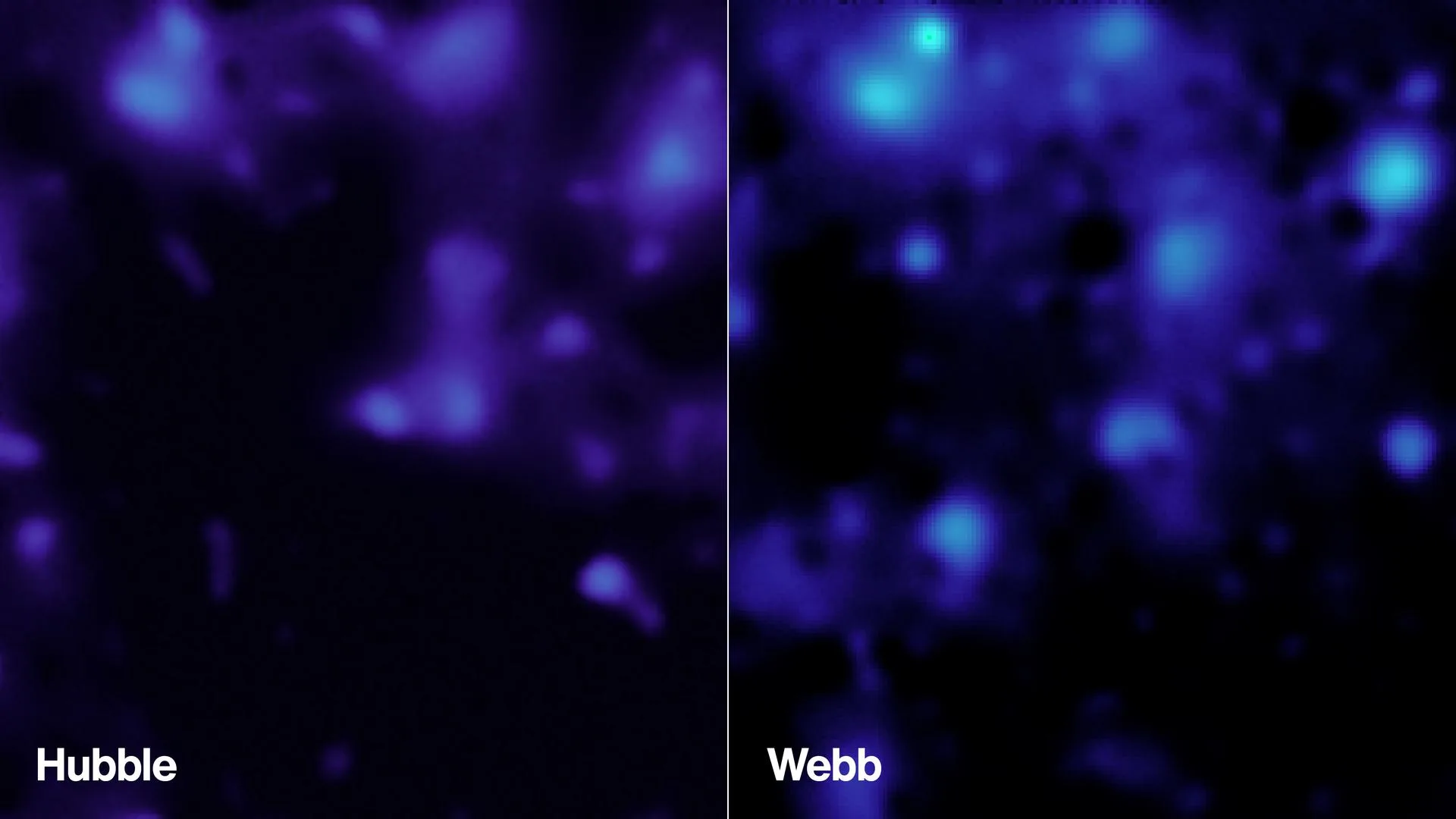
It’s worth being specific about the technical leap here, because the jump from Hubble to Webb isn’t just a matter of bigger mirrors or better sensors — it’s about observing at fundamentally different wavelengths.
Dust grains in space are sized such that they interact strongly with visible and ultraviolet light, absorbing and scattering photons before they can reach us. Infrared light, with its longer wavelength, passes through that dust with far less interference. Webb’s primary mirror — 6.5 meters across, assembled from 18 gold-coated beryllium hexagons — was specifically designed to collect faint infrared light with unprecedented sensitivity. Its Mid-Infrared Instrument (MIRI), built in partnership with ESA, pushes into wavelengths that no previous space telescope could access with this level of resolution.
For the Centaurus A galaxy specifically, that means astronomers can now study not just the stars but the dust itself — its temperature, its distribution, its chemical composition. Warm dust around the galactic nucleus glows brightly at mid-infrared wavelengths, tracing the regions where material is actively falling toward the black hole. Cooler dust further out maps the galaxy’s spiral arm remnants from the original merger. Webb sees all of it simultaneously.
The Bigger Picture for Galactic Astronomy
The Centaurus A galaxy isn’t unique in being a merger remnant with an active nucleus — the universe is full of them. What makes it exceptional is proximity. Close enough that Webb can resolve individual stars rather than blended stellar populations, that resolution is what turns a pretty picture into a scientific dataset.
Researchers will now be able to use these images to do things like measure the rate of star formation in the post-merger environment, track how the black hole’s jets interact with the surrounding interstellar medium, and compare the Centaurus A galaxy’s stellar populations against theoretical models of galaxy evolution. Every one of those threads connects to bigger questions: How do supermassive black holes grow? How does a violent merger eventually produce a stable elliptical galaxy? What role does feedback from an active nucleus play in shutting down star formation?
Webb won’t answer all of those questions on its own. But for the Centaurus A galaxy, it’s just handed astronomers a dataset that will take years to fully mine — and that’s arguably the most exciting thing about it. The telescope is four years into its mission, firing on all cylinders, and the science is only getting deeper.

