

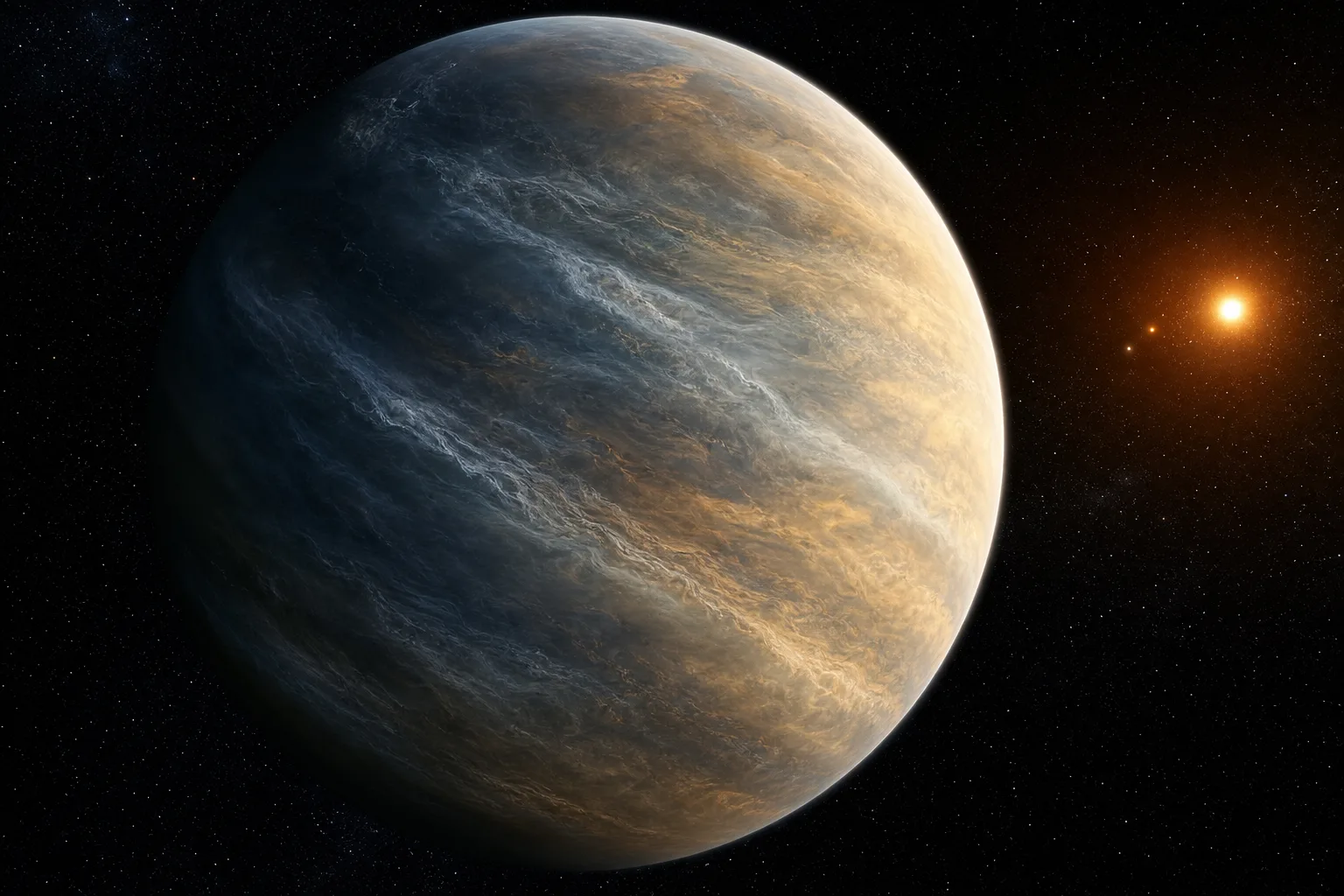
Sub-Neptune planets are the most common type of world in the Milky Way — and we barely know what they’re made of. That’s not a minor gap in our knowledge. It’s arguably the biggest open question in planetary science right now, and a new wave of research is zeroing in on why clouds are the single biggest obstacle standing between astronomers and real answers.
- Sub-Neptune planets are the most abundant planet type in the Milky Way, yet their interior composition remains largely unknown.
- Clouds in the atmospheres of sub-Neptune planets scatter and absorb light, making it extremely difficult to read what lies beneath.
- Astronomers are working to distinguish between rocky worlds wrapped in hydrogen atmospheres and volatile-rich planets loaded with water or carbon molecules.
- Understanding sub-Neptune interiors could reshape what we know about how planetary systems — including our own — actually form.
Table of Contents
The Galaxy’s Most Common Planet Type We Still Don’t Understand
Here’s the strange situation we’re in: sub-Neptune planets make up the plurality of worlds detected by missions like NASA’s Kepler and TESS, yet our solar system has nothing like them. They’re bigger than Earth but smaller than Neptune — typically clocking in between 1.5 and 3.5 Earth radii — and that size range is suspiciously absent from our own planetary neighbourhood. We can find them in abundance around other stars. We just can’t seem to figure out what they actually are.
The core question astronomers want to answer is one of interior composition. Are sub-Neptune planets essentially oversized rocky worlds that happened to accumulate a thick hydrogen-rich envelope over billions of years? Or are they something more exotic — volatile-rich planets where water, carbon dioxide, or carbon-bearing molecules make up a huge fraction of the total mass? The difference matters enormously. One scenario points to a formation history not entirely unlike Earth’s. The other suggests a class of planet that’s genuinely alien, built from ingredients and under conditions that didn’t occur in our own solar system’s early life.
The frustrating part is that we have the tools. The James Webb Space Telescope was partly designed for exactly this kind of atmospheric characterisation work. But there’s a catch — one that keeps getting in the way.
Why Clouds Are the Central Problem
To understand what a planet is made of from tens or hundreds of light-years away, astronomers rely on transmission spectroscopy. The idea is elegant: when a planet passes in front of its star, a thin sliver of starlight filters through the planet’s atmosphere. Different molecules absorb different wavelengths of that light, leaving a chemical fingerprint that instruments like JWST’s NIRSpec and NIRISS can read. In principle, you can detect water vapour, methane, carbon dioxide, and a host of other molecules this way.
In practice, clouds ruin everything.
High-altitude clouds and photochemical hazes sit like a lid over the lower atmosphere, scattering and blocking the very wavelengths astronomers need to detect those chemical signatures. Instead of sharp absorption features, you get a flat, featureless spectrum — the atmospheric equivalent of a redacted document. You know something is there. You just can’t read it.
This isn’t a new problem, but it’s proving stubbornly persistent even with next-generation instruments. The clouds that form in sub-Neptune atmospheres aren’t necessarily the same as the water clouds we see on Earth or the ammonia clouds on Jupiter. Depending on the temperature and chemical makeup of a given planet’s atmosphere, you might be dealing with silicate clouds, salt clouds, or complex organic hazes. Each one blocks light in different ways, and modelling them accurately requires knowing things about the planet’s composition that you’re trying to determine in the first place — a circular problem that’s been frustrating researchers for years.
Two Very Different Kinds of Worlds
Strip away the observational challenges and you’re left with two broad categories that researchers keep coming back to when they talk about sub-Neptune planets.
The first is the ‘gas dwarf’ model: a rocky or iron-rich core surrounded by a substantial hydrogen and helium envelope, essentially a shrunken version of Neptune or Uranus. These worlds could have formed in the outer regions of their planetary systems and migrated inward, or they could have built up their gaseous envelopes in place if conditions were right.
The second is far more intriguing. Some sub-Neptune planets may be ‘Hycean’ worlds — a term coined by Cambridge astronomer Nikku Madhusudhan to describe planets with hydrogen-rich atmospheres sitting above vast global oceans of liquid water. These aren’t ocean planets in the terrestrial sense. The pressures and temperatures involved are extreme, and any water present would exist in exotic phases. But if they’re real and common, they would represent an entirely new category of habitable environment.
K2-18b, a sub-Neptune orbiting a red dwarf about 120 light-years from Earth, became a lightning rod for this debate in 2023 when JWST detected carbon dioxide and methane in its atmosphere — a combination that some researchers argued pointed toward a Hycean configuration. The claim was immediately contested, and the scientific back-and-forth is still ongoing. That’s science working as it should, but it illustrates how difficult it is to draw firm conclusions when clouds are masking so much of the signal.
What Better Cloud Models Could Change
The push to understand sub-Neptune planets more clearly isn’t just about pointing bigger telescopes at them. A significant part of the work is theoretical — building more accurate models of how clouds form, evolve, and interact with radiation in the specific temperature and pressure regimes these planets inhabit.
That’s harder than it sounds. Cloud formation is a notoriously messy physical process even in well-studied environments. In sub-Neptune atmospheres, where the chemistry and dynamics can differ wildly from one planet to the next, producing general models that astronomers can reliably apply across a population of planets is a genuine research challenge. Groups at institutions including MIT, the University of Chicago, and several European universities have been developing increasingly sophisticated atmospheric retrieval codes that try to account for cloud and haze layers, but there’s no consensus yet on the best approach.
The payoff, if those models improve, would be substantial. Astronomers would be able to take existing JWST data — already collected for dozens of sub-Neptune planets — and extract far more information from it than current analysis allows. In some cases, the difference between a rocky atmosphere and a volatile-rich one might already be hiding in datasets we have, waiting for better tools to reveal it.
A Missing Piece in Planetary Formation Theory
There’s a broader reason all of this matters beyond the intrinsic interest of individual planets. Understanding what sub-Neptune planets are made of is directly tied to understanding how planetary systems form in general.
The fact that sub-Neptune planets are so common — statistically, they appear to orbit something like half of all sun-like stars in the galaxy — and yet our own solar system produced none of them is one of the most puzzling features of the current exoplanet census. Did the conditions in our early solar system actively suppress their formation? Did Jupiter’s gravitational influence disrupt the process? Or did they form and then get destroyed, leaving behind the rocky inner planets and gas giants we see today?
If we can establish whether the population of sub-Neptune planets skews rocky-with-atmosphere or volatile-rich, that gives planetary formation theorists a powerful constraint to work with. It’s the difference between a formation pathway that’s essentially similar to what produced Earth and Neptune, versus one that requires a fundamentally different story about what was happening in the inner disk of early planetary systems.
The clouds, in that sense, aren’t just an observational nuisance. They’re guarding the answer to one of the most significant structural questions in astronomy. Cracking them open — whether through better instrumentation, smarter atmospheric models, or both — is one of the field’s defining challenges for the rest of this decade.
Frequently Asked Questions
Why are sub-Neptune planets so difficult to study?
Sub-Neptune planets sit in a size range between Earth and Neptune that our solar system doesn’t have, so we have no nearby reference point. Scientists still do not know what these worlds are made of, making their interior composition one of the key mysteries astronomers are trying to solve.
What are the two main theories about what sub-Neptune planets are made of?
Astronomers think sub-Neptune planets are either rocky worlds wrapped in thick hydrogen-rich atmospheres, or volatile-rich worlds dominated by water or carbon-bearing molecules.
How do clouds affect what we can learn about sub-Neptune planets?
The source does not specifically address how clouds affect the study of sub-Neptune planets. What is known is that their interior composition remains deeply mysterious, as scientists have not yet determined what these worlds are made of.
Are there any sub-Neptune planets we have already studied closely?
The source does not mention any specific sub-Neptune planets that have been studied closely, nor does it reference any particular telescope observations or findings. It notes only that sub-Neptune planets remain deeply mysterious because their composition is still unknown.

