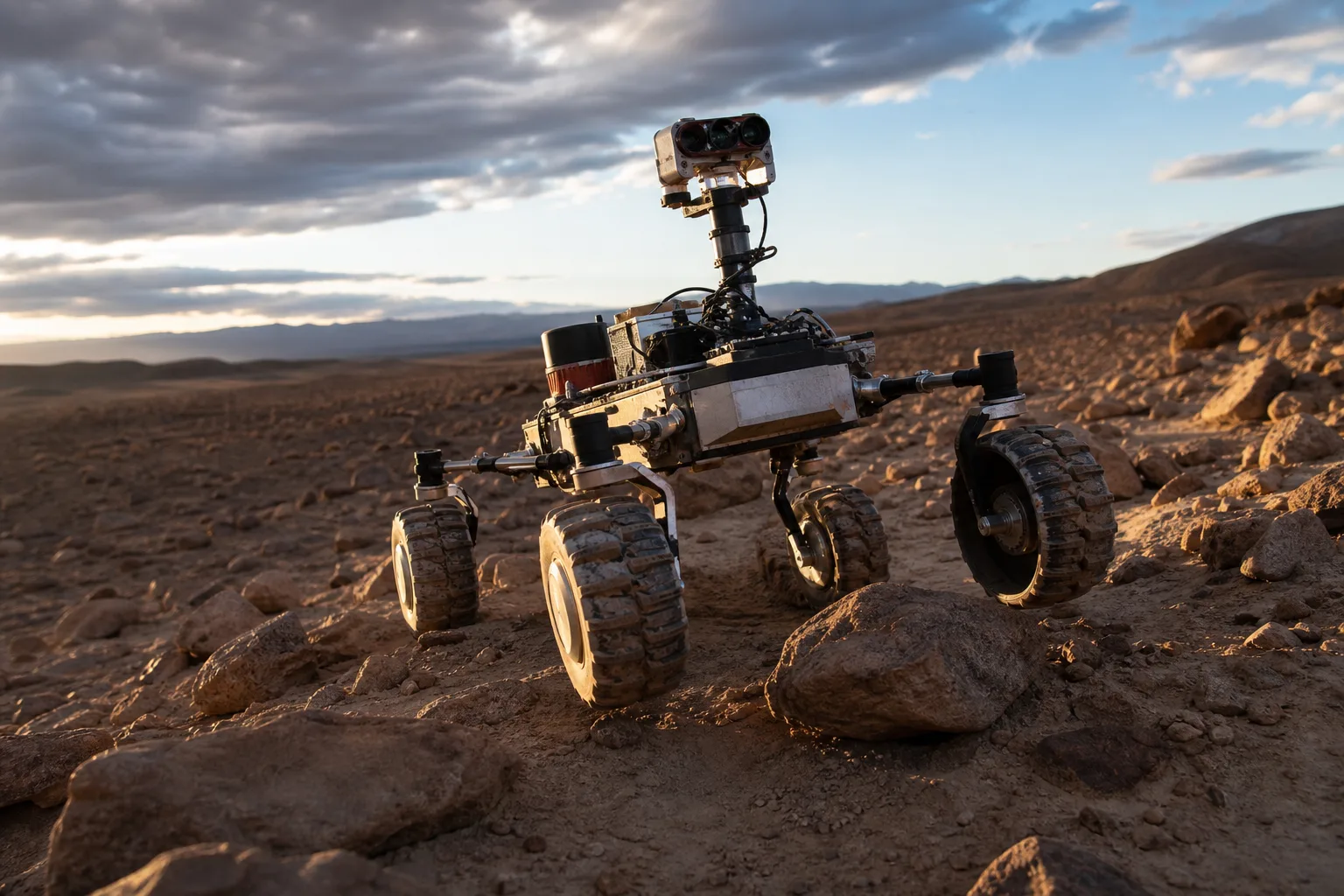
NASA’s newest Mars rover prototype just spent a week crawling through the California desert — and it did most of it on its own. The Exploration Rover for Navigating Extreme Sloped Terrain, mercifully shortened to ERNEST, covered 16 miles of Southern California terrain over seven days in March, racking up more than 37 hours of drive time with what NASA’s Jet Propulsion Laboratory describes as ‘minimal intervention’ from engineers. That’s not a minor milestone. That’s a signal that the way NASA builds planetary rovers is about to change in a significant way.
- NASA’s Mars rover prototype ERNEST completed a 16-mile autonomous desert trek over seven days with minimal human intervention.
- The Mars rover prototype uses AI trained through thousands of hours of simulated reinforcement learning to navigate extreme terrain.
- ERNEST ditches the decades-old rocker-bogie wheel system for a four-wheeled design with active suspension and per-wheel steering.
- Engineers see ERNEST as a blueprint for larger, faster rovers capable of reaching terrain that current robots simply can’t access.
Table of Contents
Why This Mars Rover Prototype Is Built Differently
Every rover NASA has sent to Mars — Sojourner, Spirit, Opportunity, Curiosity, Perseverance — has relied on some variation of the rocker-bogie suspension system. It’s a passive arrangement of open pivot points that distributes weight evenly across six wheels, letting the rover absorb rough terrain without tipping. It’s worked remarkably well. Perseverance has been exploring Mars for years, and Opportunity kept rolling for a remarkably long time. But there’s a ceiling to what rocker-bogie can do, and researchers at JPL have spent decades studying it.
‘While the rocker-bogie system has been very successful over the past 30 years, there’s been a lot of research in that time on mobility and understanding terrain interaction,’ said Hari Nayar, lead principal technologist for the ERNEST team. ERNEST is the physical expression of what that research has been pointing toward. As a Mars rover prototype, it represents a deliberate departure from the design assumptions that have governed planetary mobility for three decades.
The prototype is four-wheeled rather than six, measuring about 4 feet long. Two gimballing joints on its front chassis allow it to actively alter its own gait, producing motion patterns that JPL describes as ‘squirming, wheel-walking, and obstacle-climbing.’ Each wheel can also steer independently, so the rover isn’t limited to a fixed arc — it can sidestep, pivot, and reposition in ways its predecessors simply couldn’t. Think of it less like a car and more like an insect that’s been taught physics.
The AI Brain Behind ERNEST
Hardware alone doesn’t make this Mars rover prototype interesting. What’s genuinely compelling is how ERNEST thinks. Its navigation intelligence was built through reinforcement learning — the same broad family of AI techniques that trained DeepMind’s AlphaGo and OpenAI’s robotic systems. JPL ran thousands of simultaneous virtual simulations, allowing ERNEST to accumulate what would normally take months of physical testing in just a few days of compute time. The result is a rover that doesn’t wait to be told what to do with a rock in its path. It decides.
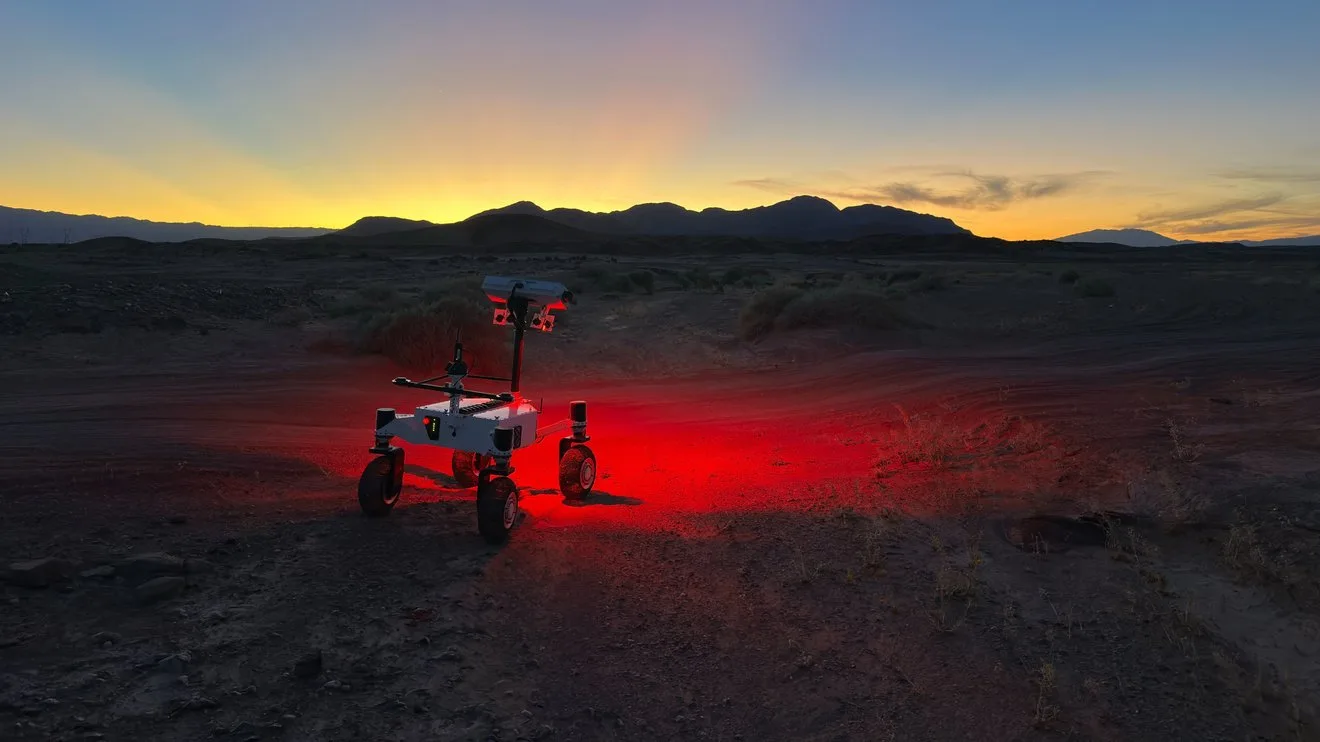
After the virtual training phase, the team put ERNEST through JPL’s Mars Yard — an obstacle course on the Pasadena campus designed to mimic Martian and lunar surface conditions — before graduating it to the real thing in the California desert. The desert test included night driving and other low-light scenarios specifically chosen to simulate conditions on the moon, where shadowed craters and long lunar nights create lighting environments that would confuse a camera-dependent rover with simpler programming.
‘This testing is helping us refine the mobility hardware and autonomy software to navigate extreme distances across a wide range of terrain and lighting conditions anticipated on the moon,’ said Issa Nesnas, a JPL principal technologist, in the agency’s June 18 statement.
That combination — an active suspension that adapts mechanically, paired with AI that adapts strategically — is what gives this Mars rover prototype its edge. Neither half of that equation is entirely new on its own. But putting them together in a single vehicle, training the AI in simulation at scale, and then validating it across 16 real-world miles with minimal human oversight? That’s the meaningful step forward.
Putting the Distance in Context
To appreciate what ERNEST pulled off in a week, consider Perseverance’s track record. NASA’s Perseverance rover, which landed in Jezero Crater, only recently crossed the marathon distance threshold — 26.2 miles — after more than five years of operation on Mars. That’s not a criticism of the rover; it reflects the caution required when you’re operating a rover across interplanetary distances, where a single misstep can end a mission. Every meter Perseverance has driven involved ground team review, path planning, and approval cycles that can take hours per command sequence.
ERNEST drove 16 miles in seven days — at speeds up to 0.6 mph, which is actually faster than any rover currently operating on the moon or Mars. The point isn’t that ERNEST is faster in a drag-race sense. The point is that a Mars rover prototype capable of intelligent self-navigation could cover vastly more ground per mission without requiring constant human oversight. For science return, that’s enormous. Opportunity’s greatest discoveries reportedly came from its ability to rove widely. A rover that can roam farther and faster without a 40-minute round-trip radio delay holding back every decision could fundamentally change what planetary science looks like.
Where ERNEST Fits in NASA’s Broader Plans
Development on ERNEST began in 2022, initially funded through JPL’s internal research and development budget. Since then it’s been formally folded into NASA’s Science Mission Directorate through the Exploration Science Strategy and Integration Office, and it’s now part of the agency’s Mars Exploration Program. That institutional adoption matters. Internal R&D projects live and die by whether they get picked up by a mission office. ERNEST has cleared that hurdle.
NASA’s stated goal for the technology is integration into future rovers destined for both the moon and Mars. The lunar angle is particularly timely. With the Artemis program pushing toward sustained crewed presence on the lunar surface — NASA’s long-term plan involves a Gateway station and eventual surface base camps — there’s real operational demand for rovers that can scout terrain, carry equipment, and operate in the perpetually shadowed regions near the lunar south pole without waiting on an astronaut to steer them. ERNEST’s desert night-driving tests were aimed directly at that use case. The lessons learned from this Mars rover prototype are expected to inform lunar rover designs as well.
The engineering team is also clear that the current prototype is a proof of concept, not a finished product. They see ERNEST as a model — a platform whose design principles will scale up into larger, faster, more capable vehicles. The four-wheel active-suspension architecture and the reinforcement-learning AI stack both have room to grow. What JPL learned about terrain interaction, wheel slip, and autonomous decision-making during that seven-day California desert run feeds directly into whatever comes next.
The Bigger Picture for Autonomous Planetary Exploration
It’s easy to frame this as a NASA story, but the underlying trend is broader. The field of autonomous robotics has accelerated dramatically over the past decade, driven by advances in simulation infrastructure, neural network training, and edge computing. What used to require purpose-built expert systems — systems that could only handle the terrain types their designers explicitly anticipated — can now be handled by AI trained through experience, even simulated experience. ERNEST is one of the clearest examples of that shift making its way into space exploration hardware, and its success as a Mars rover prototype has strengthened the case for autonomy-first rover design.
The Mars rover prototype also highlights an important tension in planetary science: the tradeoff between caution and coverage. Human-in-the-loop rover operation has served NASA well precisely because the cost of losing a rover is catastrophic and the communication delays make real-time intervention impossible. But it also means that years of mission time get spent on terrain that’s already understood, while interesting but risky features go unvisited. A rover that can make its own obstacle assessments — and has been trained well enough to make good ones — starts to shift that calculus.
ERNEST isn’t going to Mars tomorrow. But the fact that this Mars rover prototype can already navigate 16 autonomous miles through a Southern California desert, at night, with minimal human help, suggests the era of truly self-directed planetary explorers is closer than the pace of Perseverance’s odometer might lead you to believe.
Frequently Asked Questions
What makes the ERNEST Mars rover prototype different from Perseverance?
Unlike Perseverance’s passive six-wheel rocker-bogie suspension, ERNEST uses a four-wheeled active suspension with gimballing front joints and per-wheel steering. It also runs AI trained through reinforcement learning, allowing it to assess and navigate obstacles with far greater autonomy than any current rover.
How autonomous is ERNEST during testing?
During its March desert test, ERNEST completed the full 16-mile, 37-hour journey with minimal human intervention. Engineers monitored the rover remotely but rarely needed to step in, demonstrating a meaningful leap in onboard decision-making capability.
How was ERNEST’s AI trained?
ERNEST’s AI was developed through reinforcement learning in a virtual environment, where multiple simultaneous simulations allowed it to accumulate thousands of hours of experiential data within just a few days before transitioning to physical testing at JPL’s Mars Yard.
When could ERNEST’s technology be used on an actual moon or Mars mission?
NASA hasn’t announced a specific mission timeline for ERNEST’s technology, but the prototype is now under the agency’s Mars Exploration Program and Science Mission Directorate, suggesting active planning. It’s intended as a design model for the next generation of planetary rovers.