

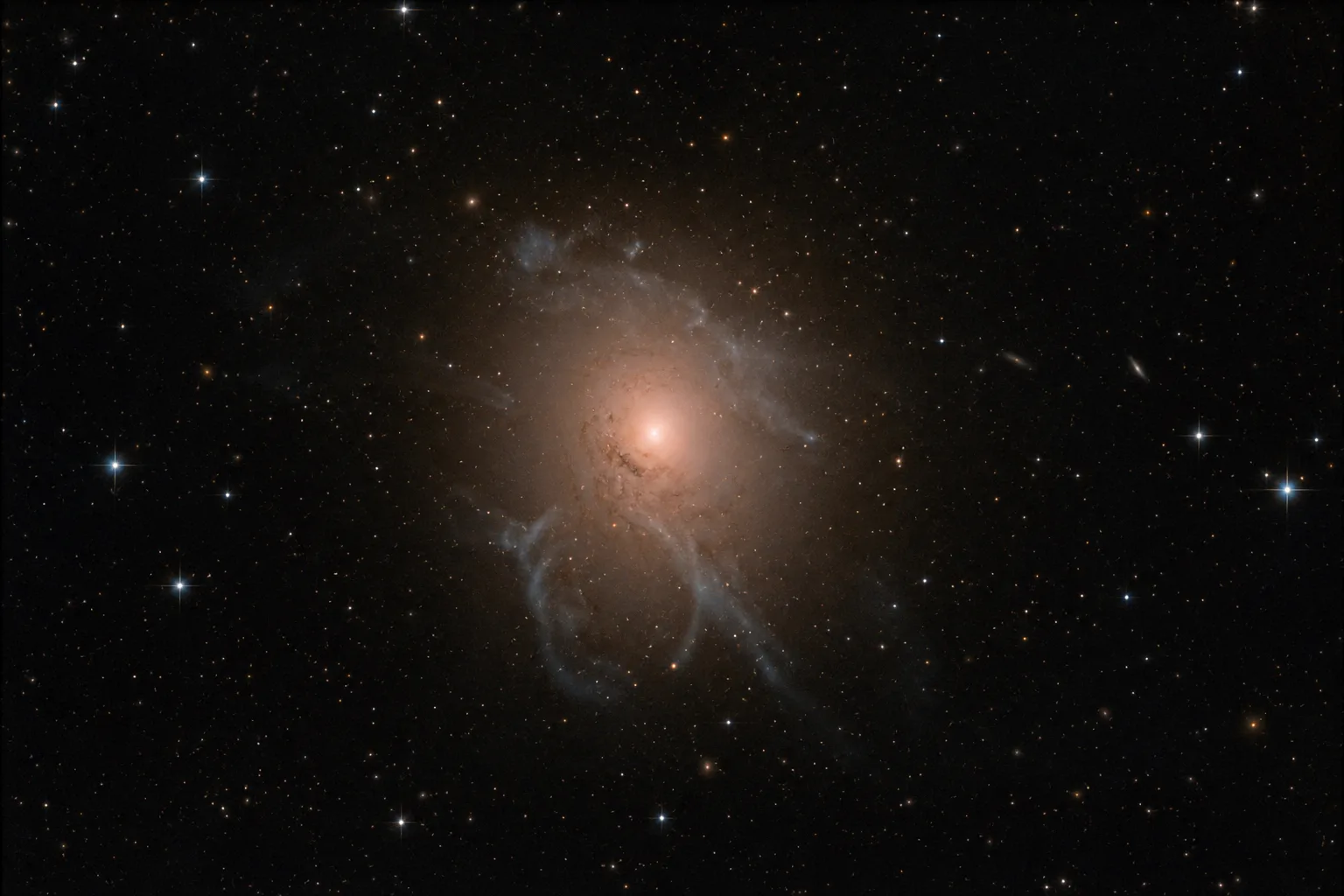
For decades, one of the more awkward facts in cosmology has been the existence of massive, ancient galaxies that simply… stopped. They churned out stars at a furious rate in the early universe, then went dark — long before they had any obvious reason to. Now astronomers say they’ve caught a dying galaxy in the act, watching it lose the raw material for star formation in real time, just 1.4 billion years after the Big Bang.
- Astronomers have spotted a dying galaxy being stripped of star-forming gas just 1.4 billion years after the Big Bang.
- The dying galaxy discovery offers a rare real-time view of a process that normally only shows up in cosmic fossils.
- So-called ‘red and dead’ galaxies stopped forming stars surprisingly early, and scientists are still working out why.
- A new arXiv preprint published June 16 lays out the evidence and explores what triggered this galaxy’s slow death.
Table of Contents
The Mystery of the ‘Red and Dead’
Astronomers have known about so-called ‘red and dead’ galaxies for years. These are massive elliptical systems whose stellar populations are old and cool — the red tones a tell-tale sign that no hot, bright, young stars have been born there for a very long time. What makes them strange isn’t their appearance. It’s their age. Many of these quiescent galaxies went dark astonishingly early in cosmic history, in an era when the universe was still rich with the gas that stars are made from.
The natural question — one that has kept astrophysicists busy for the better part of two decades — is: what killed them? Star formation doesn’t just stop on its own. Something has to remove or disable the cold, dense gas reservoirs that galaxies need to keep building new stars. Figuring out the mechanism, especially in the very early universe, has proven genuinely difficult. Most of the evidence comes from fossils: galaxies we observe long after the quenching happened, with few clues left about how it played out.
That’s precisely why the latest discovery, detailed in a paper posted to arXiv on June 16, is drawing attention. Instead of a dead galaxy, researchers believe they’ve found one that’s currently dying — a system actively being stripped of its star-forming gas at a cosmic epoch when the universe was less than 10 percent of its current age.
Catching a Dying Galaxy in the Act
The significance here is hard to overstate. Observing a dying galaxy mid-process is the difference between finding a crime scene cold and watching it happen. The clues are fresher, the physics more legible, and the opportunity to connect cause and effect is dramatically better.
At 1.4 billion years post-Big Bang, the universe was an extremely different place. Galaxy formation was happening at a ferocious pace. Mergers were common. Supermassive black holes at the centers of many galaxies were far more active than those we see today — including the comparatively sleepy one sitting at the heart of our own Milky Way. Any of these factors, alone or in combination, could plausibly trigger the stripping of a galaxy’s gas supply.
The researchers behind the preprint lay out their evidence for what’s happening to this particular system, tracing the clues that point to its star-forming gas being pulled away or disrupted. While the paper hasn’t yet cleared formal peer review — arXiv is a preprint server — the astrophysics community regularly uses it to circulate serious, high-quality work ahead of journal publication, and the findings are already generating discussion.
What Actually Kills a Galaxy?
There’s no single agreed-upon answer, and that’s part of what makes the field so active right now. A few leading candidates keep coming up in the literature.
The most dramatic is AGN feedback — the process by which an active galactic nucleus, essentially a supermassive black hole feeding at high rates, blasts energy into the surrounding gas. This can heat the gas to the point where it can’t cool and collapse into stars, or physically expel it from the galaxy altogether. It’s a compelling mechanism because the most massive galaxies — which tend to host the most massive black holes — are exactly the ones that quench earliest and most completely.
A second candidate is ram-pressure stripping, where a galaxy moving through a hot intergalactic medium has its gas physically swept away, like a comet’s tail being blown back by the solar wind. This process is well-documented in galaxy clusters in the relatively nearby universe — the Virgo Cluster offers some spectacular examples — but its role at the extreme distances and early epochs involved here is less certain.
There’s also the more gradual possibility of halo shock heating: as a galaxy grows massive enough, infalling gas gets shock-heated before it ever reaches the disk, cutting off the supply without any dramatic ejection event. The galaxy starves slowly rather than being violently stripped.
Which mechanism is at work in the newly identified dying galaxy — or whether it’s some combination — is exactly the kind of question that real-time observations, as opposed to fossil-hunting, stand a better chance of answering.
Why the Timing Matters for Cosmology
The broader stakes of understanding quenching in the early universe go well beyond cataloguing dead galaxies. The balance between star formation and quenching across cosmic time is one of the key inputs into our models of how the universe evolved into what we see around us today. Get it wrong, and the simulations that cosmologists use to test fundamental physics start producing universes that look nothing like the real one.
Modern cosmological simulations — including large-scale projects like IllustrisTNG and EAGLE — have actually improved considerably at reproducing the population of quenched galaxies, but they still struggle with the very earliest examples. A dying galaxy observed at 1.4 billion years post-Big Bang is deep in that problematic regime. Direct observational evidence of what’s happening to one could help calibrate the models in ways that synthetic data simply can’t.
It’s also worth placing this in the context of what next-generation observatories are making possible. The James Webb Space Telescope has already transformed our picture of the early universe, turning up mature, massive galaxies at epochs where the old models said they shouldn’t exist yet. The instrument’s infrared sensitivity is precisely what you need to study distant, red-shifted galaxies — and it’s almost certainly part of what made identifying this dying galaxy candidate feasible at all.
A Dying Galaxy as a Cosmic Reference Point
The early universe is often framed as a place of creation — the first stars, the first galaxies, the slow assembly of structure from primordial fog. But destruction was always part of the story too. Galaxies were being born and dying in the same cosmic moment, and the dying ones arguably tell us as much about the underlying physics as the ones that thrived.
If this observation holds up through peer review and follow-up study, it represents one of the cleaner windows yet into a process that cosmologists have been trying to pin down for years. A dying galaxy caught mid-quench, at cosmic dawn, isn’t just a curiosity. It’s a data point that could reshape how we think about what governs the life cycle of the largest structures in the universe — and why so many of them chose to die young.
Frequently Asked Questions
What is a dying galaxy and what causes it to stop forming stars?
A dying galaxy is one that has been stripped of the gas needed to birth new stars. This process can be triggered by several mechanisms, though the specific clues behind why this particular galaxy lost its star-forming material are detailed in the research paper.
Why are ‘red and dead’ galaxies puzzling to astronomers?
Red and dead galaxies are massive systems that stopped forming stars very early in cosmic history, often within the first couple of billion years after the Big Bang. They’re puzzling because the universe was young and gas-rich at that point — the conditions for star formation should have been excellent, not hostile.
How far away is the dying galaxy discovered in this study?
The galaxy existed just 1.4 billion years after the Big Bang, meaning astronomers are observing it at an extreme cosmic distance and seeing it as it was in the very early universe.
Where can I read the original research on this dying galaxy?
The findings were posted to the arXiv preprint server on June 16. The paper has not yet been through formal peer review, though arXiv is widely used by the astrophysics community to share research ahead of journal publication.

