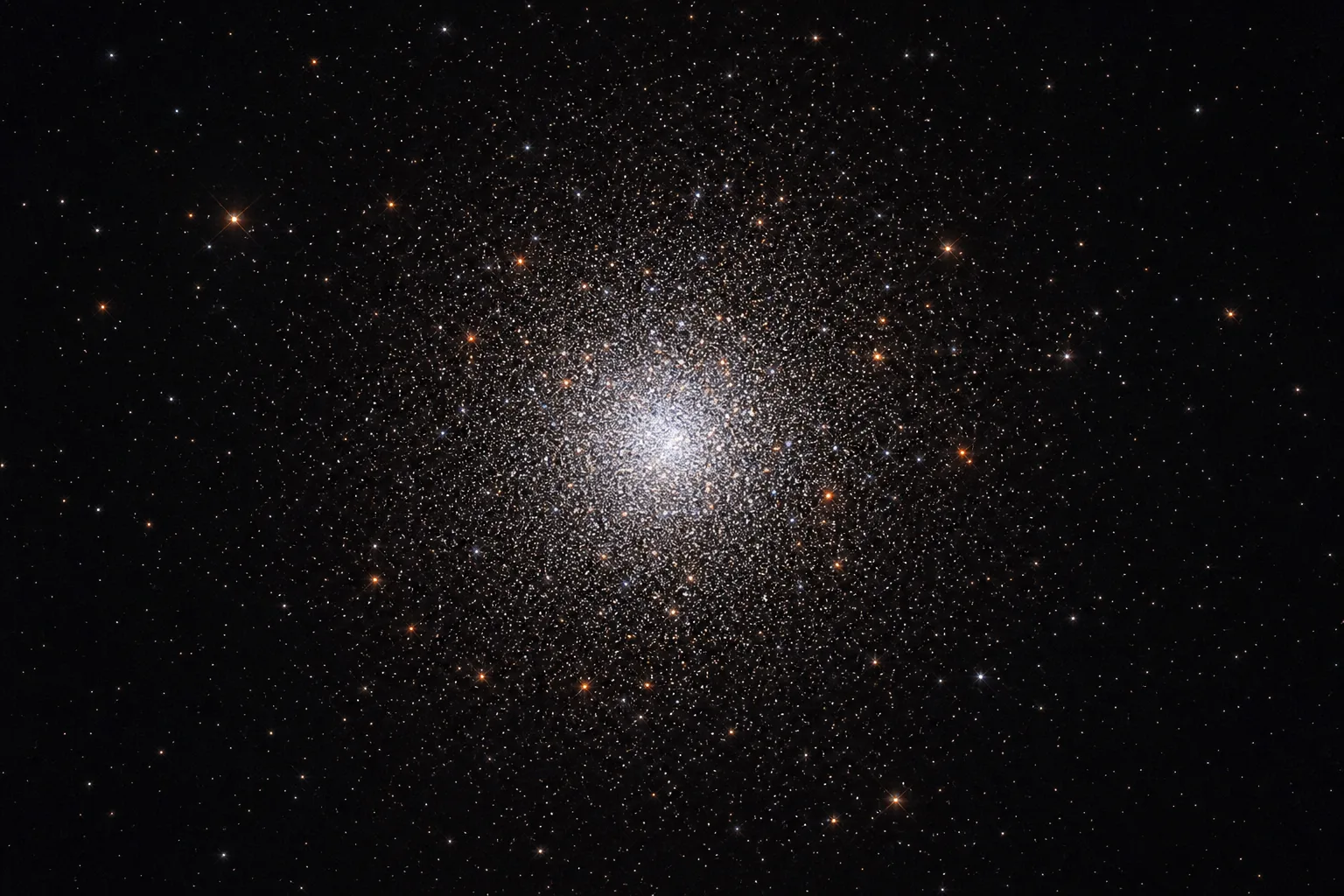
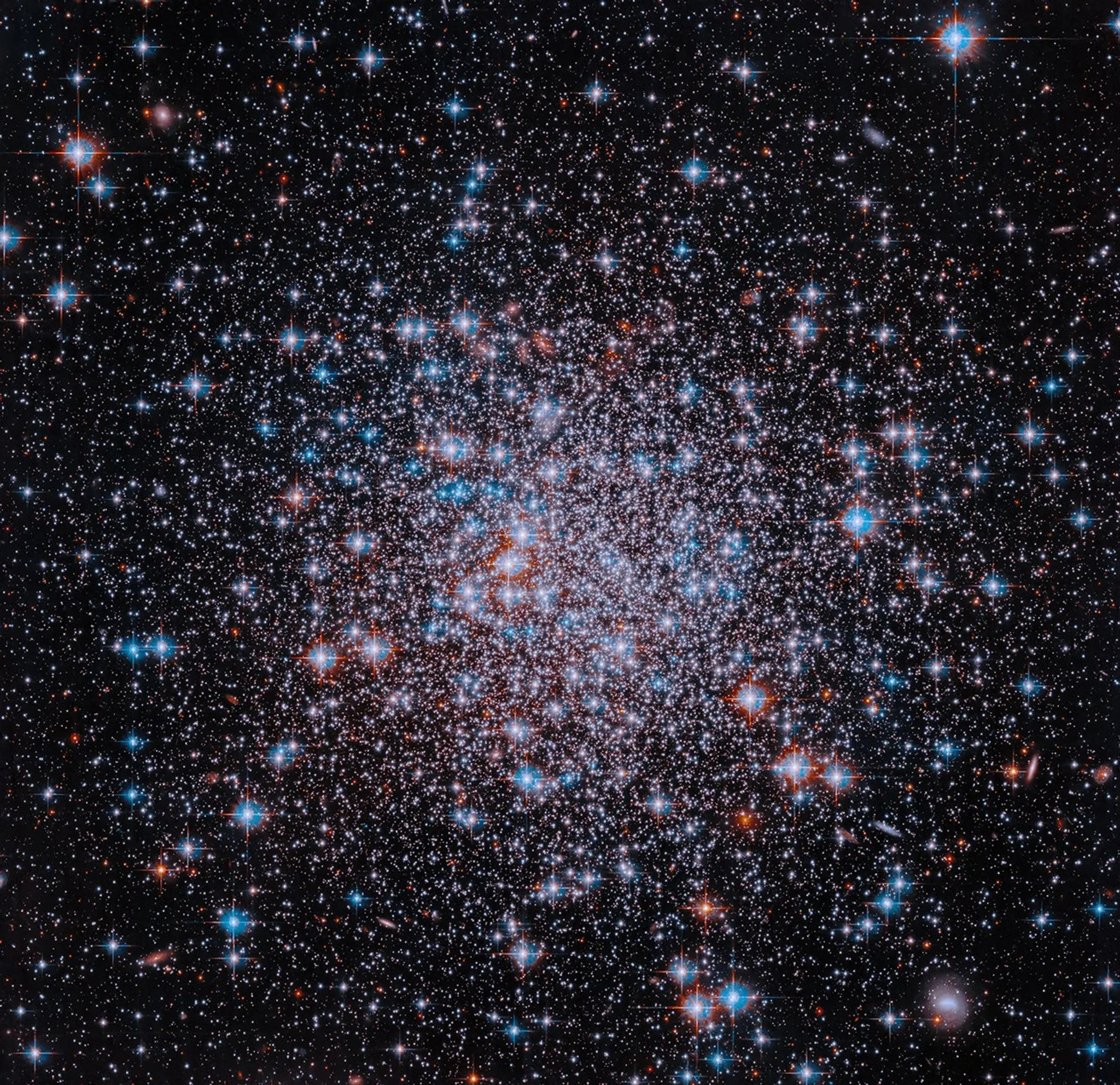
The Hubble Space Telescope has delivered one of its most visually striking images in recent memory — a tightly packed sphere of ancient stars blazing in red, white, and blue against the black void of deep space. NASA timed the release to coincide with the United States’ 250th anniversary, but the real significance of the image goes well beyond patriotic symbolism. What the Hubble Space Telescope captured is NGC 6426, a globular cluster sitting in the outer halo of our Milky Way — and at approximately 13 billion years old, it’s one of the oldest structures the galaxy has to offer.
Table of Contents
A Window Almost as Old as the Universe Itself
To put 13 billion years in perspective: the universe is estimated to be around 13.7 billion years old. NGC 6426 formed just 700 million years after the Big Bang — in cosmic terms, practically at the dawn of everything. It’s one of roughly 150 known globular clusters orbiting the Milky Way, each a gravitationally bound swarm of stars that formed together from the same collapsing cloud of gas. Think of them as the galaxy’s oldest neighborhoods, largely unchanged since their construction.
The outer halo location matters too. Globular clusters in the halo tend to be more pristine than those closer to the galactic center, less disrupted by the gravitational chaos of the inner galaxy. That makes NGC 6426 an unusually well-preserved sample of early-universe chemistry sitting in our own cosmic backyard.
Why the Colors in This Hubble Space Telescope Image Tell a Story
The red, white, and blue palette isn’t just a clever release-date choice — it’s scientifically meaningful. In Hubble Space Telescope imagery, color assignments are based on the wavelengths of light captured by specific filters. Blue corresponds to shorter, hotter wavelengths of visible light; red depicts longer wavelengths, including some near-infrared. Since a star’s color and its surface temperature are directly linked, what you’re effectively looking at is a temperature map of the cluster. The blue stars are the hottest; the red ones are the coolest. The ‘white’ stars sit in between.
This isn’t artistic license — it’s standard image-processing practice that NASA and other agencies have used for decades to make multi-wavelength data interpretable to the human eye. The Hubble Space Telescope routinely captures light across a broad spectrum, and mapping different wavelengths to visible colors is how scientists — and the public — can actually read the data at a glance.
Low Metallicity: Chemistry Frozen in Time
What makes NGC 6426 scientifically compelling isn’t just its age — it’s what the stars inside it are made of. Astronomers describe the cluster as having ‘low metallicity,’ meaning the stars contain very few elements heavier than hydrogen and helium. In the parlance of astrophysics, anything heavier than helium counts as a ‘metal,’ so even oxygen and carbon fall into this category.
This low-metal composition is a direct fingerprint of the early universe. Shortly after the Big Bang, matter was overwhelmingly hydrogen and helium. Heavier elements only began forming through nuclear fusion inside massive stars — and they only spread into the broader universe when those stars exploded as supernovae. NGC 6426 formed before much of that seeding had taken place, which is why its stars look chemically similar to the cosmos as it existed nearly 14 billion years ago. The Hubble Space Telescope has been instrumental in identifying and studying clusters like this one precisely because of its ability to resolve individual stars at such distances.
Two Generations of Stars — and What That Reveals
Here’s where the science gets genuinely interesting. Researchers analyzing the Hubble Space Telescope data found evidence for not one but two chemically distinct stellar populations within NGC 6426. The slightly younger cohort — and ‘younger’ here is relative, we’re still talking billions of years — contains a higher abundance of heavier elements than the cluster’s oldest stars.
The explanation is a classic example of stellar recycling. The cluster’s first generation of massive stars burned fast, died violently as supernovae, and flung their enriched guts — heavier elements forged during their lifetimes — back into the surrounding gas. A second generation of stars then formed from that slightly more metal-rich material. It’s a self-contained cycle of creation and destruction, playing out inside a single cluster over billions of years. The same basic process, scaled up across entire galaxies, is ultimately responsible for the existence of planets, and of us.
This two-population structure has been found in other globular clusters before, but confirming it in one of the Milky Way’s oldest clusters adds another data point to what is still an active area of research. How globular clusters form, why some develop multiple stellar generations and others don’t, and what role they played in the overall assembly of galaxies are questions astronomers are still working through.
Part of a Larger Mission to Map the Milky Way’s History
This image wasn’t taken on a whim. The Hubble Space Telescope captured NGC 6426 as part of a systematic survey of globular clusters in the Milky Way’s halo, specifically designed to pin down their ages and use that data to better understand how the galaxy formed and evolved. Globular clusters are essentially timestamps — ancient, durable, and spread across the halo in ways that trace the galaxy’s early assembly.
After more than three decades in orbit, the Hubble Space Telescope‘s contribution to this kind of work is hard to overstate. It has fundamentally reshaped our picture of the universe’s structure, age, and history. But it isn’t working alone anymore. The James Webb Space Telescope, with its powerful infrared capabilities, has been extending and deepening Hubble’s legacy since coming online in 2022 — often by following up on targets Hubble identified first. And the Nancy Grace Roman Space Telescope, currently scheduled to launch in late summer, will bring a dramatically wider field of view to bear on questions about dark energy, exoplanets, and galactic structure.
Together, these three observatories represent something close to a generational handoff in space-based astronomy. Hubble opened the door; Webb walked through it; Roman is about to expand the floor plan entirely. NGC 6426, ancient as it is, sits at the intersection of all three — a relic of the universe’s infancy that increasingly modern instruments are only just beginning to fully decode.