

Table of Contents
TikTok Returns, but the Underlying Fight Has Not Gone Away
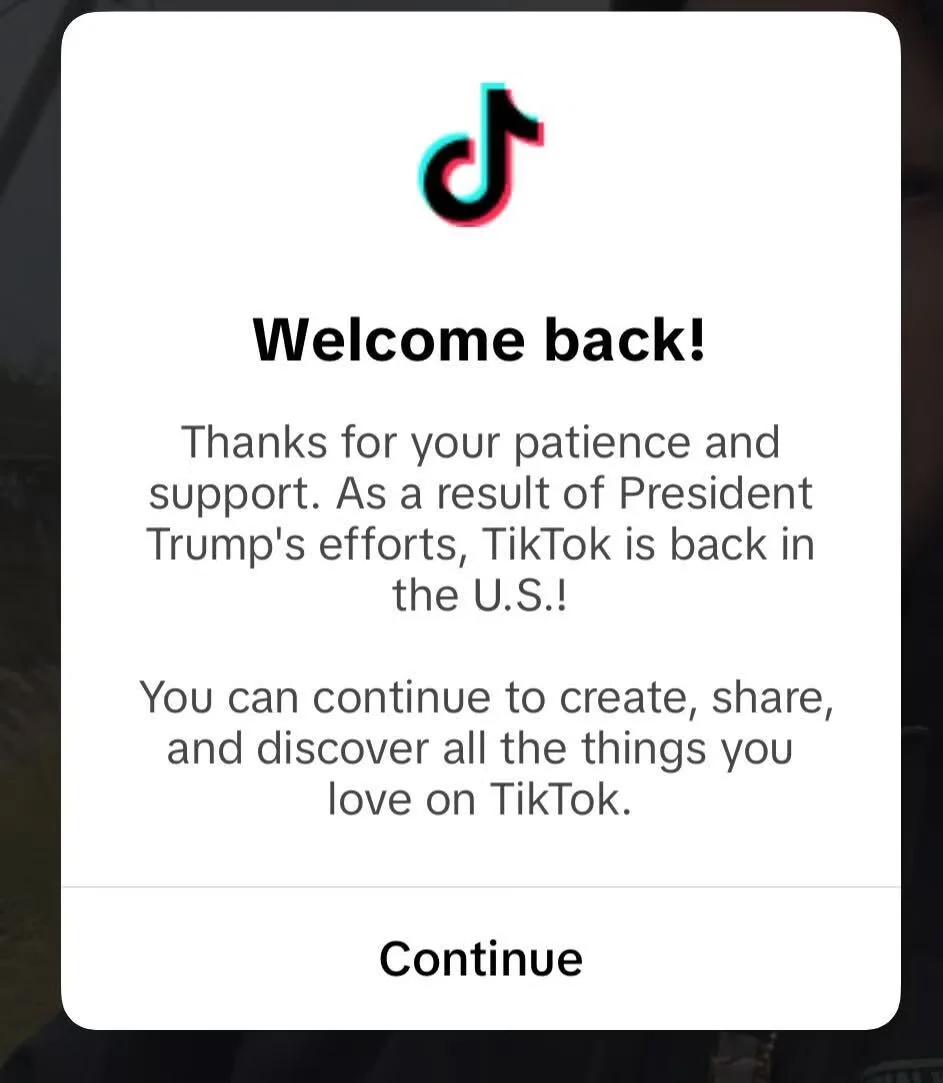
TikTok is back online in the U.S. after President Trump announced plans to delay a law that would ban the app. For users, creators and businesses, the return offered immediate relief after access disappeared late Saturday. By Sunday, users began seeing limited functionality again. But the restoration should not be confused with a final resolution. TikTok’s status remains tied to a political, legal and commercial negotiation that has been building for years.
TikTok said Trump had provided needed clarity to the service providers that keep the platform operating. That matters because an app of TikTok’s scale does not exist in isolation: it depends on technical partners, distribution channels and business relationships that can become cautious when legal liability is unclear. TikTok also stressed that it remains available to over 170 million U.S. users and supports small businesses that depend on the platform.
Those numbers and business ties help explain why a shutdown was never likely to be treated as a narrow dispute between Washington and a single social media company. TikTok is a place where creators build audiences, retailers market products, and companies run campaigns built around short-form video. Taking it offline does not simply remove an entertainment feed. It interrupts a working channel for people whose income and customer reach are tied to the app.
Trump’s Delay Creates Time, Not Certainty
Trump revealed plans to extend the ban’s effective date, giving TikTok and its Chinese parent company, ByteDance, more time to negotiate terms. He has emphasized his desire for 50% U.S. ownership in any future agreement, framing that position around national security concerns. His executive order will protect companies supporting TikTok’s operations from liability.
That protection is a central part of the immediate story. A platform can have users willing to return, but it still needs the companies around it to keep providing essential support. Trump’s intervention appears designed to prevent a temporary ban from becoming a broader business freeze, in which service providers withdraw because the legal risk is too great. It is a practical move, though it does not settle the question of what TikTok must become in order to stay in the U.S.
The distinction is important. A delayed deadline gives negotiators room, but it also extends a period of uncertainty for ByteDance, lawmakers, potential buyers and the companies whose strategies rely on TikTok. The app is functioning again, yet its future is still conditional. A business can resume operations while remaining difficult to plan around.
Check Out Our Article of TikTok Goes Dark in the U.S.: What’s Next for the App? Published on January 20, 2025 SquaredTech
TikTok’s Core Problem Is Its Relationship With ByteDance
TikTok faced shutdown because of concerns over its ties to ByteDance and the potential misuse of American user data by the Chinese government. A law passed last year, and upheld by the Supreme Court, required TikTok to sever ties with ByteDance or cease operations. ByteDance has yet to reach a resolution that satisfies U.S. lawmakers.
That is the issue any deal must answer. The debate is not only about whether TikTok is popular, useful or economically significant. It is about who has control over the U.S. operation, what separation from ByteDance would actually mean, and whether lawmakers view that separation as credible. A change in ownership could be politically meaningful, but the details would determine whether it is accepted as a genuine answer to the concerns that prompted the law.
Trump’s call for 50% U.S. ownership adds another layer to the discussion. It points toward an arrangement that would leave TikTok operating while changing the balance of ownership around it. Yet the political pressure from some lawmakers suggests that partial change may not be enough for everyone involved.
Republican Senators Tom Cotton and Pete Ricketts opposed Trump’s temporary reprieve. Their position is that ByteDance must fully divest TikTok’s U.S. operations. That disagreement makes clear that the delay is not a consensus solution. It is a pause during which competing interpretations of the law, national security and acceptable ownership are still colliding.
Users and Businesses Have Already Seen the Cost of Disruption
The sudden suspension of TikTok disrupted e-commerce transactions, marketing strategies and influencer activities. For users, the loss of access was abrupt. For businesses, the problem was more immediate than a missed source of entertainment: marketing plans, sales activity and creator partnerships can be timed around the platform’s reach and momentum.
Users also scrambled to VPN services in an attempt to bypass restrictions, while businesses that rely on TikTok prepared contingency plans. Both reactions show the same thing: participants in the TikTok economy do not assume an alternative can instantly replace what the app provides. An audience built on one platform is not automatically portable to another, and a marketing strategy designed for TikTok’s format can require substantial adjustment elsewhere.
The uncertainty has already encouraged users to look beyond TikTok. Alternatives such as RedNote have attracted attention, while competitors Meta and Snap have seen increased interest. That shift may be temporary, but it also gives competitors an opening. Any prolonged instability creates an incentive for creators and advertisers to spread their activity across multiple services rather than depend too heavily on one app.
That is a lasting implication even if TikTok remains available. The platform’s return can restore activity, but it cannot erase the lesson businesses and creators have just received: access may be vulnerable to decisions far outside their control. Contingency planning is likely to become part of the routine for anyone who treats TikTok as a major commercial channel.
Potential Buyers Face a Politically Charged Deal
ByteDance is reportedly exploring potential buyers, including interest from Elon Musk and other high-profile figures. Perplexity AI has also submitted a bid to merge with TikTok U.S., with the aim of establishing a new entity with additional partners.
Interest from prominent figures and companies reflects TikTok’s unusual position. It is not simply a large consumer app; it is an app whose ownership may determine whether it can continue serving its U.S. audience. That makes any proposed transaction more than a conventional acquisition. A buyer would need to satisfy commercial interests while addressing the national security concerns that drove the ban effort in the first place.
For ByteDance, the pressure is equally stark. Keeping the U.S. business operating requires a solution that lawmakers accept, but any divestment talks are bound to be shaped by questions of control and the future structure of TikTok’s U.S. operations. The company has time because of Trump’s intervention, but it does not yet have a settled path.
The Temporary Lifeline Still Has an Expiration Point
Trump’s intervention gives TikTok a temporary lifeline. Its long-term survival in the U.S., however, still hinges on resolving national security concerns. The broader debate over foreign-owned apps and data privacy is continuing, and TikTok remains the most visible test of how far the U.S. is willing to go when those concerns collide with the habits of a huge user base and the interests of small businesses.
ByteDance must finalize a solution before the extended deadline or risk another shutdown. Until then, TikTok’s return should be viewed as a reprieve rather than a victory. Users can reopen the app. Businesses can resume campaigns. But the central conflict—whether TikTok can separate from ByteDance in a way that satisfies U.S. lawmakers—remains unresolved.
Stay Updated: Tech News

