
- These developer job search tips reveal that most rejections are about visibility, not your technical skills or experience.
- The biggest developer job search tip most candidates ignore: five or ten targeted applications outperform fifty generic ones every time.
- Recruiters at product startups check LinkedIn and GitHub before they ever open your attached resume — your online presence is your first interview.
- Following up on applications after a week is one of the fastest ways to stand out, since most candidates never do it at all.
Table of Contents
The Skill Paradox Nobody Talks About
Here’s a frustrating reality that cuts to the core of every developer job search tip you’ll ever read: technical ability and callback rate have a surprisingly weak correlation. Developers with solid React knowledge, five deployed projects, and a clean GitHub are sitting at zero responses for months. Meanwhile, someone with two projects and a half-built portfolio is fielding four interview requests in a week. Same job market. Same roles. Wildly different outcomes.
That’s not anecdotal noise — it’s a structural problem with how the modern tech hiring pipeline actually works. And until you understand the mechanics of it, you’ll keep mistaking silence for incompetence. The developer job search tips that actually move the needle are almost never about adding another certificate or another side project — they’re about how you position and surface the work you’ve already done.
Why Job Boards Are Quietly Killing Your Chances
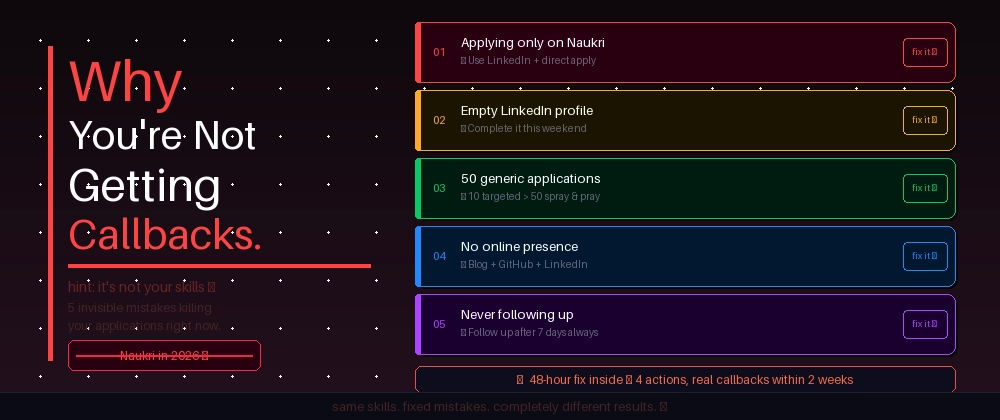
Let’s start with where most early-career developers send their applications. In India, that’s predominantly Naukri. In the US, it’s often Indeed. The instinct makes sense — these platforms have enormous listings and they’re easy to use. But for product-focused startups and modern tech companies, they’re essentially black holes. Understanding this channel mismatch is one of the most practical developer job search tips available, and most candidates skip right past it.
Here’s what the pipeline actually looks like when you apply through a generic job board as a fresher. Your resume hits an Applicant Tracking System first. ATS software, used by the vast majority of companies with more than 50 employees according to Jobscan’s research, automatically filters applications based on keyword matching before a human ever sees them. If your resume isn’t structured to speak that language, you’re out before you’re in.
And even if you clear the ATS? On a popular platform, a single listing can attract 200 or more applications in 48 hours. Recruiters — who are usually juggling multiple roles simultaneously — realistically review the first 20 to 30. If you applied on day two and you’re application number 147, you don’t exist.
Where are product startups actually sourcing candidates in 2026? LinkedIn sits at the top of that list, followed by AngelList (now Wellfound) for early-stage companies, direct careers pages, referrals, and increasingly Twitter/X where founders post roles directly to their own audiences. Discord developer communities are becoming a legitimate sourcing channel. Even GitHub itself — recruiters actively scout profiles there. What’s at the bottom of the list? The legacy job boards most freshers default to.
The practical rewrite here is straightforward: five carefully targeted applications through the right channels will generate more callbacks than fifty Naukri submissions. That’s not optimism — it’s just pipeline math. It’s also one of the developer job search tips with the clearest return on time invested.
Your LinkedIn Is a Recruiter’s First Stop, Not Your Resume
One of the most critical developer job search tips that doesn’t get nearly enough airtime: at product companies, recruiters often check your LinkedIn profile before they even open the PDF you submitted. Which means a weak LinkedIn isn’t a gap in your strategy — it’s an active liability.
What does a weak profile look like in practice? A generic avatar or no photo. A headline that reads “Student at XYZ College.” An empty About section. No projects listed. Skills that were auto-populated and never curated. Zero posting activity. Connection count in the double digits. That profile communicates to a recruiter in about four seconds that you’re either not serious or not self-aware — and they move on.
The contrast with a strong profile is stark. A clear, professional photo (smiling — it genuinely matters for perceived approachability). A headline that leads with your stack and what you’ve shipped: something like “Frontend Dev | React + Next.js | 3 deployed projects” tells a recruiter in one line whether you’re worth a closer look. Your About section should explain what you build and what you’re looking for — three or four sentences, not a biography. Projects should be listed as experience entries, because that’s where recruiters look. Posting once or twice a week about what you’re learning or building signals active engagement with the field.
Here’s the counterintuitive part: 500+ connections isn’t about popularity, it’s about search visibility. LinkedIn’s algorithm surfaces profiles more prominently to recruiters when those profiles have broader networks. It’s a discoverability mechanism, not a social flex. Optimizing for that visibility is among the developer job search tips that pays the longest dividend — your profile keeps working even when you’re not actively applying.
Developer Job Search Tips on Targeting: Quality Beats Volume
The spray-and-pray approach to job applications feels productive. You’ve sent 50 applications — surely something will land. But the math doesn’t support it. A generic resume and a copy-paste cover note signal to any experienced recruiter that the candidate hasn’t done the work. And experienced recruiters see hundreds of those every week.
The targeted approach flips the equation. Ten applications, each with a resume adjusted to surface the specific skills mentioned in that job description, each with a cover note that references something real about the company — a product feature, their tech stack choice, a recent announcement — outperforms the spray-and-pray approach by a factor of three to four in callback rate. This is one of the developer job search tips that feels counterintuitive until you run the numbers yourself.
The time investment doesn’t have to be enormous. A practical system: five minutes reading the job description and identifying the three skills they emphasize most, making sure those appear clearly on your resume. Five minutes researching the company to find one specific and genuine thing to reference. Five minutes writing three lines: what you noticed about their stack, what relevant project you built, and one sentence on why you’d fit. Fifteen minutes total. That’s a completely different signal than a mass-submitted PDF.
This is also where direct outreach compounds the effect. Finding someone at the company on LinkedIn — a developer, a team lead, even a recruiter — and sending a connection request with a brief, specific note isn’t aggressive, it’s professional. Most candidates never do it. The ones who do stand out immediately. Pairing targeted applications with direct outreach is one of the developer job search tips that consistently separates candidates who get responses from those who don’t.
Your Online Presence Is Your Real Resume
Before a recruiter opens any document you’ve sent them, they’ve almost certainly Googled your name. What comes up? If the answer is nothing, you’re starting every application from zero — your resume has to carry the entire weight of your professional credibility alone. That’s a hard position to be in when you’re competing against candidates who have a visible body of work. Among developer job search tips focused on long-term leverage, building a searchable online presence ranks near the top.
The online presence that actually moves the needle for developers in 2026 breaks down into four channels: an active GitHub with clean repositories and proper READMEs, a complete and posting-active LinkedIn, technical writing on platforms like Dev.to or Hashnode, and a personal site at yourname.dev. You don’t need all four firing at once — two strong ones change the dynamic significantly.
Technical writing is particularly underused. A developer who publishes posts explaining how they solved a specific problem, or what they learned implementing a feature, is demonstrating critical thinking, communication ability, and genuine engagement with the craft. Those are things a resume bullet point can claim but can’t actually prove. A body of technical writing proves it. If you’re looking for developer job search tips with a compounding effect, consistent technical publishing is the one most candidates leave on the table.
The Follow-Up Nobody Sends
You applied. A week passes. Nothing. The instinct most developers follow is to interpret silence as rejection and move on. But that instinct is costing real opportunities.
Most applicants never follow up. Which means the ones who do are immediately differentiated — not as desperate, but as genuinely interested and professionally persistent. A brief LinkedIn message to a hiring manager or HR contact five to seven days after applying, referencing the specific role and including a live link to a relevant project, has a surprisingly high response rate precisely because the bar is so low. Almost no one else is doing it. Of all the developer job search tips in this piece, the follow-up is the one with the highest return for the least effort — and the one most consistently ignored.
The message doesn’t need to be elaborate. One sentence on the role, one on what specifically interests you about the company’s product, one on a relevant project you built with a live link, one asking if there’s a fit worth exploring. That’s it. Clean, specific, and human — which is more than most application-to-email pipelines ever manage to feel.
The Bigger Picture
The developer hiring market in 2026 is more competitive than it was three years ago, partly due to the wider availability of coding education and bootcamps, and partly because AI tools have raised the baseline of what a solo developer can ship. Getting noticed now requires more intentional positioning than it used to. But that’s actually good news for developers willing to think strategically about how they show up — because most of their competition is still firing off resumes into the void and wondering why nothing comes back. These developer job search tips aren’t hacks. They’re just a more honest read of how the pipeline actually works — and what it takes to be visible inside it.