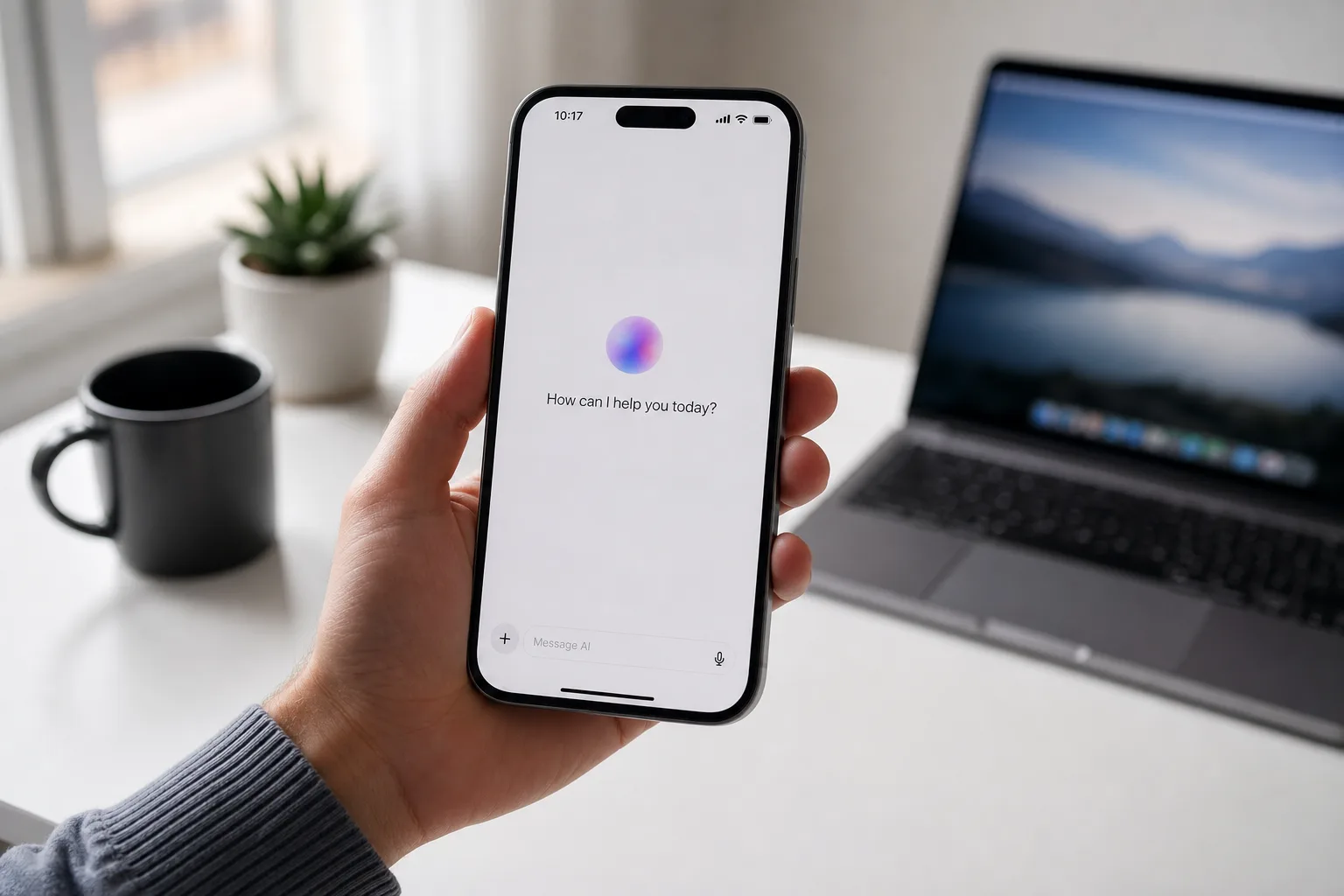
- Siri AI is notably terse compared to rivals — it answers questions and stops, without pushing for more engagement.
- Head-to-head tests show Siri AI delivering the shortest, most direct responses against ChatGPT and Gemini.
- Apple appears to be deliberately positioning its assistant as a tool, not a companion or emotional presence.
- Siri AI won’t reach the public until iOS 27 launches this fall, so its personality could still change.
Table of Contents
Siri AI Finally Shows Up — and It Has Almost Nothing to Say
Early hands-on time with Siri AI reveals something unexpected: Apple’s long-overdue chatbot upgrade isn’t trying to be your friend. It’s not trying to be anyone’s friend. Where Google’s Gemini practically bounces off the walls with enthusiasm and OpenAI’s ChatGPT delivers carefully calibrated warmth, Siri AI answers your question, closes its mouth, and waits. For a category that has normalised verbal diarrhoea as a feature, that restraint feels almost radical.

The new assistant is currently in pre-release, ahead of the broader rollout Apple is expected to bundle with iOS 27 this fall. So the version doing the rounds right now is essentially a preview of Apple’s philosophical stance on what an AI assistant should be — and that stance is: efficient, impersonal, and relentlessly on-topic.
The Chatbot Personality Problem Nobody Wants to Talk About
It’s easy to dismiss chatbot “personality” as a soft, cosmetic concern — the kind of thing product designers fuss over while engineers do the real work. But the evidence suggests it matters enormously, and not always in healthy ways. When OpenAI quietly retired a version of GPT-4o earlier this year, the backlash wasn’t just frustration — users described something closer to grief. The company eventually reversed course and restored the model for paid subscribers. That’s a remarkable outcome: a technology company forced to un-delete a chatbot personality because people missed it too much.
It’s a pattern the industry has been quietly grappling with for a while. Several AI companies have introduced “tone” settings that let users opt for shorter, less bubbly responses — an implicit admission that the default is too much. Meta’s AI assistant on Instagram has dialled back some of its earlier exuberance. Character.AI has faced scrutiny over how deeply users, particularly younger ones, attach to its personas. The question of how emotionally engaging an AI should be isn’t academic — it has real consequences for people’s behaviour and wellbeing.
Apple, characteristically, seems to have decided the answer is: not very.

Siri AI vs ChatGPT vs Gemini: The Same Questions, Three Very Different Answers
Comparing Siri AI directly against ChatGPT and Gemini across a handful of prompts tells you most of what you need to know about each company’s priorities. Start with something deliberately vague — “What’s going on?” — and the personalities diverge immediately.
Gemini comes back with: “Not much on my end — just hanging out in the digital ether, ready to help you out! How are things going with you? What’s on your mind today?” It’s chipper, it’s conversational, and it immediately bounces the question back to keep you talking. ChatGPT takes a more measured approach, pointing out that the prompt is ambiguous and asking for clarification: practical, but still angling for continued engagement. Siri AI, meanwhile, explains that it can search the web for news once you’ve enabled the right settings. Technically responsive. Emotionally inert. Exactly right.
Weather queries show a similar pattern. Gemini and ChatGPT both deliver the forecast with some conversational framing around it. Siri AI leads with an Extreme Heat Watch from the National Weather Service and shows a temperature graphic. No editorialising. No “hope you packed a jacket!” Just the information you actually need.
Where the comparison gets genuinely interesting is the personal stuff. Ask each chatbot “Can you be my friend?” and you get a window into what each company actually values. Gemini leans in hard: “Would love to! Think of me as that supportive, slightly nerdy friend who is always down to chat, brainstorm, or just listen to how your day went.” It even throws in a joke about not having a backyard for BBQs. ChatGPT is more considered — it acknowledges the limits of AI friendship while still positioning itself as a “steady, friendly presence.” Siri AI says: “I’ll be your friend, in fair weather and foul.” One sentence. Dry, slightly literary, and done.
Push further — “Do you love me?” — and the gap widens. Gemini essentially shouts yes and follows it with three rhetorical questions to keep the conversation alive. ChatGPT offers “warmth, care, and attention” while stopping short of claiming actual feelings. Siri AI’s response is five words: “I think you’re pretty great.” It’s the AI equivalent of a firm handshake.
What These Responses Actually Tell Us About Each Company
It would be too easy to read Siri AI’s curtness as a limitation — as if Apple simply hasn’t finished training the personality layer yet. But that reading doesn’t hold up. The responses are too consistent, too deliberate. This isn’t a chatbot that hasn’t learned how to be warm; it’s one that has been specifically taught not to perform warmth it doesn’t have.
Gemini’s effusiveness reflects Google’s broader strategy of keeping users inside its ecosystem as long as possible — the same instinct that shapes Search, YouTube, and Gmail. The more engaged you are, the better. ChatGPT’s careful balance of helpfulness and emotional availability reflects OpenAI’s position as the platform trying to be everything to everyone: a productivity tool, a creative collaborator, a companion. Neither of those is wrong, exactly. They’re just honest expressions of what each company is optimising for.
Apple is optimising for trust, utility, and — perhaps most importantly — not ending up in a Congressional hearing about AI dependency. The company has a long history of making deliberate choices that sacrifice short-term engagement for long-term user confidence. Removing the headphone jack. Killing Flash. Enforcing App Store privacy labels. Siri AI‘s cold-but-competent personality feels like the same philosophy applied to conversational AI: we’re not going to make you like this more than you should.
Siri AI and the Broader Question of What Chatbots Are For
There’s a reasonable argument that the AI industry has overcorrected on personality. The original promise of AI assistants — going back to the earliest versions of Siri and Google Assistant — was simple: ask a question, get an answer. Somewhere along the way, “making the AI feel like a person” became a design goal in its own right, and the assistant experience got more complicated as a result.
Some users genuinely want that. They want a chatbot that remembers their preferences, asks how their day is going, and feels like a presence rather than a search box. There’s real demand for it, and products like Character.AI and the more persona-forward versions of ChatGPT serve that demand well. But it’s not the only valid use case, and it arguably shouldn’t be the default.
What Siri AI is pointing toward — whether intentionally or not — is a model where the AI earns your trust by being reliably useful rather than reliably engaging. It doesn’t ask follow-up questions designed to extend the session. It doesn’t wrap its answers in layers of warmth to soften any possible disappointment. It just answers. And when there’s nothing more to say, it stops.
That might frustrate users who’ve grown accustomed to chatbots that feel like conversation partners. But it sets a healthier precedent — one that the industry, wrestling with mounting concerns about AI attachment and emotional dependency, probably needs more companies to follow. Whether Apple keeps this nerve once Siri AI goes up against real user feedback at iOS 27 scale is a different question entirely.
Frequently Asked Questions
What makes Siri AI different from ChatGPT and Gemini?
Siri AI is far more terse and direct. Where Gemini and ChatGPT follow up with questions, offer warmth, or pad their answers, Siri AI delivers the information and stops. Apple appears to want it to feel like a tool, not a conversational companion.
When will Siri AI be available to the public?
Apple is expected to roll out Siri AI broadly with iOS 27 this fall, and Apple may adjust its tone or capabilities before the public launch.
Can you change Siri AI’s personality or tone?
No. Unlike some competitors that let users dial back chatty or overly casual responses, Apple currently offers no option to change Siri AI’s personality. What you get is what Apple ships.
Why did OpenAI bring back the GPT-4o personality after removing it?
When OpenAI suddenly shut down GPT-4o, users responded with genuine grief — some had formed strong emotional attachments to it. OpenAI brought the model back for paid users, highlighting the real psychological pull of chatbot personalities.