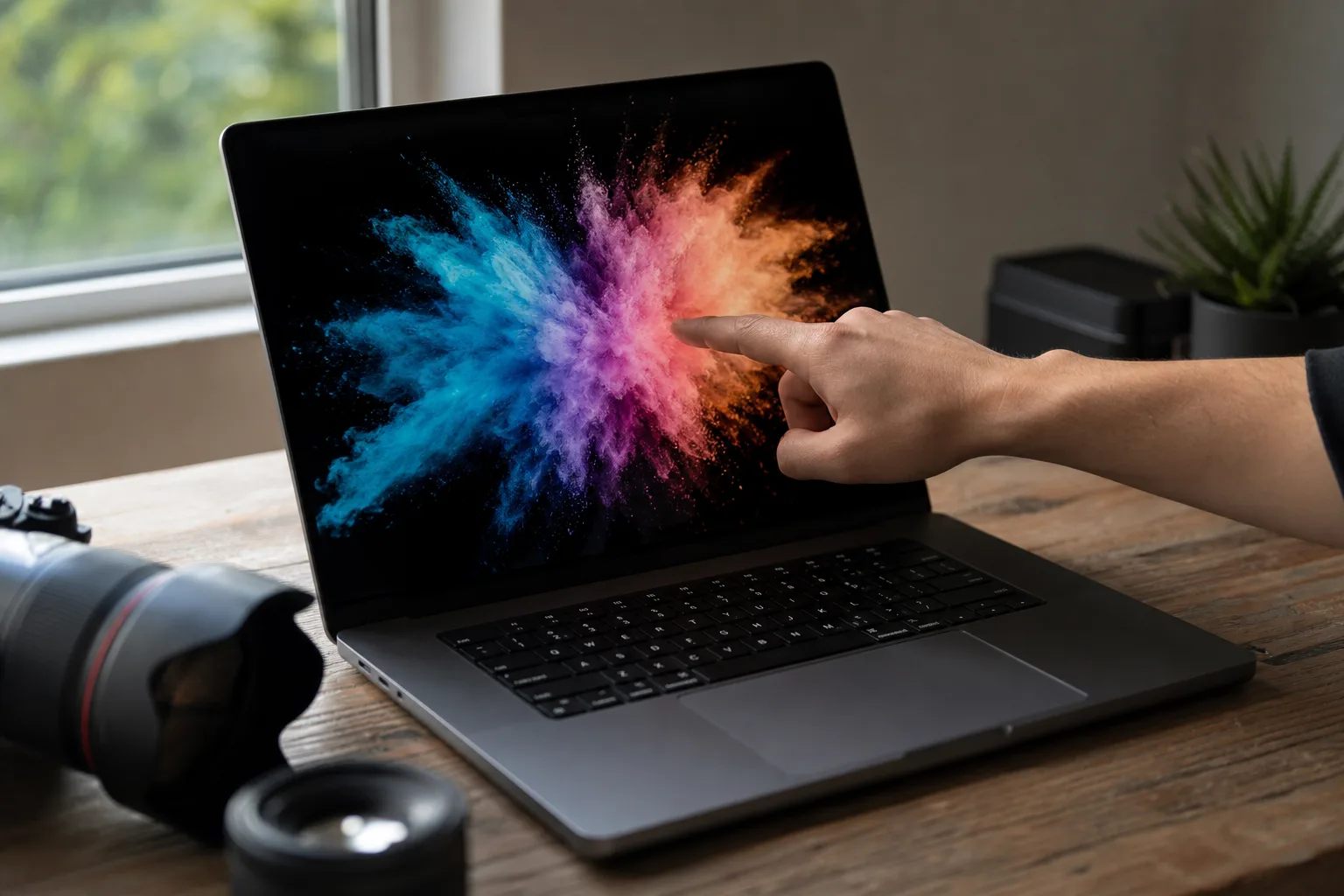
- The MacBook Ultra is reportedly Apple’s first laptop tier above the MacBook Pro, with launch timing now pointing toward 2027.
- OLED, touchscreen controls and a reinforced hinge could make the MacBook Ultra Apple’s largest rethink of pro laptops since 2021.
- A smaller camera cutout may replace the notch, while software hints suggest Apple is preparing macOS for direct touch interaction.
- Memory supply pressure could delay the redesign, leaving current MacBook Pro buyers to weigh waiting against purchasing proven hardware today.
Table of Contents
MacBook Ultra could finally give Apple’s laptop lineup a real top tier
For years, Apple’s most expensive laptop has been a MacBook Pro with more chips, more memory, or a bigger screen. The rumored MacBook Ultra could change that calculation. If the reporting holds up, Apple is preparing a genuinely distinct pro machine: thinner hardware, an OLED panel, direct touch support, and a price ladder that finally puts something above the familiar Pro badge.
That matters because the current 14-inch and 16-inch MacBook Pro design has had an unusually long and successful run. Apple introduced it in 2021 alongside the M1 Pro and M1 Max, reversing several unpopular decisions from the Intel era by restoring HDMI, MagSafe and the SD card reader. It remains an excellent workhorse. But five years is an eternity in laptop-design terms, and the notch has never exactly won a fan club.
Bloomberg’s Mark Gurman expects the redesign somewhere between late 2026 and early 2027. The later date appears increasingly plausible amid pressure on global memory supplies. Ming-Chi Kuo has separately indicated that mass production could begin late in 2026. Those are compatible forecasts, but neither is a shipping date. Apple’s roadmap has a habit of becoming less rigid the moment components become scarce.
The name itself is still rumor, not fact. Yet MacBook Ultra makes strategic sense. Apple has used Ultra to signal its most ambitious silicon with the M1 Ultra and its most expensive wearable with Apple Watch Ultra. A laptop with that label would give Apple room to sell a more exotic machine without making every MacBook Pro buyer fund the experiment.
MacBook Ultra hardware rumors point to OLED, touch and a cleaner screen
The marquee change would be OLED. Current MacBook Pros use mini-LED backlighting, which can look spectacular but is still fundamentally an LCD system. OLED lets each pixel produce its own light, enabling true blacks and potentially better power efficiency. Apple already uses tandem OLED technology in the iPad Pro, and Apple’s iPad Pro product page describes the advantages of its two-layer panel approach: high brightness with improved panel longevity.
For a MacBook Ultra, the more interesting benefit may be physical, not visual. OLED can make the display assembly slimmer, opening the door to a lighter lid and a less chunky overall chassis. But Apple should resist the old temptation to equate thinness with progress. Remember the butterfly keyboard years? Nobody needs a repeat performance where a beautiful profile comes at the expense of repairability, cooling, ports or basic durability.
The other big break with Apple tradition is touch. Kuo first reported touchscreen support, Gurman has backed the broad direction, and leaker Instant Digital has described the feature as confirmed. Apple has spent more than a decade arguing, implicitly and sometimes explicitly, that touching a vertical laptop display is awkward. It is awkward after a while. But it’s also useful in short bursts, especially when you are scrolling, annotating an image, moving through a presentation, or simply reaching for a control your cursor is already near.
My read is that Apple has finally accepted the obvious: professionals can decide for themselves. The reported plan keeps the keyboard and trackpad, rather than producing some compromised convertible. That is the right call. A MacBook Ultra should remain a laptop first, with touch as another input option, not an expensive iPad impersonation.
A reinforced hinge would be necessary if Apple goes this route. Current MacBook Pro displays are designed to stay where you put them, not absorb repeated taps. Reports also point to the notch being replaced by a small hole-punch camera, possibly surrounded by a Mac-style Dynamic Island that can expand for Siri, battery alerts, and AirPods status. That sounds slightly gimmicky on paper. Then again, the notch has consumed menu-bar space for years, so almost any sensible alternative is an upgrade.
macOS is the part Apple cannot afford to get wrong
Hardware can accommodate touch; software has to make it feel intentional. The reports describe a touch-aware macOS where controls become larger when tapped and iPad-like gestures such as pinch-to-zoom and fast scrolling are available throughout the system. That’s a more credible approach than scattering a few oversized buttons into Finder and calling it a day.
There are reportedly clues in macOS 27 Golden Gate. Sidecar now supports interacting directly with macOS elements on an iPad display, while apps including Safari, Mail, News, Podcasts and Calendar are said to gain pull-to-refresh gestures. Spotlight’s newer ‘Search or Ask’ interface also uses a dark pill-shaped form that could fit naturally around a Dynamic Island-style cutout.

Still, Apple needs to tread carefully. macOS earns its keep because it permits density: complicated menus, detailed timelines, spreadsheets with too many columns, and a dozen overlapping windows when work gets messy. Making the operating system touch-friendly is sensible. Flattening it into a giant-button version of iPadOS would be a mistake. The best outcome is adaptive behavior that stays out of the way when you have a mouse or trackpad and becomes useful when your hand reaches for the screen.
Chip choices and cellular remain the least settled pieces
One curious claim is that the first MacBook Ultra may use M5 Pro and M5 Max chips rather than an expected M6 generation. Reports suggest Apple could skip directly to M7 Pro and M7 Max for a second-generation model in late 2027, with a stronger emphasis on AI workloads, graphics, neural processing and memory bandwidth.
That would be an unusual launch structure, but not an impossible one. Apple has increasingly treated industrial design and chip cadence as separate tracks. If this machine arrives with familiar M5-class silicon, its selling point would be the display and input experience, not benchmark supremacy. Buyers who need raw performance on day one may reasonably wait for the next chip cycle. Everyone else may care more about the screen they stare at for eight hours.
Built-in cellular is even less certain. Apple has reportedly explored adding 5G through its own C1X or future C2 modem. I’d love it, frankly. Tethering works, but it is the digital equivalent of borrowing a friend’s extension cord every afternoon. Yet cellular Macs have been rumored for ages, and Apple could easily decide that battery cost, carrier support and pricing make the feature too niche for a first model.
Should MacBook Pro buyers wait?
Unless you need a laptop in the next few months, the MacBook Ultra rumor creates an awkward pause at the high end. The current MacBook Pro is not suddenly obsolete; it is mature, powerful and packed with the ports Apple once foolishly removed. But a potential OLED display, smaller camera cutout and touchscreen macOS experience are substantial enough changes that many creative professionals will want to see what Apple actually delivers.
The real question is whether Apple can make this feel like a purposeful new class of laptop rather than a Pro with an inflated price tag. OLED and touch are overdue. An Ultra label, however, carries a higher burden: it needs to solve a real problem for serious users. We will find out whether Apple has built a better workstation, or merely a more expensive one.
Frequently Asked Questions
When will the MacBook Ultra be released?
Bloomberg’s Mark Gurman has placed the laptop between late 2026 and early 2027, with the later timeframe appearing more likely. Analyst Ming-Chi Kuo has reportedly projected mass production beginning near the end of 2026, but component supply constraints could still move Apple’s schedule.
Will the MacBook Ultra have a touchscreen?
Multiple reports indicate that Apple is developing direct touch support for the display, while retaining a conventional keyboard-and-trackpad clamshell design. The idea appears to be optional touch interaction rather than turning macOS into iPadOS or building a detachable hybrid laptop.
Will Apple replace the MacBook Pro with the new model?
That remains unclear. The reported Ultra branding suggests Apple may create a tier above the MacBook Pro. Apple could also ultimately retain MacBook Pro branding, since no official product name has been announced.