The federal data center rules that currently govern how U.S. government agencies plan, build, and run their data infrastructure are on track to quietly disappear this September — and there’s no sign anyone in Washington is rushing to stop it.
- Federal data center rules established in 2023 are set to expire in September with no replacement announced.
- The expiring federal data center rules cover cybersecurity standards and energy efficiency requirements for government facilities.
- The Trump administration’s hands-off approach to AI oversight appears to extend to infrastructure policy as well.
- A Gallup survey found 70% of Americans oppose AI data center construction in their local communities.
Table of Contents
What the Federal Data Center Rules Actually Cover
The Federal Data Center Enhancement Act, or FDCEA, was passed in 2023 as part of the National Defense Authorization Act for Fiscal Year 2024. On paper, it’s the kind of policy that rarely makes headlines — but in practice, it sets the floor for how federal agencies approach everything from cybersecurity to sustainability when they’re spinning up new data infrastructure.
Under the law, the Office of Management and Budget requires any agency planning a new data center or a significant upgrade to bring in certified energy-efficiency specialists for an independent assessment. Agencies have to actively consider energy and water consumption at the design stage — not as an afterthought, but as a built-in requirement. For contractor-operated facilities that serve federal clients, the same federal data center rules apply.
That might sound like bureaucratic housekeeping, but those requirements were created precisely because federal agencies have historically been terrible at managing data center sprawl. A 2016 Government Accountability Office report found that agencies were maintaining thousands of underutilised data centers at enormous cost to taxpayers. The FDCEA was, at least in part, an attempt to prevent that pattern from repeating itself during the current AI infrastructure wave.
Why the Federal Data Center Rules Are Being Allowed to Lapse
According to Wired, which cited unnamed sources familiar with the situation, the Trump administration has no clear plan to renew or replace the FDCEA before it expires at the end of September. Neither the White House nor the Office of Management and Budget responded to requests for comment on the matter.
One General Services Administration employee, speaking to Wired, put it bluntly: ‘Never in the history of data center policies has a policy expired without another one having been painstakingly worked on for three years behind the scenes.’ That same source acknowledged the pace of change in the industry, adding that ‘the technology has changed so much it’s not about getting everything right, it’s about doing the best they can and updating to a new policy.’
That’s a remarkably candid admission. And it points to a real tension at the heart of federal technology governance right now: the federal data center rules that exist were written before the generative AI boom truly took hold, but rather than modernising them, the current administration appears content to let them expire entirely.
The broader context matters here. The Trump administration has taken a deliberately light-touch approach to AI oversight across the board. Just last week, administration officials directed the Center for AI Standards and Innovation (CAISI) to pause its public AI model review reports while Trump’s latest AI executive order — signed earlier this month after being delayed — gets implemented. That executive order calls for a new voluntary framework allowing AI companies to give the federal government access to frontier models up to 30 days before public release, ostensibly to ‘strengthen the cybersecurity of critical infrastructure.’ An earlier draft had reportedly called for a 90-day window.
The Federal Data Center Rules Gap Meets the AI Infrastructure Boom
The timing couldn’t be more awkward. Federal data center rules are expiring at exactly the moment when data center construction is accelerating faster than at any point in recent history. The AI boom — driven by the insatiable compute demands of large language models and cloud AI services — has triggered a wave of new data center projects across the United States, many of them massive facilities that consume extraordinary amounts of power and water.
Without the FDCEA’s requirements in place, federal agencies and their contractors would no longer be obligated to factor energy and water efficiency into their planning processes. There’d be no mandated assessment by certified specialists, no formal requirement to weigh environmental impact at the design stage. At a moment when AI infrastructure is already straining local power grids and water supplies in communities across the country, that’s a gap that’s hard to justify on any grounds other than a general preference for deregulation.
And it’s not as though the market is self-correcting on this front. The major hyperscalers — Microsoft, Google, Amazon, Meta — have made significant public commitments around renewable energy and water efficiency, but those are voluntary pledges with patchy enforcement. Federal data center rules carry actual teeth. When they go away, there’s nothing forcing government contractors to maintain the same standards.
Community Backlash Is Growing Louder
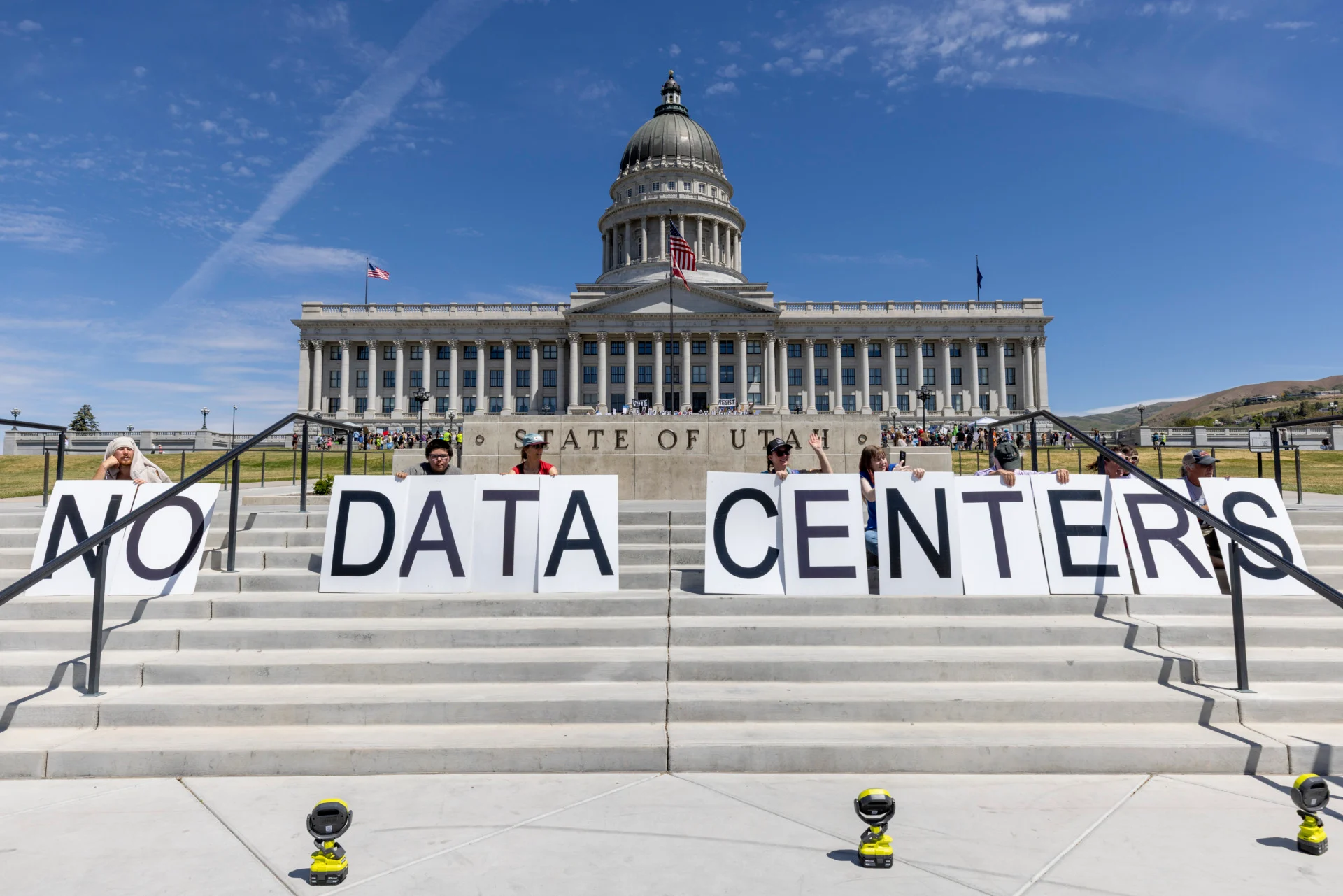
While Washington apparently looks the other way, the people living near proposed data center sites are getting increasingly organised. A Gallup survey conducted in March found that seven in ten Americans oppose AI data center construction in their local area — a striking number that includes 48% who are strongly opposed. About 46% said they worried a great deal about the environmental impacts of these facilities.
That opposition has already translated into real outcomes. Several proposed data center projects around the country have been defeated or delayed in the face of community pressure, with local residents raising concerns about power grid strain, water use, noise, and the visual impact of industrial-scale server farms in residential or rural areas.

The pushback has attracted some high-profile attention. Erin Brockovich — the environmental activist whose work inspired the 2000 film — has entered the fight, launching a crowdsourced map that collects and aggregates community concerns about major AI data centers across the country. It’s a smart tactic: by centralising local complaints into a single visible resource, it makes the scale of opposition harder to dismiss as isolated NIMBYism.
The administration’s position — that advancing AI is essential to U.S. national security and economic competitiveness — isn’t wrong on its face. But national competitiveness arguments tend to collapse when they’re used to justify ignoring the infrastructure consequences of rapid expansion. Building AI capacity on a foundation of underregulated, energy-hungry federal data centers isn’t a strength. It’s a liability waiting to be called in.
What Happens Next
The most likely immediate outcome is that federal data center rules simply expire quietly in September, agencies lose their formal obligation to conduct energy-efficiency assessments, and the vacuum gets filled — if it gets filled at all — by informal guidance or agency-level policies that vary wildly in their rigour.
Congress could still act. Lawmakers have until the end of September to pass an extension or a replacement, and the FDCEA was originally bipartisan — it passed as part of a defence authorisation bill, which is about as close to guaranteed passage as legislation gets in Washington. But there’s been no visible movement in that direction, and with lawmakers consumed by budget battles and the administration signalling that AI regulation is not a priority, the window is closing fast.
The longer-term question is whether the expiration of federal data center rules creates a precedent that’s hard to walk back. Once the mandatory assessment framework disappears and agencies adapt their workflows accordingly, reimposing those requirements becomes politically and operationally harder. History suggests that policy vacuums in federal technology governance tend to persist far longer than anyone expects — and the GSA employee’s comment about policies normally taking three years to replace suggests any successor framework, if one is ever drafted, won’t arrive quickly. Without robust federal data center rules on the books, that three-year clock may not even start.

For an administration that has staked a significant part of its identity on AI leadership, letting the basic federal data center rules governing federal AI compute quietly lapse is an odd way to demonstrate that the U.S. is serious about building resilient, sustainable AI capacity for the long haul.
Frequently Asked Questions
What are the federal data center rules that are expiring?
The Federal Data Center Enhancement Act (FDCEA), passed in 2023 as part of the National Defense Authorization Act for FY2024, sets cybersecurity and sustainability standards for federally operated and some contractor-operated data centers. It requires energy-efficiency assessments for new builds and major upgrades.
When do the federal data center rules officially expire?
The FDCEA is set to expire at the end of September. As of now, neither the Trump administration nor lawmakers appear to have made major moves to renew or replace it.
Why does it matter if data center energy efficiency rules expire?
Without the rules, federal agencies won’t be required to factor energy and water use into new data center designs. At a time when AI-driven demand is pushing new data center projects across the country, that’s a significant gap in government oversight.
How does the public feel about AI data centers being built nearby?
According to a March Gallup survey, seven in ten Americans oppose AI data center construction in their local area. Nearly half — 48% — are strongly opposed, and 46% said they worry a great deal about the environmental impact of these facilities.