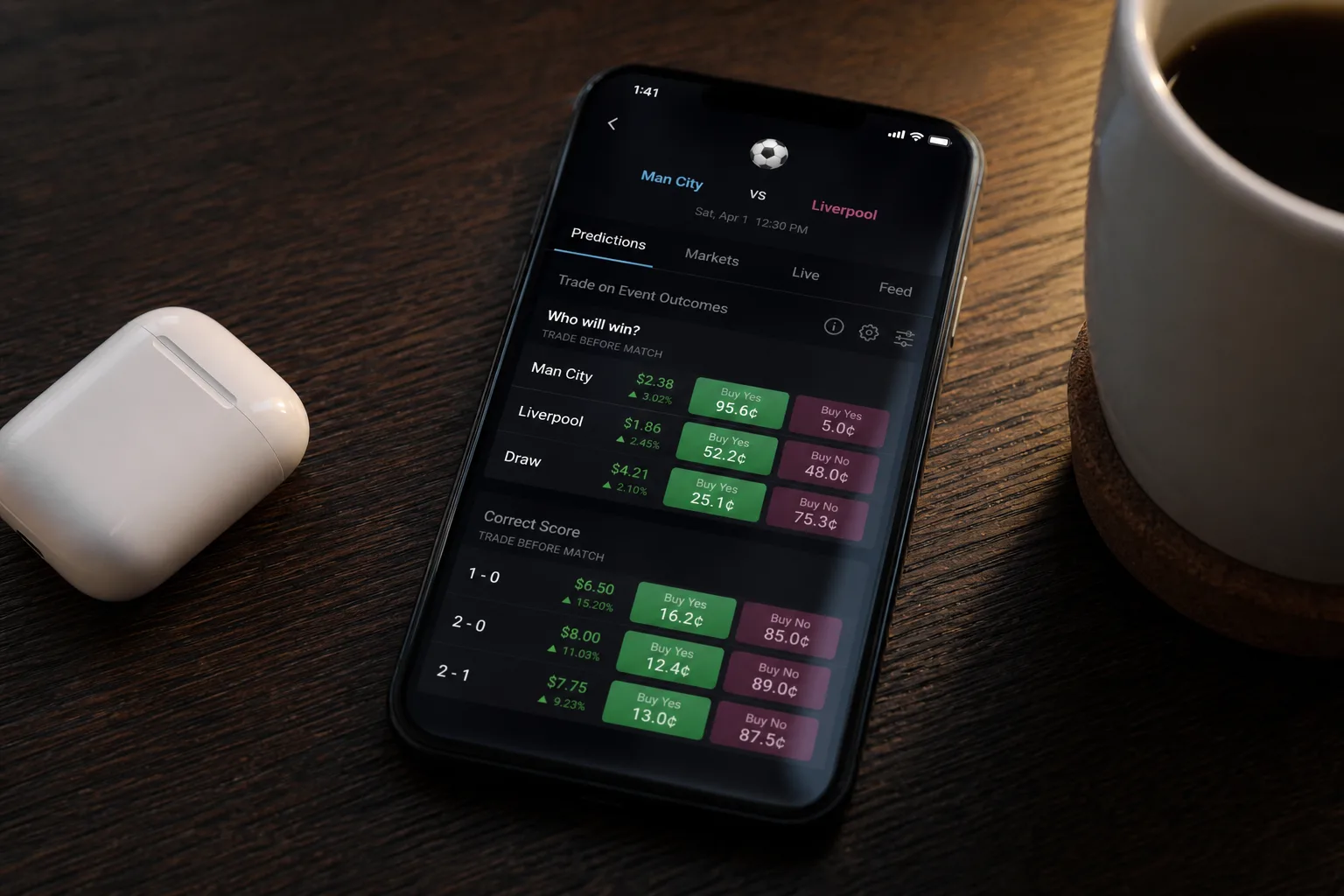
Wall Street is starting to take Robinhood prediction markets very seriously. Analysts at Bernstein have put a striking number on the table: they expect this single product line to generate $586 million in revenue for Robinhood in 2026, up from a projected $150 million in 2025. That’s not a modest growth forecast — that’s a nearly fourfold jump in twelve months, and the catalyst analysts are pointing to is the FIFA World Cup.
- Robinhood prediction markets revenue is projected to jump nearly fourfold, from $150M in 2025 to $586M in 2026.
- Bernstein analysts say Robinhood prediction markets will benefit from strong tailwinds as the 2026 World Cup drives record volumes.
- The forecast signals that event-driven betting is becoming a serious, mainstream revenue line for retail trading apps.
- Prediction markets are rapidly shifting from niche crypto products to high-traffic features on regulated consumer platforms.
Table of Contents
Why Bernstein Is Bullish on Robinhood Prediction Markets
Bernstein’s thesis isn’t complicated, but it is compelling. The firm projects significant revenue tailwinds for Robinhood as the 2026 World Cup approaches — a tournament that, when it arrives in the United States, Canada, and Mexico, will be the largest sporting event ever held in North America. Prediction markets thrive on exactly this kind of moment: a globally televised, emotionally charged event with hundreds of matchups, millions of casual fans, and an audience that’s increasingly comfortable placing money on outcomes through an app on their phone.
Robinhood’s broader user base is already primed for this. The platform built its reputation on democratising access to financial products — first stocks, then options, then crypto. Robinhood prediction markets fit that same instinct. They’re accessible, they’re intuitive, and when something big is happening in the world, they’re addictive. The platform’s median user is younger, more digitally native, and more willing to experiment than the average Fidelity customer. That’s a genuinely useful tailwind before the World Cup whistle even blows.
The Prediction Market Landscape Is Shifting Fast
To understand what Robinhood is positioning itself for, it helps to look at where prediction markets have come from. For most of the last decade, they existed on the fringes — Augur on Ethereum, PredictIt operating under a CFTC no-action letter with strict limits, academic curiosity more than consumer product. Then Kalshi came along, spent years fighting regulators in court, and won the right to offer federally regulated event contracts to US retail traders. That legal precedent cracked the door open, and now the door is swinging wide.
Robinhood prediction markets entered this environment at exactly the right time. The 2024 US presidential election was a watershed moment for the category — Polymarket, a crypto-native platform, processed over $3.5 billion in election-related volume. That number got the attention of every platform executive in fintech. If users were willing to move that kind of money through an offshore, crypto-denominated platform with no customer support number, imagine what they’d do through a regulated, FDIC-adjacent app they already have on their phone.
Robinhood clearly imagined it. The company integrated prediction market functionality and has been quietly building volume ahead of what Bernstein now believes will be a very big 2026.
A $586M Forecast — What It Actually Means
Let’s put the Bernstein numbers in context. Robinhood’s total net revenue for full-year 2024 came in around $2.9 billion, a record for the company. If Robinhood prediction markets hit $586 million in revenue in 2026, that’s potentially 15–20% of total revenue from a product that barely existed as a consumer offering three years ago. That’s not a side feature — that’s a core business line.
The $150 million baseline for 2025 is itself significant. It suggests Robinhood prediction markets are already generating meaningful volume even without a marquee event to anchor them. Sports, economic data releases, political outcomes, award shows — the content calendar for prediction markets is surprisingly full year-round. But Bernstein is right that the World Cup is in a different league.
The 2026 tournament will feature 48 teams (expanded from 32), meaning more matches, more storylines, and a longer event window. With games being played in US cities including New York, Los Angeles, Dallas, and Miami, domestic interest will be unusually high. And unlike the Super Bowl — which is a single game — the World Cup runs for an entire month, sustaining trading volume over weeks rather than hours.
Robinhood Isn’t the Only One Watching
It would be a mistake to read Bernstein’s report as a story about Robinhood in isolation. The broader prediction market space is attracting serious capital and serious competition. Kalshi continues to expand its product range. Polymarket, despite operating offshore, has become a cultural reference point for anyone tracking live event probabilities. Traditional sportsbooks like DraftKings and FanDuel are starting to bump into prediction market territory as they diversify beyond conventional sports betting lines.
What Robinhood has that most competitors don’t is an existing, trusted relationship with tens of millions of retail investors. These are people who’ve already done their KYC, connected their bank accounts, and made their first trades. The friction to start using Robinhood prediction markets is minimal compared to signing up for a new platform. That distribution advantage is genuinely hard to replicate.
There’s also a regulatory dimension worth watching. The CFTC has been the key gatekeeper here, and its stance has been gradually loosening — partly through court losses, partly through evolving political winds. A more permissive regulatory environment in Washington could open up even more event categories, including individual game outcomes and potentially non-sports political events at scale. Every expansion of the permitted universe is good news for platforms with scale, and Robinhood has scale.
The Bigger Picture: Event-Driven Finance Is Going Mainstream
What Bernstein’s forecast really captures is a structural shift in how retail users think about financial engagement. Robinhood prediction markets sit at the intersection of entertainment and finance — they’re not quite gambling, not quite investing, but something new that borrows from both. And that hybrid quality is exactly what resonates with younger users who grew up watching sports analytics, fantasy football, and crypto trading simultaneously.
If the $586 million number proves accurate, it won’t just be a win for Robinhood’s income statement. It’ll signal that Robinhood prediction markets have completed their journey from crypto experiment to mainstream financial product — and that the 2026 World Cup was the moment it became undeniable. Platforms that aren’t already building in this space will be playing catch-up, and catch-up in consumer finance is an expensive place to be.
Frequently Asked Questions
What are Robinhood prediction markets and how do they work?
Robinhood prediction markets let users bet on the outcomes of real-world events — sports results, elections, economic data — using a contract-based system where prices reflect the crowd’s probability estimates. Payouts depend on whether the predicted outcome occurs.
Why does the 2026 World Cup matter for Robinhood prediction markets?
The World Cup is one of the most-watched sporting events on the planet, generating enormous speculative interest. Analysts project 2026 could be a breakout year for Robinhood’s prediction market revenue, with forecasts pointing to substantial growth in this segment.
How does Robinhood’s $586M prediction market forecast compare to its current revenue?
Bernstein projects prediction market revenue will grow from $150M in 2025 to $586M in 2026 — a nearly fourfold increase in a single year, making it one of the fastest-growing lines in Robinhood’s overall business.
Is prediction market trading legal in the United States?
It’s a complicated area. Regulated platforms like Kalshi have won legal battles to operate in the US, and Robinhood has followed their lead. The regulatory landscape is still evolving, but the direction has been gradually more permissive for event-contract trading.