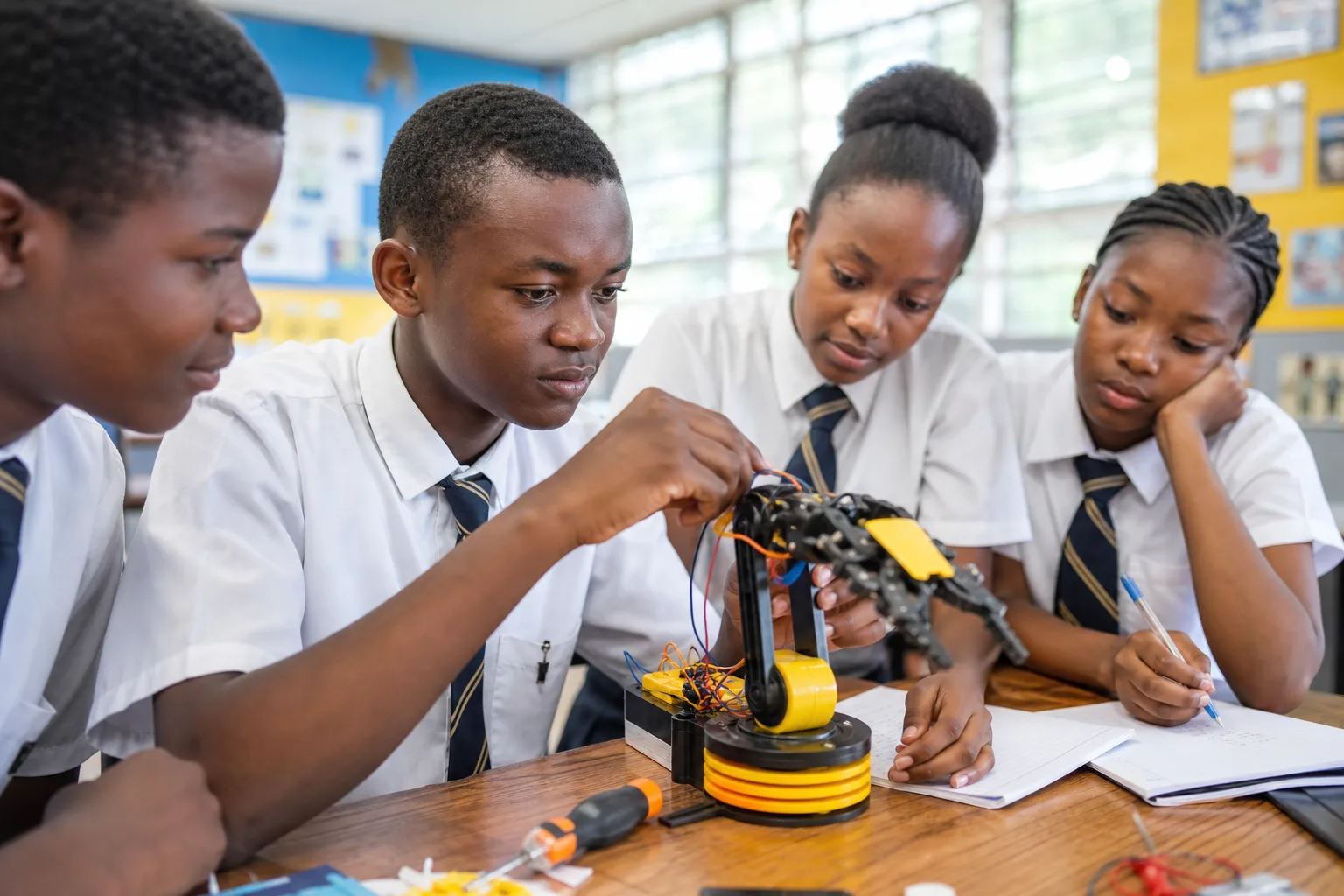
The African Youth AI Competition for 2026 has officially opened its application window, inviting young people from across the continent to compete in artificial intelligence and robotics. It’s one of the more ambitious youth-focused STEM initiatives to come out of Africa in recent years — and if it delivers on its stated goals, it could become a genuine pipeline for the kind of homegrown AI talent the continent desperately needs.
- The African Youth AI Competition 2026 is now accepting applications from young people across the continent.
- The African Youth AI Competition targets the next generation of AI and robotics talent in underrepresented regions.
- Africa’s growing youth population makes programs like this critical for shaping the continent’s future tech workforce.
- Applications are open continent-wide, signalling serious institutional ambition behind the initiative.
Table of Contents
What Is the African Youth AI Competition?
The full name is the Presidential African Youth in Artificial Intelligence and Robotics Competition — PAYARC for short. The ‘Presidential’ tag isn’t just window dressing. Government-backed initiatives carry a different weight than privately funded hackathons: they signal policy intent, tend to attract institutional support, and have a better shot at sustained funding beyond a single edition.
The competition is aimed squarely at Africa’s youth, inviting applicants to demonstrate skills and ideas at the intersection of AI and robotics. Applications are open continent-wide, which is significant in itself. Too many African tech initiatives focus on a handful of established tech hubs — Lagos, Nairobi, Cape Town, Accra — while talent in less-connected regions goes unnoticed. A pan-African scope, if genuinely enforced, could surface competitors from places that rarely appear on the startup or innovation map.
Why Africa Needs the African Youth AI Competition Now
The timing isn’t accidental. Africa is experiencing a demographic surge that the rest of the world is watching closely. By 2050, the continent will be home to roughly one in four people on Earth, and the majority of that population will be young. That’s an enormous potential workforce — but potential only converts into economic output when it’s met with education, infrastructure, and opportunity.
AI is increasingly the lens through which global economic competitiveness is being measured. Countries that build strong AI talent bases now will have structural advantages in the decades ahead. Those that don’t will find themselves importing both the technology and the expertise to run it — a dynamic that historically hasn’t ended well for developing economies.
The African Youth AI Competition is one concrete response to that challenge. It creates a visible, aspirational target for young people who might otherwise have no clear pathway into the field. Competitions of this kind do something that curricula alone can’t: they make expertise feel achievable and socially valued.
The Global South Context
It’s telling that the competition is being positioned partly within the Global South framing. That’s a deliberate signal about whose interests this is meant to serve. Western AI development — dominated by a handful of American and Chinese companies — has consistently failed to reflect the priorities, languages, and lived realities of people in Africa, South Asia, or Latin America.
The consequences of that gap are practical, not just political. AI models trained predominantly on English-language, Western-context data perform poorly on African languages, agricultural conditions, healthcare scenarios, and infrastructure realities. If Africa is going to build AI systems that actually work for Africans, it needs African engineers, researchers, and entrepreneurs in the rooms where those systems get designed.
Competitions like the African Youth AI Competition can’t fix structural underinvestment in research institutions or the brain drain that sees talented graduates leave for better-funded labs abroad. But they can start shifting the narrative about where AI talent lives and what it’s capable of.
How It Stacks Up Against Other Youth AI Initiatives
Globally, youth AI competitions have proliferated in the past five years. Google, MIT, and various national governments have all launched programmes targeting students and early-career technologists. China has made AI education a national priority from secondary school upward. The US runs competitions through organisations like Science Olympiad and various DARPA-adjacent programmes.
Africa has been slower to develop comparable infrastructure, which makes PAYARC’s presidential backing worth paying attention to. It’s not a corporate initiative that disappears when a sponsor’s marketing priorities shift. That institutional foundation matters when you’re trying to build something that outlasts a single news cycle.
That said, ambition and execution are two different things. The real test of the African Youth AI Competition will come in how winners are supported after the competition ends — whether there are mentorship pipelines, funding pathways, or university placements attached to the programme, or whether participants collect a certificate and return to under-resourced environments with no further scaffolding. That follow-through is where most youth competitions quietly fail.
What Applicants Should Know
Applications are now open across Africa for the 2026 edition. If you’re a young person on the continent with an interest in AI or robotics — whether you’re a seasoned coder or someone who’s been tinkering with hardware in a school lab — this is worth looking into. The pan-African scope means the playing field is deliberately broad, and that’s an opportunity, not just a logistical challenge.
For educators, school administrators, and anyone working in African tech ecosystems: spreading awareness of programmes like this is genuinely useful. A lot of the talent that could compete in the African Youth AI Competition simply won’t hear about it through official channels. Word-of-mouth and community networks have historically been how these things actually reach their intended audience.
The Bigger Picture
Individual competitions don’t transform continents. But they contribute to something cumulative — a growing sense among young Africans that AI and robotics are fields they can enter, compete in, and eventually lead. The African Youth AI Competition isn’t a silver bullet, and anyone who frames it as one is selling something.
What it can do is add another visible data point to a still-forming picture of Africa as a serious player in the global AI story. The continent’s tech sector has already demonstrated in fintech, mobile payments, and agri-tech that homegrown innovation can outpace imported solutions. The question is whether AI will follow the same trajectory — and whether programmes like this one will have played a meaningful role when someone eventually writes that history.