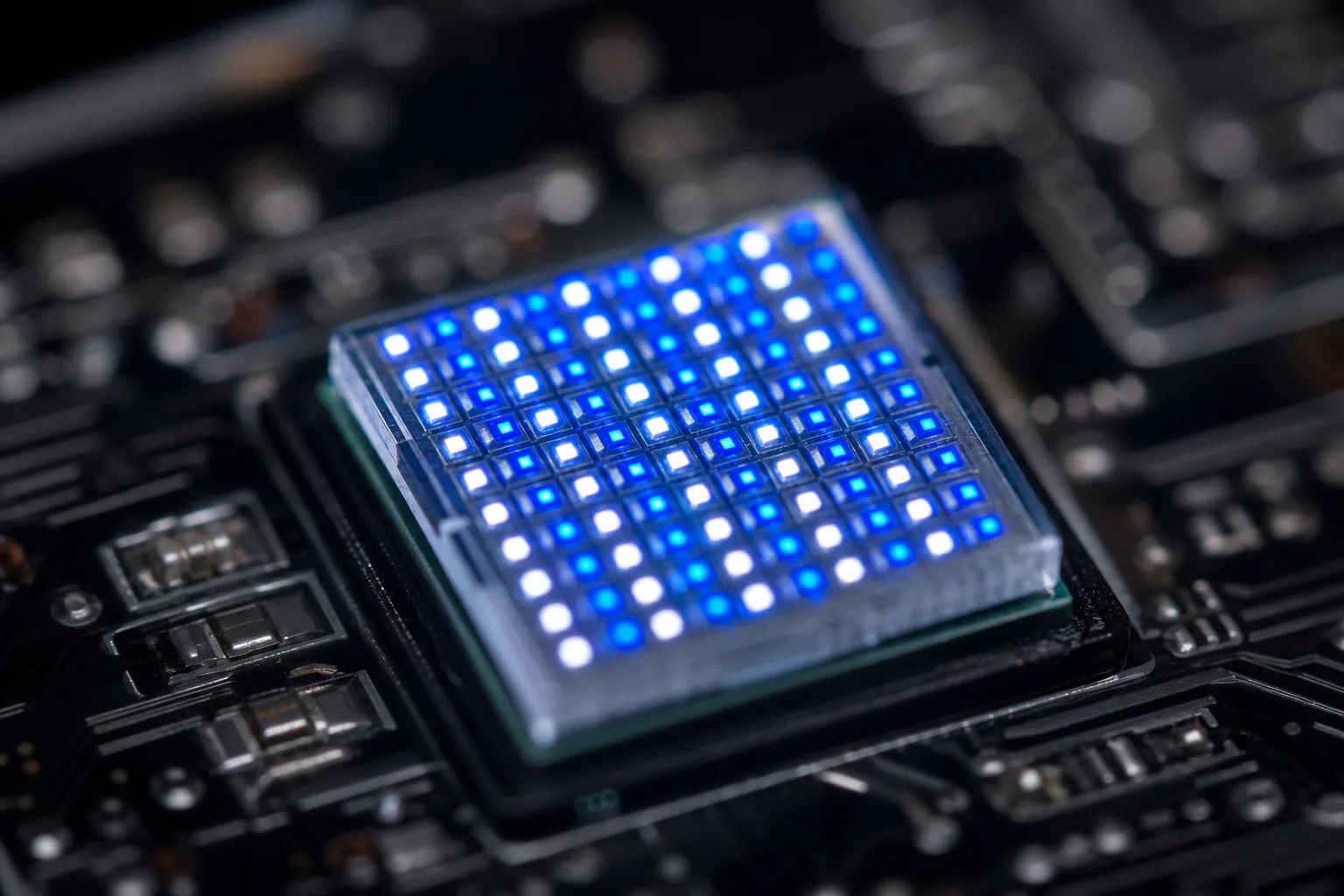
The MicroLED interconnect market is quietly becoming one of the more compelling hardware stories of the decade — and new market forecasts put a sharp number on just how big the opportunity is. Analysts are projecting the sector will reach $722 million by 2033, up from a comparatively modest base today, with artificial intelligence infrastructure build-out and high-performance computing demand doing most of the heavy lifting.
- The MicroLED interconnect market is projected to reach $722 million by 2033, driven by AI and HPC demand.
- Growth in the MicroLED interconnect market is closely tied to expanding AI data center infrastructure worldwide.
- MicroLED technology offers significant power efficiency and brightness advantages over OLED and LCD alternatives.
- Semiconductor packaging advances and rising demand for AR and wearable displays are accelerating market adoption.
Table of Contents
Why the MicroLED Interconnect Market Is Accelerating Now
Timing matters here. The MicroLED interconnect market isn’t growing in isolation — it’s riding one of the largest capital expenditure waves the tech industry has ever seen. Hyperscalers like Microsoft, Google, Amazon, and Meta are collectively spending hundreds of billions of dollars expanding their AI data center footprints. That kind of infrastructure investment doesn’t just create demand for GPUs and custom silicon; it creates demand for the interconnect technology that ties all those components together.
Traditional copper interconnects have served data centers reasonably well for years, but they hit a wall when you start pushing the data rates that modern AI workloads require. Optical interconnects — and increasingly, MicroLED-based optical solutions — sidestep copper’s bandwidth and heat limitations in ways that are genuinely hard to replicate with incremental improvements to existing materials. That’s the wedge the MicroLED interconnect market is exploiting right now, and it’s a wide one.
High-performance computing facilities face the same physics problem. Whether it’s climate modeling, drug discovery, or training the next generation of large language models, HPC workloads are data-hungry in ways that demand interconnect performance far beyond what consumer or enterprise IT infrastructure has historically needed. MicroLED-based solutions offer the bandwidth density and low-latency characteristics that make them a credible answer to that challenge.
MicroLED’s Technical Edge — and Why It’s Taken This Long
MicroLED has been a ‘technology of the future’ for frustratingly long. The displays industry has been talking about it since at least the early 2010s, and Samsung famously showed off its modular ‘The Wall’ MicroLED display concept back in 2018. Apple’s reportedly been working on MicroLED wearable displays for years, with various reports suggesting the Apple Watch was the intended debut platform before the project hit yield and cost hurdles.
So what’s different now? A few things. Manufacturing processes for transferring microscopic LED chips — a notoriously difficult step called mass transfer — have matured significantly. Yields are improving. And crucially, the economics are shifting as volumes start to build in adjacent markets like AR headsets and premium automotive displays, which in turn helps bring down the cost curve for interconnect applications.
The core technical story is compelling. MicroLED emitters are inorganic, which means they don’t degrade the way organic LEDs do — no burn-in, longer lifespan, and the ability to operate across a much wider temperature range. Peak brightness is dramatically higher than OLED, which matters for both display applications in bright environments and for the signal integrity requirements of optical interconnects. Power efficiency is better too, and in a world where data center energy consumption is under increasing regulatory and public scrutiny, efficiency gains aren’t just engineering wins — they’re business wins.
Beyond Data Centers: The Broader Demand Picture
While AI infrastructure is the headline growth driver, the MicroLED interconnect market is drawing demand from several directions simultaneously. Augmented reality is a significant one. Devices like Microsoft’s HoloLens and whatever Apple eventually ships as a follow-up to Vision Pro will need display and interconnect technology that’s power-efficient, compact, and capable of extremely high pixel densities. MicroLED checks all three boxes in ways that LCD and even OLED struggle to match at small form factors.
Wearables more broadly — smartwatches, fitness trackers, heads-up displays for industrial and military applications — represent another layer of demand. These are devices where battery life is paramount and where display quality in outdoor or variable-lighting conditions matters enormously. The military and aerospace sectors, in particular, have long been willing to pay a premium for displays that perform reliably under harsh conditions, and MicroLED’s durability profile makes it a natural fit.
Automotive is worth watching too. The shift toward software-defined vehicles and increasingly digital cockpit experiences has created genuine appetite for display technology that can handle automotive temperature extremes, high ambient light environments, and the kind of operational lifespan that car manufacturers require. MicroLED ticks those boxes in ways that LCD and OLED — which have well-documented failure modes in extreme temperatures — don’t always manage.
The Competitive Landscape and Key Players
The MicroLED interconnect market is still relatively fragmented, which is typical for an emerging technology sector at this stage of the growth curve. You have specialist component manufacturers, vertically integrated display companies, and semiconductor packaging firms all working on pieces of the puzzle. Taiwan’s AUO and Japan Display have active MicroLED programs. PlayNitride and Jade Bird Display are two of the more prominent pure-play MicroLED companies. On the interconnect side specifically, companies working on silicon photonics and optical transceiver technology — including Intel’s photonics division, Coherent, and II-VI — are increasingly intersecting with the MicroLED space as the two fields converge around data center applications.
The MicroLED interconnect market also benefits from the broader momentum in chiplet architectures and advanced packaging. As the semiconductor industry moves away from monolithic chips toward disaggregated designs where multiple chiplets are packaged together, the interconnect layer becomes critically important. MicroLED-based optical interconnects are one of several competing approaches — alongside electrical through-silicon vias and other optical technologies — vying to become the dominant solution for chiplet-to-chiplet communication at short distances.
Getting to $722 Million: What Has to Go Right
Reaching $722 million by 2033 isn’t a given — it assumes continued AI infrastructure investment, sustained progress on MicroLED manufacturing yields, and successful commercialization in at least two or three of the end markets described above. If AI capital expenditure cools significantly — and there are analysts who think the current pace isn’t sustainable — that timeline could stretch. If Apple or another major consumer electronics player successfully ships a MicroLED product at meaningful volumes, it could accelerate it.
The manufacturing challenge is real and shouldn’t be glossed over. Mass transfer of micro-scale LEDs at the speed and precision required for commercial volumes remains one of the trickier engineering problems in the display and interconnect industry. Companies that crack it at competitive cost will have a durable advantage; those that can’t will struggle to participate in the market at scale regardless of what the demand curve looks like.
Still, a $722 million market by 2033 — while significant for an emerging segment — is actually a relatively conservative number when set against the scale of the AI infrastructure and semiconductor markets it’s feeding into. If MicroLED interconnects establish themselves as the preferred solution for short-reach optical data center links, the ceiling could be considerably higher than current forecasts suggest. The MicroLED interconnect market is, in that sense, less of a niche display story and more of a foundational infrastructure play — one that will look increasingly important as AI workloads continue to scale.
Frequently Asked Questions
What is driving growth in the MicroLED interconnect market?
The MicroLED interconnect market is expanding primarily because of surging investment in AI infrastructure and high-performance computing. Data centers and HPC facilities require high-bandwidth, low-latency interconnects, and MicroLED-based optical solutions are increasingly well-suited to meet those demands at scale.
How does MicroLED differ from OLED in terms of performance?
MicroLED offers higher peak brightness, better energy efficiency, and longer operational lifespan compared to OLED. It also avoids OLED’s burn-in issue. These advantages make it attractive for both consumer displays and demanding industrial or data-center optical interconnect applications.
Which industries are the biggest adopters of MicroLED interconnect technology?
AI infrastructure and high-performance computing are identified as leading drivers of MicroLED interconnect adoption. Other industries are also exploring the technology for applications that benefit from its performance characteristics.
When is the MicroLED interconnect market expected to reach $722 million?
The MicroLED interconnect market is forecast to reach USD 722.0 million by 2033, driven by AI infrastructure expansion and high-performance computing demand.