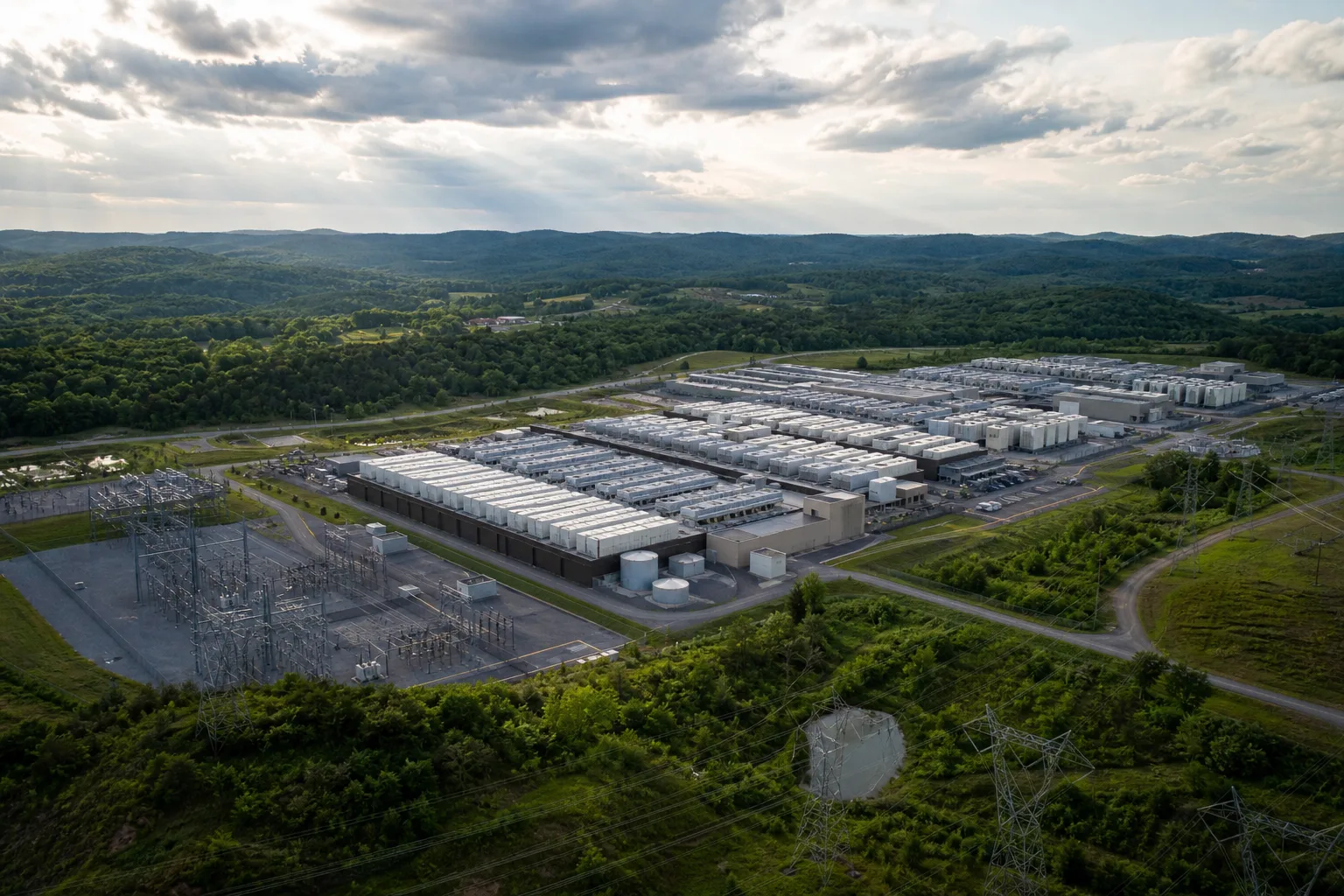
Google’s data center expansion in Jackson County, Alabama, is moving forward with a $1.5 billion investment that covers construction costs, energy infrastructure, and a longer-term bet on nuclear power. It’s one of the more transparent commitments a major tech company has made about how it plans to power the AI era — and what it won’t ask local communities to subsidize.
Table of Contents
What Google Is Actually Building
The Jackson County campus has been operational since 2019, originally developed on the site of the Tennessee Valley Authority’s retired Widows Creek coal plant. That location wasn’t chosen by accident. Repurposing an existing industrial site gave Google ready access to high-capacity electrical infrastructure — transmission lines, substations, and grid connections that would have cost significantly more to build from scratch. It’s a playbook more companies should probably follow.
The new $1.5 billion phase of Google data center expansion runs from 2026 through 2027. Google hasn’t broken down exactly what’s being added in terms of rack capacity or square footage, but at that price point, this isn’t a minor refresh — it’s a substantial physical expansion of one of its more strategically positioned facilities in the American South.
Google Data Center Expansion and the Ratepayer Promise
What makes this Google data center expansion stand out isn’t just the dollar figure. It’s the explicit commitment Google is making under the White House’s Ratepayer Protection Pledge. The pledge essentially requires that companies expanding energy-intensive infrastructure take full financial responsibility for the power and grid upgrades their operations demand — rather than letting those costs flow through to residential electricity bills.
Google says it will cover 100% of its power consumption costs and fund the infrastructure directly tied to its operations at Jackson County. That’s a meaningful commitment in a region where energy affordability matters. The Tennessee Valley Authority serves parts of seven states, and historically, large industrial loads have sometimes pushed up rates for everyone else on the grid. This Google data center expansion is specifically pledging not to be that kind of tenant.
To manage grid strain in the interim, Google is also participating in demand response programs with TVA — essentially agreeing to dial back its power draw during peak demand periods and extreme weather events. That kind of grid flexibility is genuinely useful, and it’s the sort of arrangement that utilities are increasingly looking for as AI data centers threaten to reshape load curves across the country.
The Nuclear Play: Kairos Power and TVA’s Long Game
The longer arc of this Google data center expansion story involves nuclear energy. In 2025, Kairos Power, TVA, and Google announced a partnership to supply up to 50 megawatts of advanced nuclear power to Google’s data centers in Tennessee and Alabama. Kairos is developing a fluoride salt-cooled high-temperature reactor — a design that differs from conventional light-water reactors and is still working through the regulatory approval process in the US.
The catch: the plant isn’t expected to come online until around 2035. That’s nearly a decade away. In the meantime, Google has contracted with TVA to bring more than 300 megawatts of new generation capacity to the Tennessee Valley region through other means. The nuclear pipeline is real, but it’s a long-term play rather than an immediate solution.
Still, the strategic logic is sound. A dedicated nuclear supply — drawing from its own grid rather than competing with local demand — would give Google a stable, carbon-free baseload power source that doesn’t fluctuate with weather or fuel prices. Wind and solar are part of most tech companies’ clean energy mix, but they’re intermittent. Nuclear isn’t. For AI workloads that run around the clock, that distinction matters enormously.
Why Alabama, and Why Now
The timing of this Google data center expansion lines up directly with the surge in compute demand driven by generative AI. Google’s own products — from Gemini to the AI features woven throughout Android and Search — require substantially more processing power than the previous generation of services. Every AI-assisted query, every on-device model inference, every agentic task running in the background represents a real energy cost at the infrastructure level.
Google isn’t alone in this race. Microsoft has committed to spending over $80 billion on AI data centers in fiscal 2025. Amazon Web Services is pouring billions into its own infrastructure buildout. Meta has announced plans for a $10 billion data center campus in Louisiana. The industry is in the middle of an infrastructure arms race, and the companies that secure reliable, affordable, clean power now will have a structural cost advantage for years.
Alabama, specifically, offers some compelling fundamentals that make it an attractive destination for Google data center expansion. Land is relatively cheap compared to coastal markets. TVA power has historically been among the most affordable in the country. And the existing Widows Creek site gives Google infrastructure that would take years to replicate elsewhere. The repurposed coal plant story also plays well politically — it’s a concrete example of industrial transition rather than just a press release about it.
The Bigger Picture for AI Infrastructure
This announcement is worth watching as a signal about where the broader industry is heading. The Ratepayer Protection Pledge, backed by the White House, is an attempt to get ahead of a legitimate public concern: that the AI infrastructure boom will quietly inflate electricity bills for ordinary households. If major players like Google publicly commit to absorbing those costs through responsible Google data center expansion practices, it becomes harder for others to dodge the same accountability.
The nuclear angle is equally significant. Google, Microsoft, and Amazon have all made bets on next-generation nuclear in the past two years — from small modular reactors to partnerships with companies like Kairos, X-energy, and Westinghouse. The consensus forming among hyperscalers is that solar and wind alone can’t carry AI-scale compute loads on a 24/7 basis. Nuclear is being repositioned not as a legacy technology but as the clean baseload solution that makes always-on AI workloads actually sustainable.
Whether that future arrives on the timelines these companies are projecting is another question. Kairos’s 2035 target date for the plant supplying Google’s Alabama and Tennessee facilities is optimistic by historical standards for nuclear construction. Regulatory timelines, supply chain constraints, and workforce availability are all real variables. But the direction of travel is clear: the biggest tech companies are making very long-horizon infrastructure bets, and they’re willing to spend billions now to secure energy certainty a decade from now. Each new Google data center expansion announcement reinforces just how seriously the company is treating this strategic imperative.
For Jackson County, Alabama, the more immediate story is simpler: a $1.5 billion construction project tied to Google data center expansion, thousands of jobs during the build phase, and a major corporate anchor that’s committed — at least on paper — not to make the electricity bill any worse for the people who live there. In the current environment, that’s not nothing.