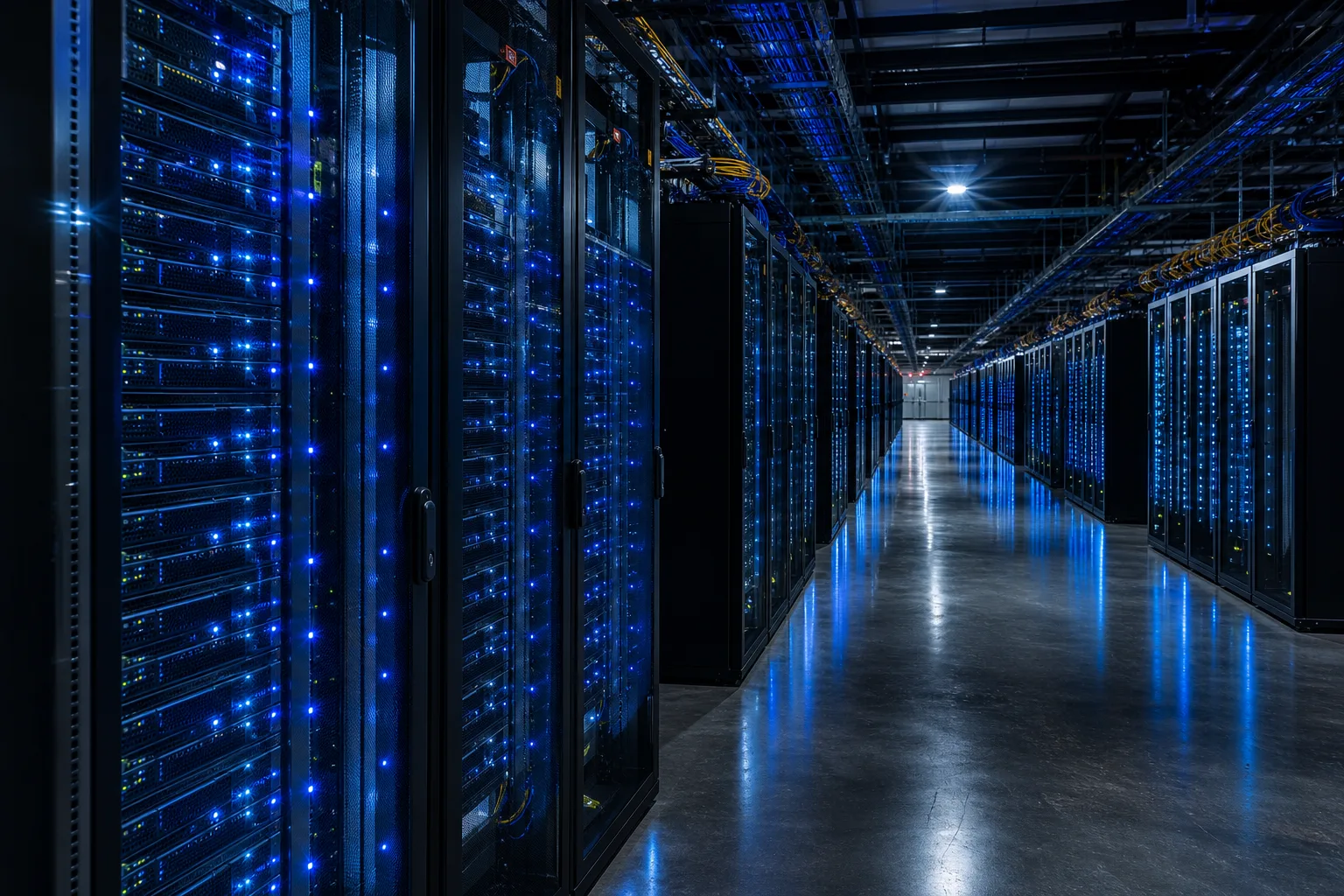
AI power demand isn’t a future problem. It’s here, it’s accelerating, and according to a new report from NTT Global Data Centers, the infrastructure industry is only just beginning to grapple with what it actually takes to keep the lights on — literally — for the next generation of artificial intelligence workloads.
- AI power demand is outpacing existing data center infrastructure, according to a new NTT Global Data Centers report.
- The report identifies cooling, grid capacity, and renewable sourcing as the critical bottlenecks limiting AI power demand responses.
- NTT’s findings highlight that hyperscale operators are increasingly building dedicated campuses to handle AI workloads.
- Without urgent investment in energy infrastructure, AI power demand growth could stall the next wave of model deployment.
Table of Contents
The Scale of the Problem Is Bigger Than Most People Realise
There’s a tendency to think of AI power demand in the abstract — as a talking point for earnings calls or a footnote in a sustainability report. NTT’s findings pull that conversation firmly into the concrete. The company operates one of the world’s largest data center networks, spanning multiple countries, so when its researchers talk about what’s coming, they’re drawing on direct operational experience, not theoretical modelling.
The core tension is straightforward: the compute requirements for training and running large AI models are growing faster than the energy infrastructure designed to support them. A modern GPU cluster running continuous inference workloads can draw several megawatts on its own. String enough of those together — as hyperscalers like Microsoft, Google, and Amazon are doing at pace — and you’re talking about facilities that consume as much electricity as a small city.
That’s not hyperbole. Microsoft’s partnership with Constellation Energy to restart the Three Mile Island nuclear plant is a direct response to exactly this pressure. AI power demand has moved from a data center concern to an energy policy concern almost overnight.
What NTT’s Report Actually Found
NTT identifies three interlocking bottlenecks that will determine whether the industry can keep up with AI power demand: grid capacity, cooling infrastructure, and the availability of clean energy at scale.
Grid capacity is the most immediately visible constraint. In markets like Northern Virginia — the world’s densest concentration of data centers — utilities are already reporting multi-year queues for new power connections. Operators who want to bring a new AI-focused facility online can’t simply plug in; they’re often waiting years for grid access. That’s a problem when hyperscalers are trying to deploy GPU clusters on a quarterly timeline to stay competitive.
Cooling is the second chokepoint, and it’s one that often gets less attention than it deserves. Traditional air-cooled data centers have meaningful limits on how much heat they can handle per rack. AI accelerators — Nvidia’s H100s and newer models, for instance — can demand significantly more power per rack than conventional hardware. Air cooling simply can’t shift that much heat fast enough. Liquid cooling, whether direct-to-chip or full immersion, is no longer an exotic option; it’s becoming a baseline requirement for serious AI infrastructure.
The third issue is arguably the most complex: sourcing clean energy at the scale AI demands. The industry has made genuine commitments to renewable power — Microsoft, Google, and Meta have all signed enormous power purchase agreements — but renewable capacity additions are running behind the pace of new data center construction. The gap is real, and it’s widening. NTT’s report frames this not as a failure of intent but as a structural mismatch between the speed of AI investment and the slower timelines of energy infrastructure development.
AI Power Demand Is Reshaping How Data Centers Are Built
One of the clearest signals in NTT’s findings is that AI workloads are forcing a fundamental rethink of data center design. The old model — a general-purpose facility serving a mix of enterprise IT, cloud hosting, and colocation customers — isn’t going away, but it’s no longer the leading edge.
What’s emerging instead are purpose-built AI campuses: large, often campus-scale facilities designed from the ground up around the specific requirements of GPU-dense workloads. These buildings look different, cool differently, and connect to the grid differently than a standard hyperscale cloud facility built a decade ago.
NTT itself has been expanding its own AI-ready capacity, and the report reflects that the entire industry is moving in this direction. Equinix, Digital Realty, and a wave of newer operators backed by infrastructure investment funds are all racing to build out facilities that can genuinely handle what AI demands — not just in raw power, but in the reliability and redundancy that enterprise customers expect.
The interesting wrinkle here is geography. The historical clustering of data centers around low-cost land and fibre hubs is giving way to something more complex. Operators are increasingly chasing power — locating new builds near hydroelectric resources, nuclear plants, or regions with grid capacity to spare. That’s shifting the map of global data center investment in ways that will play out over the next decade.
The Renewable Energy Equation Is More Complicated Than It Looks
Every major tech company has a net-zero or 100% renewable energy target. Google has had one for years. Microsoft reportedly aims for carbon negativity within this decade. Other major tech firms have made similar claims about their renewable energy status. But when AI power demand is growing this fast, those commitments face a genuine stress test.
The issue isn’t whether the industry wants clean energy — it clearly does, both for reputational reasons and because corporate buyers have driven significant growth in renewable capacity globally. The issue is additionality and timing. A data center that signs a power purchase agreement for solar energy being built elsewhere on the grid isn’t necessarily running on solar electrons; it’s offsetting its consumption on paper. As AI facilities demand gigawatts of always-on power, the mismatch between intermittent renewable generation and continuous AI compute becomes harder to paper over.
This is why nuclear has come back into the conversation so forcefully. It’s dispatchable, carbon-free, and capable of delivering the kind of sustained baseload power that AI clusters require. Beyond the Microsoft-Constellation deal, reportedly Google and Amazon have also been pursuing nuclear energy arrangements of various kinds. NTT’s report reflects a broader industry acknowledgement that solar and wind alone won’t close the gap.
Why This Matters Beyond the Data Center Industry
It’s easy to frame AI power demand as an infrastructure niche — something for data center operators and utility executives to sort out. But the downstream implications are much wider.
If power and cooling constraints genuinely throttle the pace of AI infrastructure deployment, that flows directly into the competitive dynamics of AI development. The companies that secure power capacity — whether through direct utility deals, on-site generation, or control of power-rich land — will have a structural advantage over those that can’t. In a world where the ability to train larger models faster is still a meaningful competitive differentiator, energy access becomes a strategic asset in a way it never was for previous waves of technology.
There’s also a public policy dimension. Grid operators in Virginia, Texas, and Ireland have already raised concerns about the pace of data center load growth. Some have imposed moratoriums on new connections. Regulators are starting to ask questions about who pays for grid upgrades when a single hyperscaler facility requires as much new capacity as thousands of homes. These aren’t questions the tech industry can answer on its own.
NTT’s report doesn’t pretend to have all the answers. What it does is put numbers and operational specificity behind a challenge that’s been discussed in general terms for too long. AI power demand is the defining infrastructure problem of this decade — and the industry’s ability to solve it will shape not just which companies win the AI race, but how quickly and equitably AI capabilities can be deployed at scale.
Frequently Asked Questions
Why is AI power demand growing so rapidly?
Modern AI workloads — especially large-scale model training and inference — require dense clusters of GPUs running continuously. This creates sustained, high-intensity power draws that traditional data center designs weren’t built to handle, pushing both grid capacity and cooling systems to their limits.
What does NTT Global Data Centers recommend to address the energy gap?
NTT’s report points to a combination of purpose-built AI campuses, investment in on-site and grid-scale renewable energy, and advanced liquid cooling systems as the most practical near-term responses to surging AI infrastructure requirements.
How does AI power demand compare to traditional data center workloads?
A single AI GPU cluster can consume several megawatts continuously — far beyond what a standard enterprise server rack demands. AI-optimised facilities are being designed from the ground up with power densities that would have seemed extraordinary just five years ago.
Are renewable energy sources keeping pace with AI power demand?
Not yet. While major operators are signing large power purchase agreements and exploring on-site generation, renewable capacity additions are lagging behind the pace of AI infrastructure buildout, creating a growing gap the industry is still working to close.