

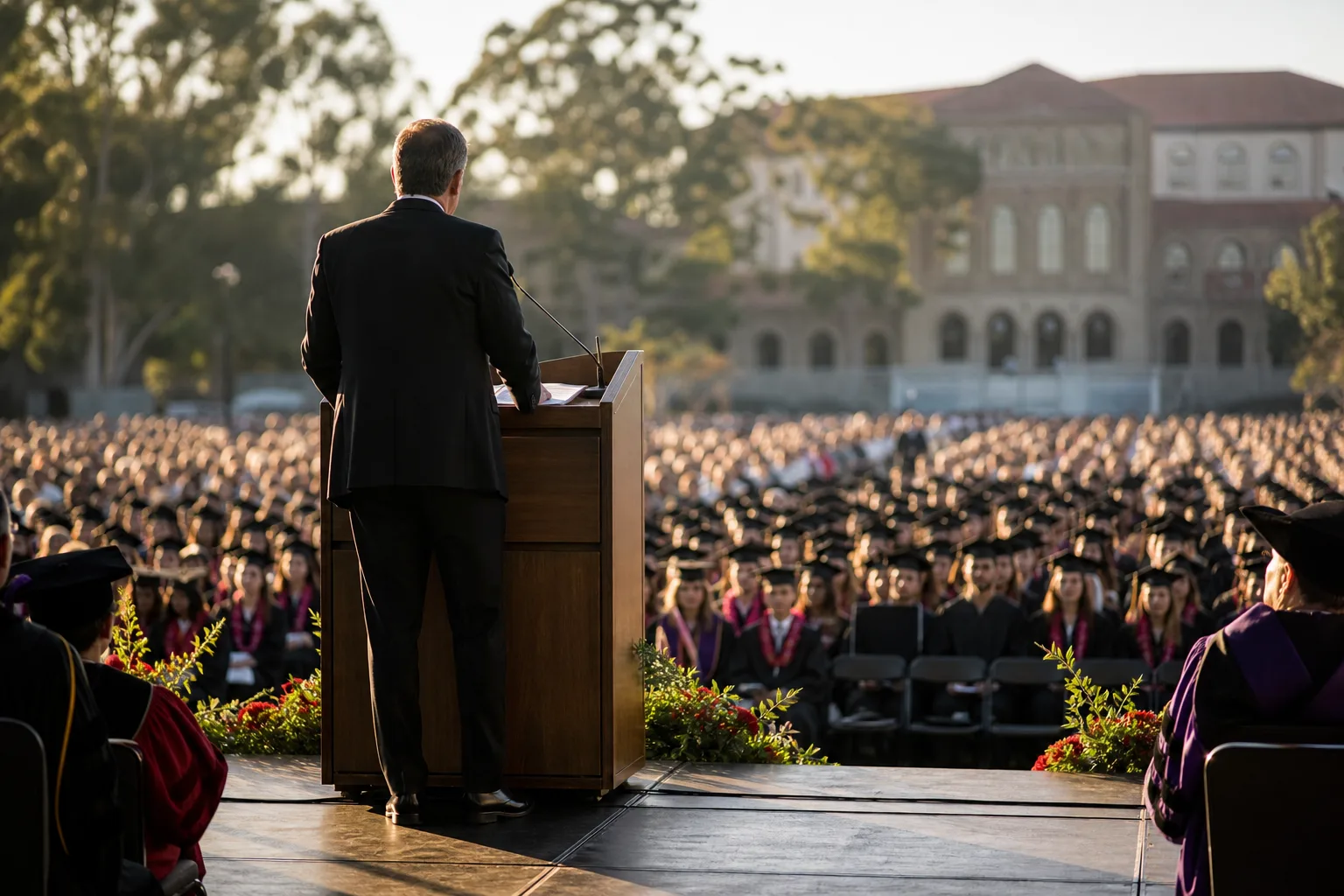
The Sundar Pichai Stanford speech at this year’s commencement had everything you’d expect from a sitting CEO addressing one of the world’s most prestigious engineering schools — except the one thing everyone assumed he’d lead with. There was no Gemini. No AI Overviews. No breathless talk about large language models reshaping civilisation. For a man who has spent the better part of two years telling anyone who’ll listen that AI is the most profound technology humanity has ever developed, the silence was conspicuous.
- Sundar Pichai’s Stanford speech notably avoided the AI evangelism that dominates almost every Google public appearance in 2025.
- The Sundar Pichai Stanford speech focused on personal resilience and navigating uncertainty rather than product announcements or technology trends.
- Pichai’s decision to sidestep AI at one of tech’s most prestigious graduation stages signals a deliberate, carefully managed public persona shift.
- For a CEO whose company is spending billions racing against OpenAI and Microsoft, the silence on AI was louder than any talking point.
Table of Contents
What Sundar Pichai Actually Said at Stanford
Pichai’s address leaned into the kind of timeless commencement territory that CEOs often reach for when they want to appear statesmanlike rather than promotional — resilience in the face of setbacks, the value of intellectual curiosity, and the importance of staying grounded when the world moves fast. These aren’t bad themes. In fact, for a graduating class walking into a job market being actively reshaped by automation and AI-driven hiring freezes, advice about navigating uncertainty is arguably more useful than another lecture on prompt engineering. The Sundar Pichai Stanford speech made that case quietly but effectively.
But context matters enormously here. This wasn’t a random regional college appearance. Stanford sits at the literal epicentre of the AI industry. Half the founding teams of the most-talked-about AI startups in Silicon Valley have Stanford on their CVs. Stanford’s own HAI institute is one of the most cited sources in the AI policy conversation. Delivering a speech there without engaging AI even tangentially isn’t just an editorial choice — it’s a statement.
The Pressure Every Tech CEO Is Under Right Now
It’s worth stepping back and thinking about the environment Pichai is operating in. Google is deep in one of the most expensive and high-stakes technology races in corporate history. The company is reportedly spending heavily on AI infrastructure, and the pressure from Wall Street, from employees, and from the press to show tangible returns on that investment is relentless. Every public appearance Pichai makes gets picked apart for signals about Google’s direction, its confidence in Gemini, its response to OpenAI’s latest move.
That’s exhausting — and it probably explains some of what happened at Stanford. The Sundar Pichai Stanford speech reads, at least in part, as an attempt to step off that treadmill for a moment. To be a person rather than a product roadmap. There’s something almost countercultural about a Google CEO standing at a podium and not mentioning AI in 2025.
Sundar Pichai Stanford Speech Signals a Subtle Persona Shift
Pichai has always been quieter and more measured than peers like Elon Musk or even the more theatrically enthusiastic Sam Altman. But lately there are signs he’s working to reinforce that image deliberately — presenting himself as a steady hand rather than a hype machine at a moment when the AI industry desperately needs someone to play that role.
The criticism levelled at AI leaders over the past year has been sharp. Overpromised timelines, products that hallucinate confidently, and a communications culture that sometimes feels detached from how ordinary users actually experience these tools — all of it has eroded public trust in a way that flashy keynotes can’t easily repair. The Sundar Pichai Stanford speech, with its choice to address human resilience rather than technological determinism, is a small but meaningful signal that Pichai is aware of this credibility gap.
It also points to something broader about where the AI conversation might be heading. The full-throated techno-optimism that characterised the immediate post-ChatGPT period — where every executive felt compelled to outbid the last in enthusiasm — is giving way to something more measured. Not pessimism, but a growing recognition that the public, regulators, and even investors are getting more sceptical of claims that aren’t backed by concrete outcomes.
What This Means for Google’s Public Strategy
Reading too much into a single commencement speech would be a mistake. Pichai will almost certainly be back on stage at Google I/O and beyond, talking up AI features and Gemini integrations with his usual composed enthusiasm. The Sundar Pichai Stanford speech doesn’t represent a strategic retreat from AI — Google’s quarterly spending figures make that abundantly clear.
But it does suggest that Google’s communications team is thinking carefully about how their CEO is perceived at a moment when the AI gold-rush narrative is getting harder to sell uncritically. There’s a real audience — graduates, policymakers, skeptical journalists — for a version of Sundar Pichai who talks about values and judgment rather than just velocity and capability.
Whether that positioning holds under pressure from OpenAI’s next product launch or a rough earnings call is another question entirely. But for one afternoon in Palo Alto, Google’s CEO chose to be something rarer than an AI evangelist: just a person with something genuinely human to say.

