
Price charts still dominate the conversation in most crypto circles. But the real story of 2026 is playing out at the protocol layer — and it’s one that institutional players, developers, and serious builders can’t afford to ignore. The blockchain upgrades 2026 has lined up for its second half are, in many ways, the most consequential set of infrastructure changes the industry has attempted since Ethereum’s Merge back in September 2022. Speed, reliability, and institutional-grade predictability are the new benchmarks. Hype is, for once, taking a back seat.
- The most important blockchain upgrades 2026 has scheduled focus on reliability and institutional infrastructure, not raw speed alone.
- Ethereum’s Glamsterdam, one of the headline blockchain upgrades 2026 is tracking, targets scalability and fairer transaction ordering via ePBS.
- Solana’s Alpenglow consensus overhaul could slash finality times from 12.8 seconds to under 150 milliseconds when it ships.
- Base’s Beryl hard fork went live despite a two-hour chain halt, raising honest questions about Layer 2 resilience for always-on finance.
Table of Contents
Why Blockchain Upgrades 2026 Look Different From Previous Years
Historically, protocol upgrades chased the same goals: more features, faster throughput, higher transaction counts. That made sense when the primary audience was retail traders and DeFi degens. But the audience is changing. Sovereign wealth funds, asset managers, and payment processors are now actively evaluating blockchain infrastructure for real financial use cases — stablecoin settlement, tokenised bonds, cross-border payments that need to clear on a schedule. The blockchain upgrades 2026 is delivering are being designed with exactly this audience in mind.
Tim Sun, a senior researcher at Hong Kong-based asset manager HashKey Group, puts it plainly: the emphasis in 2026 is shifting toward reliability, predictable governance, and infrastructure that can support large-scale financial operations. That’s a very different design brief from ‘make the number go up.’ It also explains why the blockchain upgrades 2026 developers are prioritising look so different from the feature-chasing releases of earlier cycles.
Bitcoin, notably, is sitting this cycle out. Development remains effectively frozen while the community argues over covenant proposals and post-quantum cryptography approaches. It’s a reminder that decentralised governance can be a feature and a bug simultaneously — and that indecision at the base layer has real opportunity costs as competitors move fast. Against that backdrop, the blockchain upgrades 2026 is seeing on other chains stand out even more sharply.
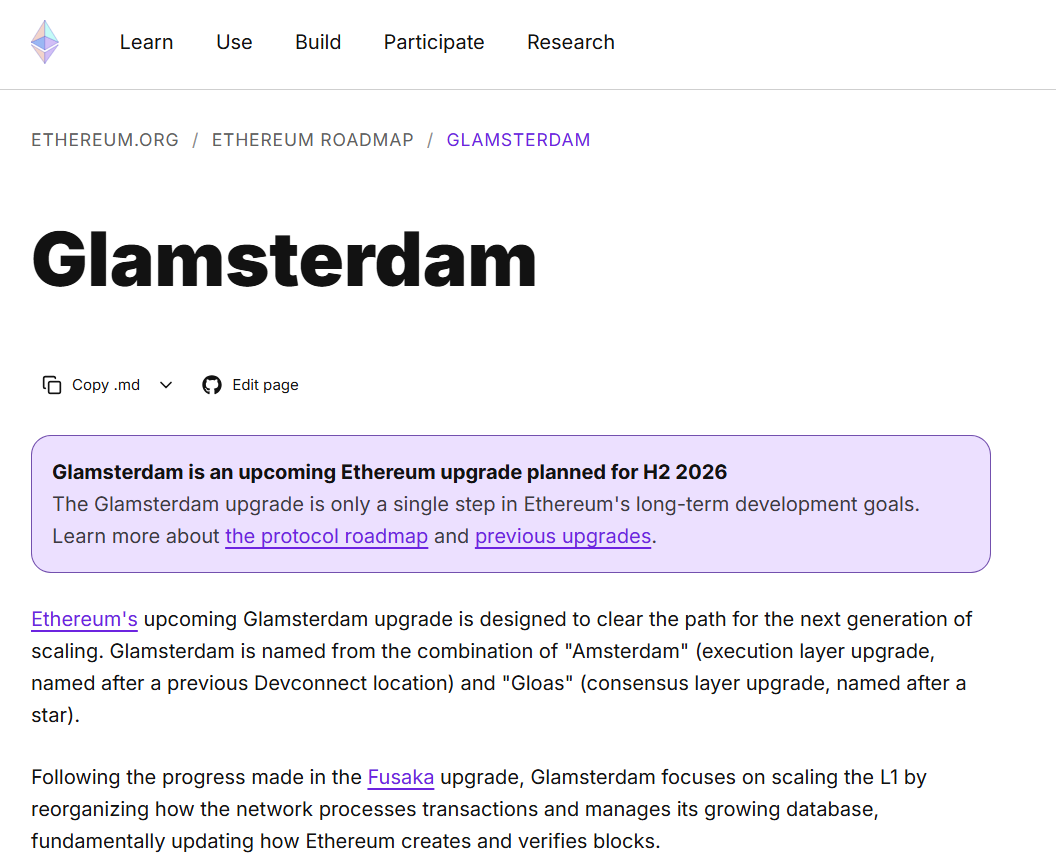
Ethereum Glamsterdam: The Blockchain Upgrade 2026 Is Watching Most Closely
Ask any serious Ethereum developer what’s keeping them busy right now, and Glamsterdam will come up almost immediately. Already being stress-tested on developer networks, Glamsterdam is designed around three interconnected goals: better scalability, a harder and more resilient Layer 1, and a meaningfully improved user experience. Mainnet deployment is expected sometime in the second half of 2026, according to Ethereum’s official public roadmap. Among all the blockchain upgrades 2026 has on the schedule, Glamsterdam carries the heaviest institutional weight.
Sun says the practical benefits should include parallel transaction processing, expanded data capacity, and meaningfully reduced database bloat — all of which point toward Ethereum becoming a more credible settlement layer for stablecoins and tokenised real-world assets. That’s not a small thing. The stablecoin market alone is now well past $150 billion in circulation, and the infrastructure that those tokens settle on matters enormously to issuers and regulators alike.
Holly Atkinson, chief product and technology officer at DeFi aggregator 1inch, told Cointelegraph that many in the ecosystem view Glamsterdam as Ethereum’s most significant upgrade since The Merge — which, it’s worth remembering, was itself a multi-year engineering effort that removed proof-of-work from the world’s second-largest blockchain. That’s a meaningful benchmark to be compared against, and it helps explain why Glamsterdam sits at the top of every serious list of blockchain upgrades 2026 analysts are watching.
ePBS: Fairer Block Building, or Just a Different Centralisation Problem?
The headline technical change inside Glamsterdam is enshrined proposer-builder separation, universally shortened to ePBS. To understand why it matters, you need to know how Ethereum’s block-building actually works today. The vast majority of validators — the nodes that propose and validate blocks — don’t build those blocks themselves. They outsource that work to a small cluster of specialised builders and relays. That concentration of power amplifies maximal extractable value (MEV), creates censorship risks, and quietly centralises one of the most important functions in the network. ePBS is one of the reasons blockchain upgrades 2026 has on the Ethereum roadmap are being watched so closely by institutional operators.
ePBS pulls that process back into the protocol itself. Rather than relying on a private marketplace of builders operating outside the consensus layer, it creates a formal, transparent, in-protocol separation between the entity that proposes a block and the entity that constructs it. Atkinson argues this makes the process more accountable and harder to game.
But the picture isn’t entirely clean. Pavan Kaur — a Solana Foundation judge and founder of RuleSpark, a compliance engine for digital asset marketing — offers a more cautious read. She describes ePBS as one step in a longer journey rather than a destination. Sandwich attacks and other MEV extraction techniques may simply migrate to new vectors rather than disappearing. ‘Practices like sandwich attacks may therefore migrate rather than disappear,’ she said. It’s a fair warning against over-reading any single upgrade as a complete fix — a caution that applies broadly to the blockchain upgrades 2026 is rolling out across multiple chains.
Solana Alpenglow: Consensus Gets a Full Rebuild
If Glamsterdam is about refinement, Alpenglow is about replacement. Among the blockchain upgrades 2026 has queued up, Solana’s Alpenglow is arguably the most technically radical. It doesn’t tinker around the edges of the existing consensus mechanism — it replaces the core of it. The upgrade, which was approved by an overwhelming majority through Solana’s governance process back in September 2025, is still in active development and is expected to ship as part of the Agave 4.1 validator client release later this year.
Solana ecosystem lead David Liang has described Alpenglow as the chain’s ‘most significant consensus upgrade yet,’ and the technical ambition behind it backs that claim. The existing TowerBFT-based system is being replaced by a redesigned architecture centred on a new voting component called Votor. The practical effect is a dramatic compression of finality times — from roughly 12.8 seconds today to somewhere in the 100–150 millisecond range under optimal conditions.
To put that in context: 150 milliseconds is faster than a human blink. For applications that need near-instant settlement — high-frequency trading infrastructure, payments at point of sale, or real-time financial data feeds — the difference between 12.8 seconds and 150 milliseconds isn’t incremental. It’s categorical. It’s also why Alpenglow ranks among the most consequential blockchain upgrades 2026 has produced so far.
There’s another change inside Alpenglow that’s attracting attention from a different audience entirely. Currently, validator votes on Solana are recorded as on-chain transactions. That sounds reasonable in principle, but in practice it means a significant portion of Solana’s transaction count at any given moment is just validators talking to each other — not users transacting. Alpenglow removes that overhead by shifting validator communication off-chain.
Hadley Stern, board director at DeFi Development Corp, told Cointelegraph that removing on-chain vote transactions is the ‘real story’ for institutional allocators. His reasoning is direct: it ‘cleans up validator economics and gives you honest telemetry, which matters when you’re underwriting SOL as a treasury asset.’ He added that a network capable of migrating its consensus layer this cleanly demonstrates ‘governed adaptability legacy financial infrastructure can’t match.’ That’s a pointed argument, and it’s aimed squarely at the CFOs and treasury teams now taking crypto seriously as a balance sheet item — precisely the audience the blockchain upgrades 2026 is most urgently trying to win over.
Arun Krishnakumar, vice president of institutional capital at enterprise software firm R3, echoed the optimism — describing Alpenglow as a ‘major tailwind’ that will reinforce what Solana’s backers call the ‘internet capital markets’ thesis. The idea is that Solana’s speed and cost profile make it uniquely suited to become the plumbing for a new generation of financial markets. Alpenglow, if it ships cleanly, makes that case considerably harder to dismiss.
Base Beryl: A Hard Fork Launch That Asked Hard Questions
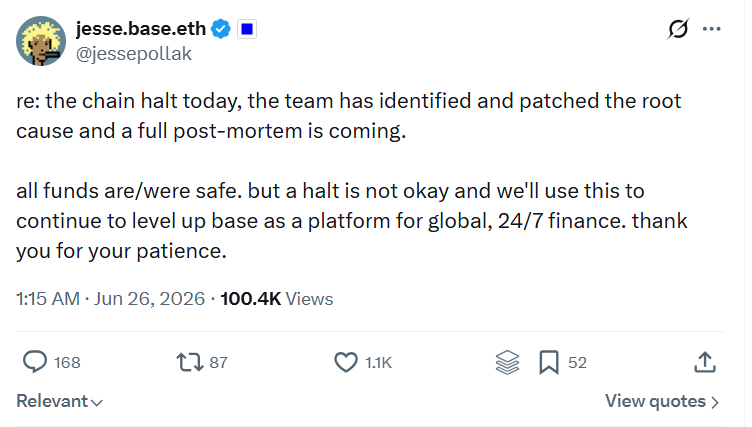
Coinbase’s Base network had a more eventful upgrade weekend than anyone planned. Beryl, a hard fork designed to streamline the Layer 2 network with a native token standard and shorter withdrawal windows, went live on Friday — but not without drama. Block production halted for approximately two hours after an invalid block triggered a temporary consensus failure. The episode became one of the more talked-about blockchain upgrades 2026 has produced, for reasons its developers would rather forget.
Base co-founder Jesse Pollak moved quickly to reassure users, confirming that all funds were safe throughout the outage. But he didn’t soft-pedal the incident either. ‘A halt is not okay,’ he said publicly — an unusually candid acknowledgement from someone at the centre of one of the most watched Layer 2 networks in crypto. He committed to using the lessons from the episode to strengthen Base as infrastructure for ‘global, 24/7 finance.’
The honesty is commendable, but the incident is worth sitting with for a moment. Base isn’t a small experimental testnet — it’s Coinbase’s flagship Layer 2, backed by one of the most regulated and scrutinised companies in the US crypto industry. A two-hour production halt, however technically explainable, is exactly the kind of event that gives institutional operators pause. Real financial infrastructure — the kind that processes payroll, clears settlements, or handles retail payments — doesn’t get to go offline for two hours without serious consequences. It’s a sobering data point in any honest assessment of the blockchain upgrades 2026 has shipped so far.
Beryl’s underlying changes are sensible: tighter performance, a cleaner native token standard, reduced withdrawal friction. Those are the kinds of improvements that make Base more competitive with other Ethereum Layer 2s like Arbitrum and Optimism. But the launch serves as a pointed reminder that shipping upgrades at protocol level carries real operational risk — and that ‘always-on finance’ is an aspiration that requires flawless execution, not just good intentions.
The Bigger Picture: Infrastructure Over Speculation
Step back and the pattern across all these blockchain upgrades 2026 is serving up becomes clear. The industry is, slowly but meaningfully, maturing. The conversations happening at the protocol level — about MEV, validator economics, finality times, and governance predictability — are not the conversations of a speculative bubble chasing the next meme coin. They’re the conversations of an industry trying to build infrastructure that serious money can actually trust.
Whether that trust gets established depends entirely on execution. Glamsterdam needs to ship on time and deliver its scalability promises without introducing new attack vectors. Alpenglow needs to prove that a live, high-value network can swap out its core consensus mechanism without catastrophic disruption. And Base needs to demonstrate that a two-hour halt was a one-off learning experience rather than a preview of fragility to come. Each of these represents a real test for the blockchain upgrades 2026 has staked its credibility on.
None of that is guaranteed. But the ambition on display in the second half of 2026 — across multiple chains, with serious institutional eyes watching — suggests the blockchain industry is finally treating its infrastructure like it means it. For developers and allocators paying attention to fundamentals rather than price tickers, the blockchain upgrades 2026 is delivering are where the real signal is hiding.
Frequently Asked Questions
What are the most important blockchain upgrades 2026 has scheduled?
The three biggest are Ethereum’s Glamsterdam, Solana’s Alpenglow, and Coinbase’s Base Beryl hard fork. Each targets different pain points — scalability, consensus speed, and Layer 2 efficiency respectively — and all are expected to ship in the second half of 2026.
What is Ethereum’s Glamsterdam upgrade and why does it matter?
Glamsterdam is Ethereum’s most significant protocol upgrade since The Merge in 2022. It introduces enshrined proposer-builder separation (ePBS) to reduce centralization risks, expands data throughput, and cuts database bloat — making Ethereum more suitable for stablecoin settlement and real-world asset use cases.
How fast will Solana’s Alpenglow make transaction finality?
Alpenglow targets finality of roughly 100–150 milliseconds in optimal conditions, a dramatic improvement over today’s approximately 12.8-second finality. It achieves this by replacing Solana’s TowerBFT consensus mechanism with a redesigned system built around a new voting component called Votor.
Does ePBS fully solve Ethereum’s MEV and centralization problems?
Not entirely. While ePBS pulls block building back into the protocol for greater transparency, experts like Pavan Kaur of RuleSpark caution that practices like sandwich attacks may migrate rather than disappear. It’s best understood as one important step in a longer roadmap.
What happened during the Base Beryl hard fork launch?
Block production on Base stalled for roughly two hours after an invalid block triggered a temporary consensus failure. Base co-founder Jesse Pollak confirmed user funds were unaffected, but acknowledged a halt is unacceptable for a network positioned as global, always-on financial infrastructure.