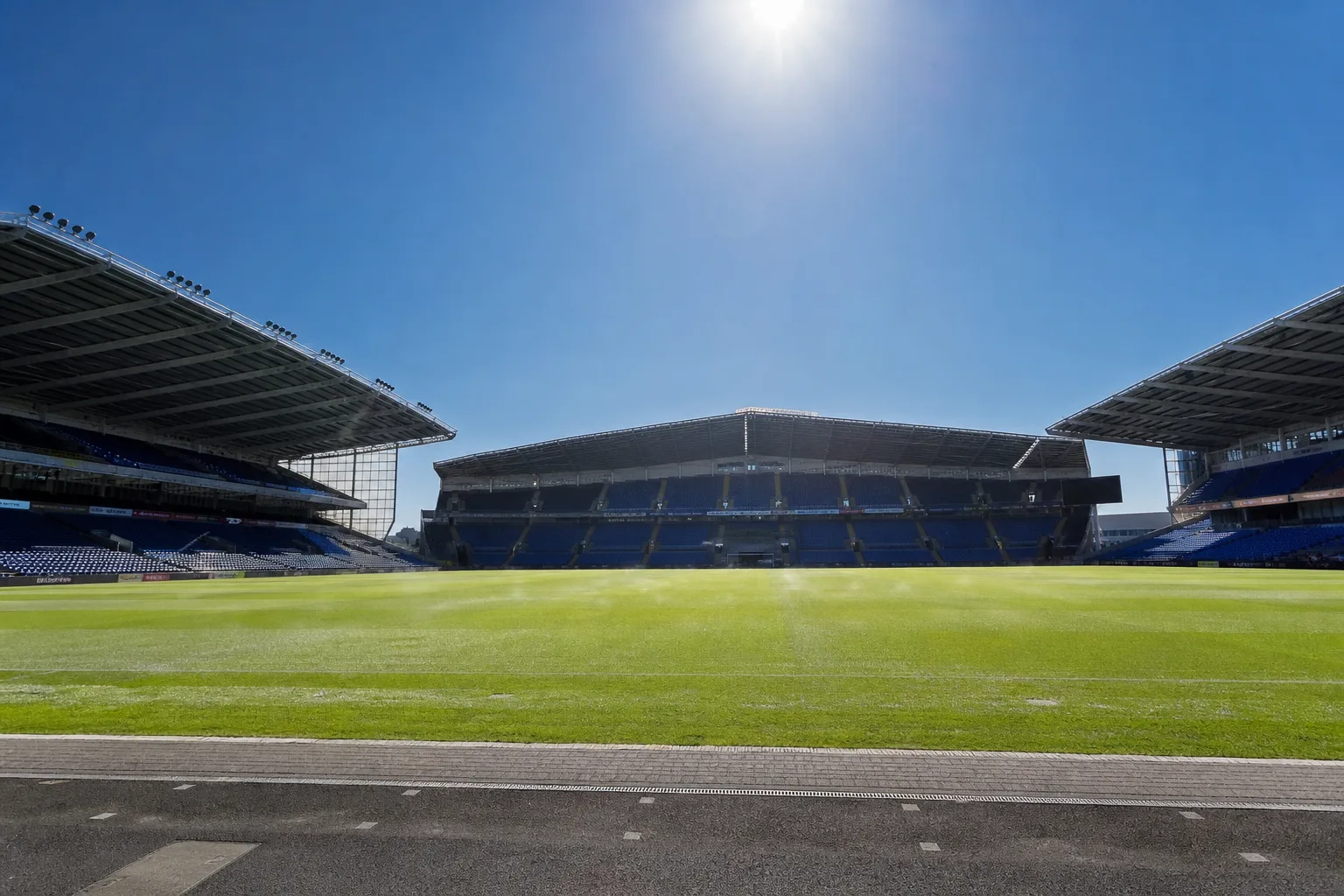
When England and Norway take to the pitch in Miami this Saturday for their World Cup quarter-final, the scoreline won’t be the only thing to watch. World Cup heat stress is emerging as a genuine medical concern for players, officials, and tens of thousands of fans — and the science behind just how dangerous Saturday’s conditions could be makes for sobering reading.
- World Cup heat stress in Miami could hit a WBGT of 88°F on Saturday, well above the 82°F safety threshold.
- Scientists have warned that World Cup heat stress guidelines from FIFA are dangerously inadequate for 2026 conditions.
- A plume of Saharan dust crossing the Atlantic is amplifying South Florida’s already punishing heat and humidity.
- Fans in the stands face real risks too, with older supporters and those with health conditions especially vulnerable.
Table of Contents
The Numbers Behind the Danger
Scientists don’t just talk about temperature when they assess the risk to athletes performing in extreme conditions. They use a measure called the WetBulb Globe Temperature, or WBGT, which layers in humidity, wind speed, and solar radiation on top of raw air temperature to give a fuller picture of how hard the human body has to work to stay cool. Saturday’s match in Miami is forecast to hit a WBGT of around 88°F (31°C) — a reading that places World Cup heat stress firmly in the danger zone by any credible scientific measure.
That number matters a lot. The American College of Sports Medicine recommends that organised athletic activity stop entirely when WBGT exceeds 82°F — because beyond that point, the body’s cooling mechanisms start to lose the battle. Sweat can’t evaporate efficiently in high humidity. Wind offers little relief. The sun beats directly onto skin, driving up both surface and core temperature. At 88°F WBGT, players aren’t just uncomfortable. They’re operating in territory where heat exhaustion becomes a real possibility, and heat stroke isn’t far behind.

FIFA has its own threshold, set at 90°F WBGT, above which it mandates cooling breaks at the 30- and 75-minute marks — players and referees dousing themselves with ice-water-soaked towels. Saturday’s forecast sits just below that line, which means those mandatory breaks may not even be triggered. That’s a detail the scientific community has been vocal about, and it illustrates why World Cup heat stress management is drawing such intense scrutiny ahead of kick-off.
World Cup Heat Stress and the Saharan Factor
South Florida in July is already an oppressive environment for elite sport. But this weekend, conditions are being amplified by something that sounds almost cinematic: a plume of dust swept off the Sahara desert, carried west across the Atlantic by seasonal trade winds, and now sitting over the Florida peninsula. These Saharan dust events are a known meteorological phenomenon in the region, but their interaction with Miami’s humidity and intense sunshine creates a compounding effect — trapping heat close to the surface and intensifying solar radiation intensity at ground level. The result is a World Cup heat stress scenario that goes well beyond what any standard seasonal forecast would suggest.

For players from northern Europe, this is genuinely alien territory. Norway’s Eliteserien is played in conditions that rarely approach anything close to this. Even England’s Premier League, played through an October-to-May season in one of the world’s more temperate climates, gives players no preparation for what they’ll face on the pitch at Hard Rock Stadium. Both squads will have been doing heat acclimatisation work in training, but adaptation takes weeks, and there’s a hard ceiling on how much the body can adjust in a short window.
What the Science Says About Athletic Performance
Matt Maley, a researcher in environmental ergonomics and physiology at Loughborough University, has been watching this situation closely. His assessment of Saturday’s conditions is blunt: players will slow down. Speaking to WIRED, he suggested that players may actually reduce the amount of sprints or the distance they cover at Miami this weekend. Anyone expecting the relentless pressing and high-tempo transitions of a typical Premier League or Champions League night should temper their expectations.
But Maley’s more serious concern isn’t sluggish football — it’s motivated football. Elite athletes at a World Cup quarter-final don’t dial back because their bodies are asking them to. They push through. ‘Motivation does sometimes supersede what the body’s telling the brain,’ he explained, ‘so that’s when we get to the danger area, because people are that motivated to run the same distance, conduct the same amount of sprints, and they could expose themselves to heat exhaustion.’ That’s the paradox at the heart of World Cup heat stress: the higher the stakes, the greater the risk.

Scientists Are Losing Patience With FIFA’s Guidelines
The broader scientific community has been raising the alarm on World Cup heat stress for months. In May, a coalition of researchers spanning five continents published an open letter directed at FIFA and tournament participants, warning that the organisation’s current heat-mitigation framework is not fit for purpose. ‘We are concerned that FIFA’s current guidelines on heat-stress mitigation are inadequate and will place players at risk of heat injury at the 2026 men’s World Cup,’ they wrote plainly.
Their specific criticisms are technical but important. The three-minute hydration breaks FIFA allows are, the scientists argue, simply too short. Rehydration takes longer than that. Meaningful core temperature reduction takes longer than that. The letter called for breaks to be doubled in length and — most significantly — for any match set to take place with a forecast WBGT of 82°F to be postponed outright. Given that Miami in June and July regularly hits those numbers, that recommendation would have dramatic scheduling implications for the tournament.
It’s worth putting this in a wider context. Miami’s urban heat island effect — the phenomenon where dense concentrations of concrete, asphalt, and air conditioning exhaust units push local temperatures higher than surrounding rural areas — has been intensifying for decades. Greenhouse gas emissions are layering additional warming on top of that. The city is getting measurably hotter, and the 2026 World Cup was always going to be a stress test for FIFA’s approach to athlete safety in extreme climates.
Fans Face Serious Risks Too
The conversation around World Cup heat stress tends to focus on players, but spectators are equally exposed — and in some ways more so. Players have medical teams, physios, and cooling stations. Most fans have a bottle of water and whatever shade they can find. Scientists from the New Weather Institute have published a stark warning about conditions inside World Cup stadiums, noting that older supporters and those with pre-existing health conditions are at particular risk of heat exhaustion, dehydration, and heat stroke.
Their framing is unsparing: ‘The 2026 World Cup’s heat stress crisis threatens to transform what should be football’s greatest celebration into a public health emergency.’ That’s not hyperbole from an advocacy group — it’s the considered assessment of scientists whose job it is to model exactly these kinds of risk scenarios.

A Bigger Question for Global Sport
Saturday’s quarter-final is one match, but it sits inside a much larger question that sport’s governing bodies are going to have to answer more honestly in the coming years: what does it mean to hold mass-participation athletic events in cities that are becoming demonstrably harder for human bodies to perform in safely? FIFA awarded the 2026 World Cup to a North American bid covering venues from Vancouver to Miami — a decision made years before the current scientific consensus on tournament heat risk had fully crystallised. The organisation now finds itself defending guidelines that its own critics describe as dangerously out of date.
The IOC faces the same reckoning. So does World Athletics, tennis’s Grand Slam committees, and every other body that schedules elite competition in outdoor summer venues. World Cup heat stress is, in that sense, a preview of conversations that sport will be having for decades — about where elite competition can safely happen, when, and under what conditions. Miami on Saturday is just the most visible current example of a problem that isn’t going away.
Frequently Asked Questions
What is World Cup heat stress and how is it measured?
World Cup heat stress is quantified using the WetBulb Globe Temperature (WBGT), which accounts for air temperature, humidity, wind, and solar intensity. The American College of Sports Medicine recommends stopping athletic activity when WBGT exceeds 82°F, as the body struggles to cool itself above that threshold.
What are FIFA’s current rules if WBGT gets too high during a match?
FIFA currently requires cooling breaks after 30 and 75 minutes if WBGT exceeds 90°F. Scientists have criticised these three-minute hydration breaks as too short for effective rehydration and cooling, calling for them to be doubled in length.
Why is Saharan dust making things worse in Miami?
A plume of dusty air from the Sahara desert sweeping across the Atlantic and through Florida is boosting South Florida’s already intense combination of heat and humidity, contributing to elevated heat stress conditions in the region.
Are fans at risk from heat stress at the 2026 World Cup?
Yes. Scientists from the New Weather Institute have warned that high WBGT levels inside stadiums put fans at risk of heat exhaustion, dehydration, and heat stroke, with older supporters and those with pre-existing health conditions facing the greatest danger.