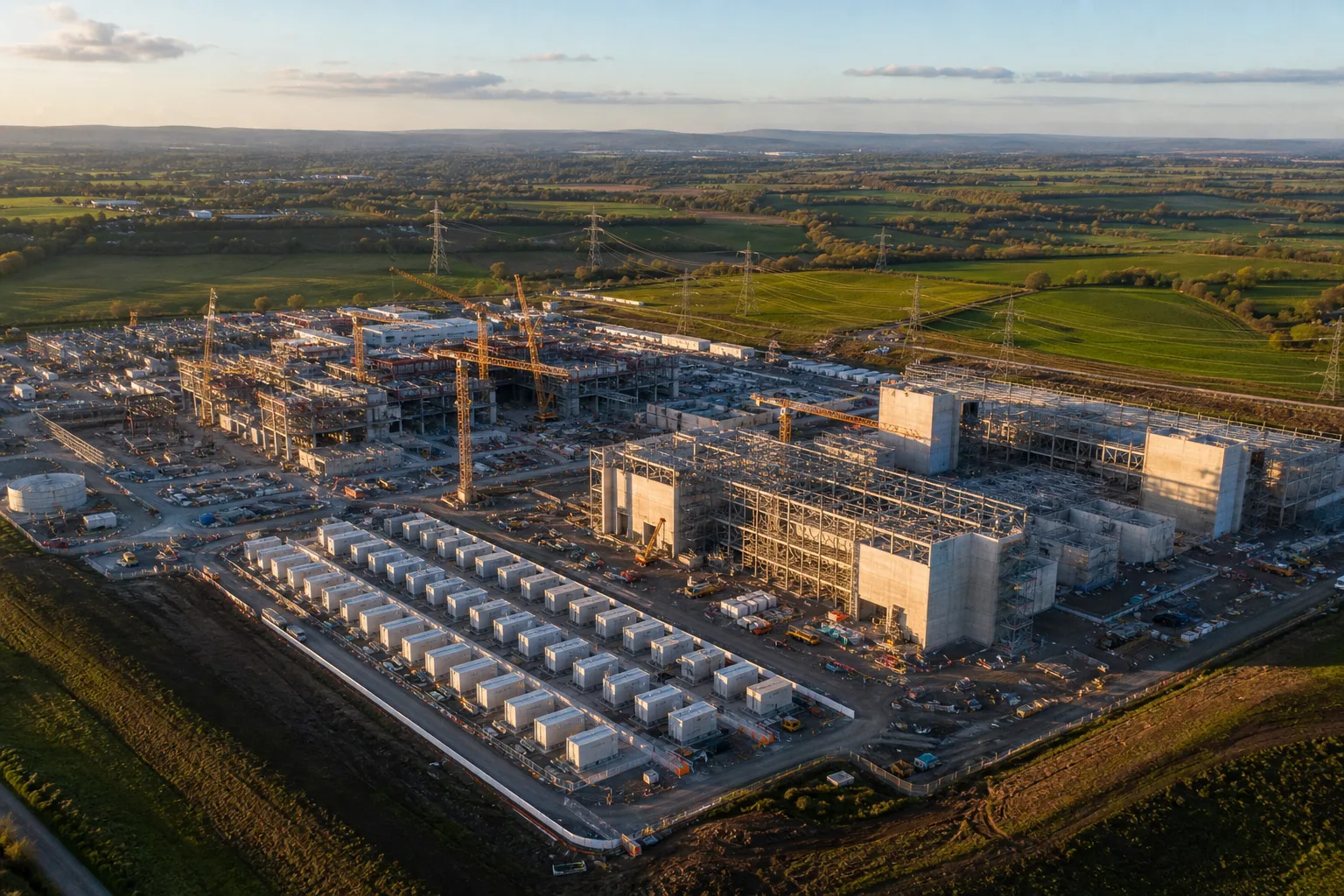
The TeraWulf debt raise making headlines this week isn’t just a big financing round — it’s a signal of how dramatically the line between crypto infrastructure and AI computing has blurred. The Bitcoin miner turned data center operator is reportedly seeking $3.5 billion in debt financing, led by Morgan Stanley, to expand its Justified Data campus in Hawesville, Kentucky. The anchor tenant? Anthropic, the AI safety company backed by Google and Amazon, which signed a 20-year lease on the facility just days ago.
- The TeraWulf debt raise targets $3.5B via Morgan Stanley, including leveraged loans and high-yield bonds, marking a first for the company.
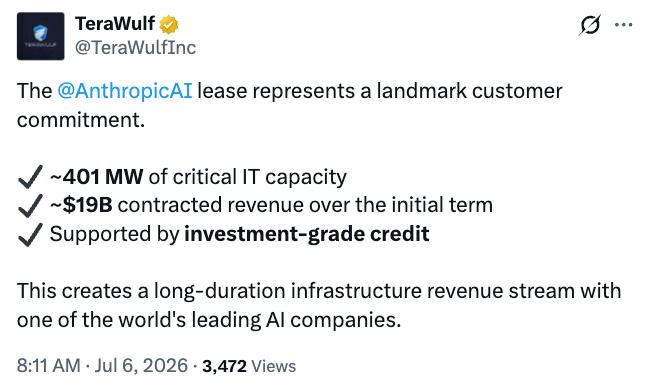
- The TeraWulf debt raise is tied to a 20-year Anthropic lease on the Kentucky campus, expected to generate $19B in contracted revenue.
- TeraWulf has now raised over $8B in roughly six months, signalling an aggressive push into AI infrastructure from a Bitcoin mining background.
- Insider stock sales and short-seller scrutiny are adding pressure on TeraWulf as it attempts to reposition itself as a serious AI data center operator.
Table of Contents
What the TeraWulf Debt Raise Actually Involves
According to a Bloomberg report citing TeraWulf CFO Patrick Fleury, the deal is expected to launch this year and will include a mix of leveraged loans and high-yield bonds. That’s a notable combination. The leveraged loan component would mark TeraWulf’s first time entering that particular market — a sign the company is maturing beyond the convertible notes and equity raises more typical of crypto-adjacent firms. Morgan Stanley’s involvement adds institutional credibility to what is, at its core, a speculative bet on AI infrastructure demand holding up for two decades.
The $3.5 billion target sounds enormous in isolation, but it fits a pattern TeraWulf has established at breakneck speed. The TeraWulf debt raise follows a $3.2 billion round in October 2025 and another $1.3 billion in December 2025. Add this latest round and TeraWulf will have pulled in roughly $8 billion in financing in the span of about six months. That’s a staggering clip for a company that, not long ago, was primarily known for mining Bitcoin using nuclear and hydroelectric power.
The Kentucky Campus and What Anthropic Gets Out of It
The Justified Data campus in Hawesville, Kentucky sits at the centre of all this activity. TeraWulf is developing it as a large-scale AI computing facility, with initial operations expected to come online in the second half of 2027 and a full buildout targeting early 2028. That’s a meaningful runway, and one that explains why the TeraWulf debt raise leans so heavily on long-dated instruments like leveraged loans and bonds rather than short-term credit.
For Anthropic, the appeal is clear. The company is in an arms race with OpenAI, Google DeepMind, and Meta for compute capacity. Locking in a 20-year lease on a dedicated, purpose-built facility gives it a degree of infrastructure certainty that renting cloud time from AWS or Azure simply can’t. The deal reportedly positions TeraWulf to generate approximately $19 billion in contracted revenue over the initial lease term — a figure that, if it holds, transforms the company’s financial profile entirely.
TeraWulf’s model here is worth understanding clearly. CFO Patrick Fleury has been emphatic on this point: TeraWulf’s job is to provide power and physical facility infrastructure. The computing equipment — the GPUs, the networking gear, the servers — is Anthropic’s responsibility. Fleury made this argument directly on the McNallie Money podcast this week, pushing back against a short-seller’s model that projected higher maintenance and reconfiguration costs. His position is that because TeraWulf doesn’t own the compute hardware, it avoids the costly upgrade cycles that typically erode data center margins. This asset-light approach is central to understanding why the TeraWulf debt raise is structured the way it is.

The Scrutiny TeraWulf Can’t Escape
Not everyone is buying the story at face value. TeraWulf has faced a rising tide of investor questions over insider stock sales — an issue that Bitcoin mining advisory firm Blocksbridge Consulting flagged publicly this week, naming TeraWulf specifically as an example of miners that have benefited from AI-related momentum while insiders have been quietly reducing their positions. That’s a tension that rarely resolves quietly, and it adds another layer of complexity to the TeraWulf debt raise narrative.
The short-seller scrutiny is separate but related. When a company’s entire valuation thesis rests on a long-duration, high-dollar lease with a single anchor tenant, the math of that lease gets picked over intensely. The short case against TeraWulf appears to hinge on whether the company’s infrastructure costs are genuinely as lean as management claims. Fleury’s counterargument — that customers handle their own hardware — is logical, but it also means TeraWulf’s revenue upside is capped at what the lease specifies. There’s no GPU upgrade cycle for TeraWulf to profit from, but there’s also no GPU replacement bill landing on its desk. It’s a deliberately asset-light model for the operator layer of AI infrastructure.
This kind of scrutiny isn’t unique to TeraWulf. Bloomberg has documented how multiple Bitcoin miners pivoting to AI have faced questions about whether their transition is genuine operational strategy or primarily a way to sustain elevated stock prices during a period of compressed mining economics. The honest answer is probably ‘both,’ and investors are right to ask which dynamic dominates at any given company.

Why This Matters Beyond TeraWulf
The broader pattern here is one of the more interesting structural shifts in the tech infrastructure space right now. Bitcoin miners entered the last cycle with significant advantages: they’d built expertise in managing high-density power loads, negotiated long-term energy contracts at competitive rates, and developed relationships with utilities that most data center operators don’t have. Those skills translate directly to AI computing infrastructure, where power density and energy cost are among the primary constraints on expansion.
TeraWulf’s Kentucky campus benefits from access to relatively cheap, reliable power — part of the original thesis for siting a Bitcoin mining operation there. Repurposing that infrastructure footprint, or expanding it with AI in mind from the start, is a logical extension. What’s changed is the scale of capital required, and the TeraWulf debt raise illustrates just how different that scale is. Bitcoin mining operations were largely self-funding through coin revenue and smaller credit facilities. A $3.5 billion debt raise to serve a single AI tenant is a different financial universe entirely.
For Morgan Stanley, leading this deal is a bet that institutional appetite for AI infrastructure debt remains strong enough to absorb the offering. Given how aggressively pension funds, sovereign wealth funds, and credit investors have been chasing yield in infrastructure assets, that’s probably not a difficult sell — provided Anthropic’s long-term covenant holds. The 20-year lease is the load-bearing wall of the entire structure. If Anthropic’s position in the AI market weakens significantly before 2045, or if it gets acquired by a company with different infrastructure preferences, the calculus changes. That’s the risk embedded in the TeraWulf debt raise, and it’s one that $19 billion in contracted revenue projections can obscure if you’re not paying attention.

The TeraWulf debt raise represents a clear, high-conviction bet: that Anthropic will be a major player in AI for the next two decades, and that purpose-built, operator-managed AI campuses will command premium lease rates for the foreseeable future. Whether the company’s financials and governance hold up to the scrutiny that comes with operating at this scale is the open question. The capital markets, for now, appear willing to find out.
Frequently Asked Questions
What is the TeraWulf debt raise being used for?
The TeraWulf debt raise of $3.5B will fund the expansion of its Justified Data campus in Hawesville, Kentucky — a facility leased by Anthropic under a 20-year agreement. Initial operations are expected in the second half of 2027, with full buildout targeted for early 2028.
How much revenue will the Anthropic lease generate for TeraWulf?
According to TeraWulf, the Anthropic lease on its Kentucky campus is expected to generate approximately $19 billion in contracted revenue over the initial term of the agreement.
Why is TeraWulf facing investor scrutiny?
TeraWulf has drawn questions over insider stock sales, shareholder alignment, and the economics of its AI data center model. A short-seller has also challenged the company’s cost assumptions, though CFO Patrick Fleury has publicly pushed back on those estimates.
Is TeraWulf still a Bitcoin mining company?
TeraWulf is a US-listed Bitcoin mining company that is expanding into AI infrastructure. Its Justified Data campus in Kentucky is focused on AI computing workloads, and the company has undertaken significant financing activity tied to that expansion.