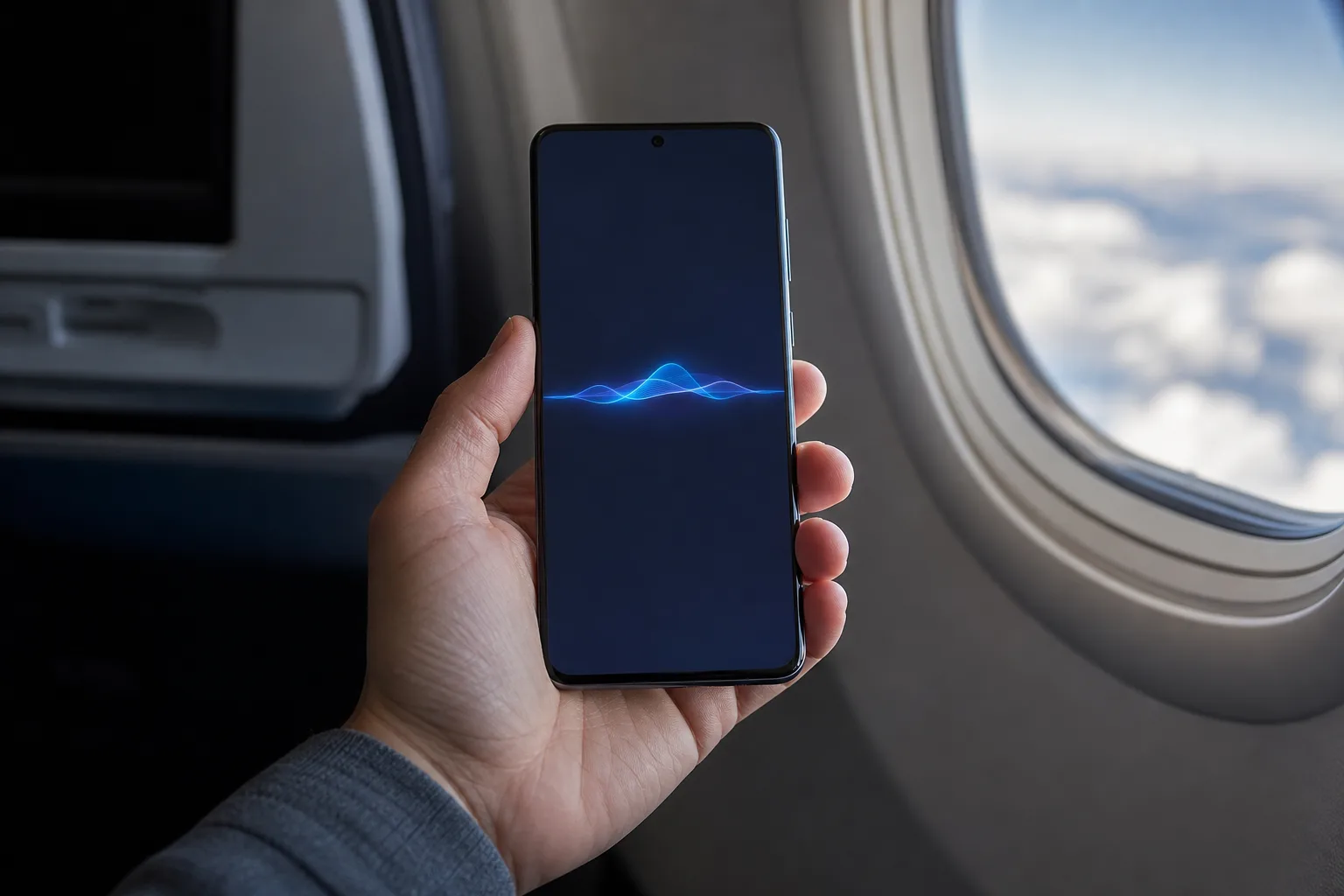
- Pixel 10 Gemma 4 puts a TPU-tuned open model on Google’s latest phones for private chat, image queries, and transcription.
- Google says Pixel 10 Gemma 4 supports every Pixel 10 model. The real test is how speed, accuracy, and battery life hold up.
- The model points to a future where useful phone AI works in airplane mode instead of constantly sending requests to cloud servers.
- Google’s open Gemma strategy may give developers a more practical way to build local Android AI experiences.
Table of Contents
Google wants AI to work when the internet does not
The pitch for Pixel 10 Gemma 4 is refreshingly easy to understand: your phone should still be smart when it has no signal. Google has introduced a new Gemma 4 E2B variant tuned for the Tensor G5’s Tensor Processing Unit, or TPU, in the Pixel 10 family. That means some chat, visual questions, audio transcription, and even device-control tasks can happen directly on the handset rather than taking the familiar round trip to a distant data center.
That distinction matters more than the industry’s AI marketing tends to admit. Cloud AI can be remarkably capable, but it comes with delays, data-use concerns, and an awkward failure mode: it simply stops being useful on a plane, in a dead zone, or during a spotty commute. Google is framing this release as a powerful but lightweight model designed for local use. If it lives up to that description, the practical result is less sci-fi assistant and more dependable pocket tool.
Google announced the model at I/O Connect India, following another developer-focused gathering in Berlin. The company’s Gemma program is its family of openly available AI models, intended to give developers and researchers something they can run and adapt outside Google’s own consumer services. Gemma 4 first arrived in April, and Google has positioned it as the foundation for its forthcoming Gemini Nano 4 work.
What Pixel 10 Gemma 4 is supposed to do
Google says Pixel 10 Gemma 4 will run on the Pixel 10, Pixel 10 Pro, Pixel 10 Pro XL, and Pixel 10 Pro Fold. The company’s examples are fairly broad: offline conversations, identifying an object or plant from a photo, and transcribing lectures or notes privately on the device. In theory, you could ask a question at 30,000 feet and get an answer without paying for onboard Wi-Fi. That is a far better demo than another AI-generated wallpaper.
There is also a more ambitious idea called Mobile Actions. Google says users can command core functions, including Wi-Fi and maps, through private voice or text requests. This is where on-device models become genuinely interesting, and also where they can get messy. Asking a phone to turn Wi-Fi on is simple enough. Asking it to interpret a vague request, choose the correct map destination, and avoid making a bad assumption is considerably harder. Anyone who has watched a voice assistant confidently call the wrong person knows the problem.
Google also floated industry examples: an offline system that turns recipe ideas into localized store maps, and visual diagnostics that help auto mechanics identify faulty parts from photos. Those are plausible uses, though they are demonstrations rather than products someone can buy today. The stronger point is that local AI can make sense in settings where connectivity is unreliable, data is sensitive, or every second counts.
The Tensor G5 TPU is doing the heavy lifting
Pixel 10 Gemma 4 is ultimately a chip story as much as a model story. Google has spent years arguing that its Tensor silicon gives Pixel phones a different kind of intelligence than rivals built around Qualcomm chips or Apple’s A-series processors. The Tensor G5 TPU is the dedicated hardware intended to run machine-learning workloads efficiently, and this Gemma release is a concrete attempt to show why that hardware exists.
For consumers, the acronym soup only matters if the experience feels immediate. A local model that takes ten seconds to answer a simple question will not replace a web search. One that runs hot enough to drain the battery will be used once, shown to a friend, and forgotten. Google did not publish latency figures, memory requirements, battery measurements, or a side-by-side comparison against cloud Gemini in its announcement. Those omissions are understandable for an early developer-oriented release, but they are also the numbers that determine whether this becomes a Pixel advantage or a footnote.
Apple has taken a similar broad direction with Apple Intelligence, splitting work between on-device processing and private cloud computing. Samsung, meanwhile, has pushed Galaxy AI features that use both local and online systems. Google’s particular angle is its open-model ecosystem: Pixel 10 Gemma 4 could let developers build narrow, useful applications around local inference instead of waiting for a giant general-purpose assistant to solve everything.
Privacy is the promise, not a blank check
On-device processing gives Google a credible privacy argument. Audio notes that never leave a phone are inherently less exposed than recordings uploaded to a server. The same goes for photos of documents, household items, or mechanical parts. Google’s claim of private, on-device transcription is especially relevant for students, journalists, doctors, and anyone who has looked at a meeting recording and wondered where it is actually being processed.
But local does not automatically mean perfect. Apps still need clear permissions. Users need to know which model is handling their data, what gets retained, and when a feature quietly falls back to the cloud. Google has been improving these disclosures across Android, but AI features have a talent for blurring the line between a local convenience and a connected service. Pixel 10 Gemma 4 will be judged partly on whether that boundary is obvious in ordinary use.
Google has to turn a model into a habit
My read is that this is a strategically important release even if most Pixel owners never learn the name Gemma. The industry has spent the past two years stuffing generative AI into phones, often with results that feel like a trade-show demo in search of a daily purpose. Offline capability is one of the few areas where phone AI can be plainly better than an app connected to a server.
Still, Google needs to prove that Pixel 10 Gemma 4 handles everyday requests accurately, quickly, and without making users babysit it. The most persuasive version of this future is not a phone that talks constantly. It is a phone that quietly understands a note, a photo, or a task when there is no connection to save it. If Google can make that feel routine, Tensor’s local AI story finally has some teeth.