

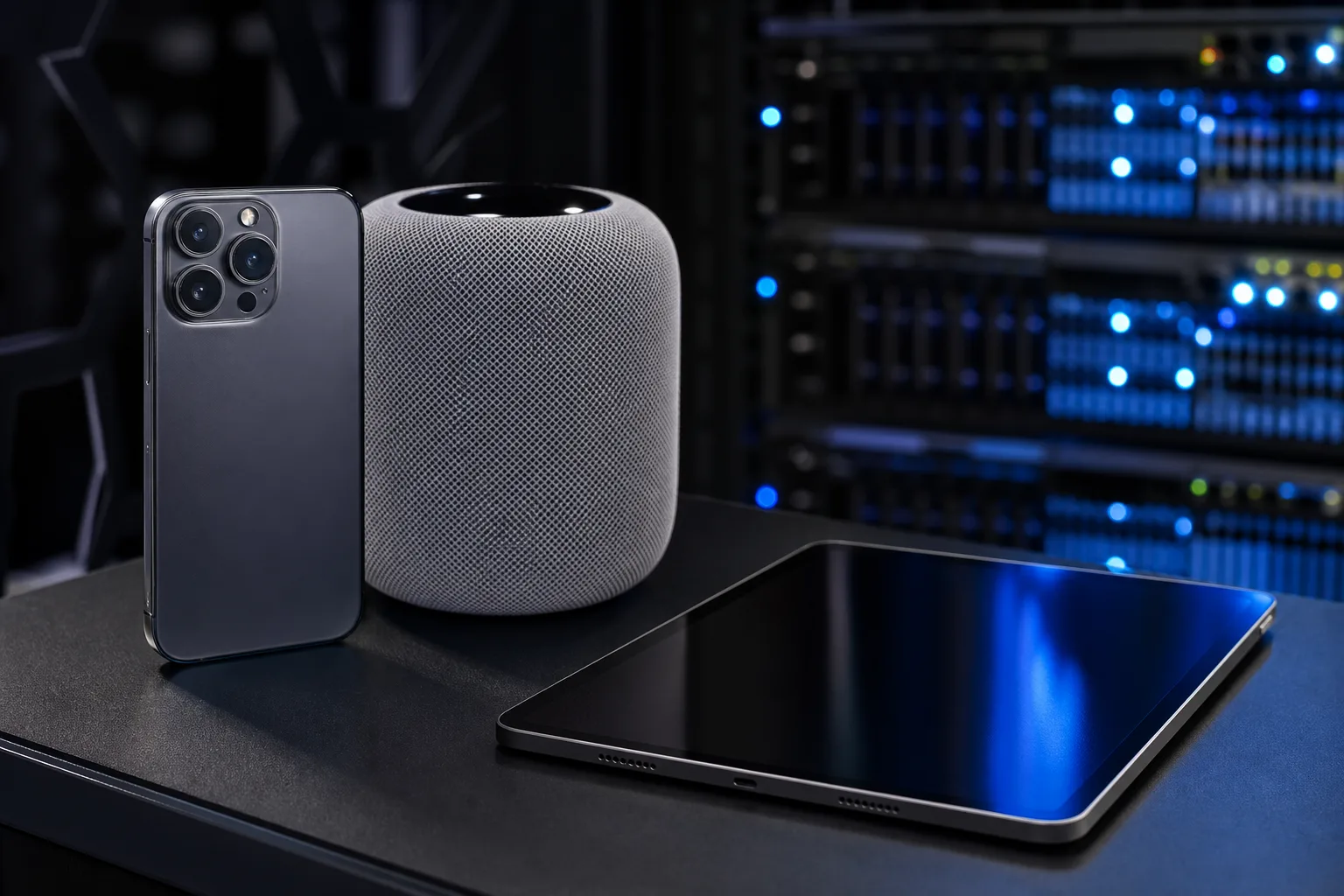
- The Apple OpenAI dispute has moved from courtroom allegations to a blunt public denial by OpenAI over alleged trade-secret misuse.
- The Apple OpenAI dispute lands as both companies pursue more control over the costly computing infrastructure behind modern artificial intelligence.
- Apple is reportedly examining AI chip startup acquisitions while OpenAI’s first hardware product may be a camera-equipped portable speaker.
- New iPad financing terms and an iPhone purchase-policy change show Apple still tightening the practical mechanics of selling its hardware.
Table of Contents
Apple OpenAI dispute puts AI’s supply chain under a microscope
The Apple OpenAI dispute is getting attention for the obvious reason: Apple and OpenAI are two of the few companies capable of defining how consumer AI works at global scale. But the sharper story sits behind the legal language. OpenAI says it has found no evidence supporting Apple’s allegation that trade secrets were misappropriated, a firm denial that sets up what could become an awkward and revealing fight over talent, technical knowledge and the boundaries of competitive hiring.
Apple’s claim, as reported this week, concerns alleged trade-secret theft. OpenAI’s response is deliberately categorical: it says it has found nothing that supports the accusation. That doesn’t decide the matter, of course. Companies regularly disagree about what constitutes a protected secret versus general expertise an employee carries from one job to the next. Courts exist for a reason. Still, the public posture matters. Neither side is treating this like a minor HR squabble.
My read is that the Apple OpenAI dispute reflects a bigger anxiety spreading through the AI business. The industry is spending extraordinary sums on chips, data centers, researchers and proprietary model work. When those ingredients are scarce, every senior departure and every suspiciously familiar product decision can look like a threat. AI may be sold as software magic, but its competitive edge is increasingly built from very human, very expensive organizational knowledge.
Apple and OpenAI have reason to know each other well. Apple’s partnership with OpenAI brought ChatGPT into parts of Apple Intelligence, while Apple has also been emphatic that users should control when requests leave their device and go to an outside model. That arrangement was always more pragmatic than romantic. Apple needs capable frontier models today; OpenAI wants access to a vast installed base. Partnerships like that can survive tension, but they rarely remove it.
Apple OpenAI dispute arrives alongside a chip-shopping push
The timing matters because Apple is reportedly looking at buying AI chip startups to strengthen its infrastructure. Apple has spent years building custom silicon for iPhones, Macs, iPads and its own data-center efforts. Its chip teams gave the company a meaningful advantage during the PC industry’s transition to Apple Silicon. Yet training and serving large AI models is a different kind of endurance race, dominated by Nvidia and increasingly contested by AMD, Google, Amazon, Microsoft and a sprawling collection of specialized chip designers.
Buying a smaller chip company would not suddenly turn Apple into Nvidia. Frankly, no acquisition fixes that. What it could do is give Apple more specialized engineering talent, intellectual property and options around inference hardware, where models answer real user queries after training. That is the part consumers feel: whether a request completes quickly, whether it can stay private, and whether Apple has to send it to someone else’s cloud.
The Apple OpenAI dispute is tied to Apple’s infrastructure ambitions. If Apple wants Apple Intelligence to feel like an extension of its devices rather than a relay service for third-party AI, it needs more ownership over the stack. That means silicon, server capacity, models and the people who know how to bind all of it together. It also means that disputes over confidential work become more consequential than they were in the old app economy.
Its Apple Intelligence overview frames privacy as a central product principle, not an afterthought. We’ll see whether that design can remain a selling point as the company asks its systems to do more demanding work.
OpenAI’s reported speaker could test the limits of screen-free AI
While the lawyers and chip engineers occupy one side of the story, OpenAI is reportedly preparing a first device described as a portable speaker with a camera and other sensors. If that description holds, it points toward an old Silicon Valley dream: a computer that listens and sees without demanding that users constantly unlock a glass rectangle.
That dream has produced mixed results. Amazon’s Echo made voice interfaces familiar, but it did not replace phones. Humane’s AI Pin became a cautionary tale about hardware that promised freedom from screens while introducing new friction, heat and reliability problems. Rabbit’s R1 generated curiosity but struggled to make a convincing case for carrying yet another device. Remember when the smartwatch was supposed to make phones less central? It helped, but your phone is still in your pocket.
OpenAI’s possible device would face the same unforgiving question: what can it do better than a phone with earbuds? A camera and sensors could make it context-aware, but they also create privacy concerns before the product even ships. Consumers may accept a smart speaker sitting on a counter. A portable sensor device that follows them around is a much tougher proposition, especially when the maker is synonymous with a powerful cloud AI service.
The Apple OpenAI dispute makes that hardware report more interesting, not less. OpenAI is not merely a model provider if it is moving into dedicated devices. It becomes a potential competitor for the attention, data and ambient computing role Apple wants across the iPhone, AirPods, Watch and Home ecosystem.
The ordinary Apple retail changes matter too
Two smaller Apple moves round out this week’s picture. The company has added 36-month financing options for iPad purchases, lowering the monthly cost of tablets that can climb quickly once storage, keyboards and cellular connectivity enter the cart. Three years is a long time to finance an iPad, though. It makes a premium model more attainable, but buyers should be honest about whether they need the high-end configuration rather than simply liking the monthly number.
Apple has also reportedly shut down a popular route buyers used to obtain an unlocked iPhone. That sounds mundane next to AI litigation, but it is very Apple: control the sales channel, reduce edge cases, and make activation policies behave as intended. For travelers, prepaid-plan users and people who simply dislike carrier ties, the practical effect could be irritating.
The pieces point to a broader picture: the Apple OpenAI dispute is less isolated legal theater than a snapshot of Apple’s 2026 priorities. It is building AI capacity, protecting what it believes belongs to it, experimenting with how it sells expensive hardware, and watching a key AI partner edge toward consumer devices. The legal claim may take time to resolve. The competitive question will not wait: can Apple keep AI close to its hardware while OpenAI tries to make the hardware matter less?

